

PART VI: SUOJELUSKUNTA IN WORLD WAR 2
The Finnish main fortified defense line of the Winter War on the Karelian Isthmus became known as the Mannerheim line during the war. The line's concrete structures had been built in two phases: The first ones in the early 1920's and the second ones in the late 1930's, when many early 1920's bunkers were also modified into more modern configuration. The somewhat small number of concrete structures, however, were only small part of the defense line. The other equally or more important elements of the defense line included groundwork field fortifications such as trenches, barbwire obstacles, machinegun nests and dugouts. Unlike concrete structures these field fortifications were not built by contractors and military specialists, but by volunteers and soldiers. Civil Guards and their guardsmen played major part among voluntary fortification builders of the summer of 1939.
The whole idea of gathering volunteers for building fortifications to Carelian Isthmus originated from Lieutenant-Colonel Väinö Leopold Merikallio, who at the time was commander of the Keski-Pohjanmaa Civil Guard District. Chief-of-Staff of Civil Guard Colonel A-E Martola introduced the idea to both General Headquarters of Civil Guard and Defense Minister Juho Niukkanen, who supported the idea and set a committee to further develop it. The committee got planning for volunteer fortification works completed at April of 1939. At the time the basic plan was for a maximum of 3,300 volunteers working from early June to the end of October. From those volunteers 3,000 were to work on the Carelian Isthmus and 300 volunteers in coastal forts. Technical leadership and supervision of the volunteer fortification workforce was left to Lieutenant-Colonel Otto Bonsdorff, who had served as teacher of fortification doctrine in Military Academy (Sotakorkeakoulu) in 1928 - 1933. When the work was about to start on the 4th of June 1939, in total some 4,000 men appeared instead of the planned 3,300. Volunteer fortification building works continued until 8th of October 1939, when the military took over the fortifications. By that time in total over 60,000 people had taken part in voluntary fortification building work and over half of them had been officers and guardsmen of Civil Guard.
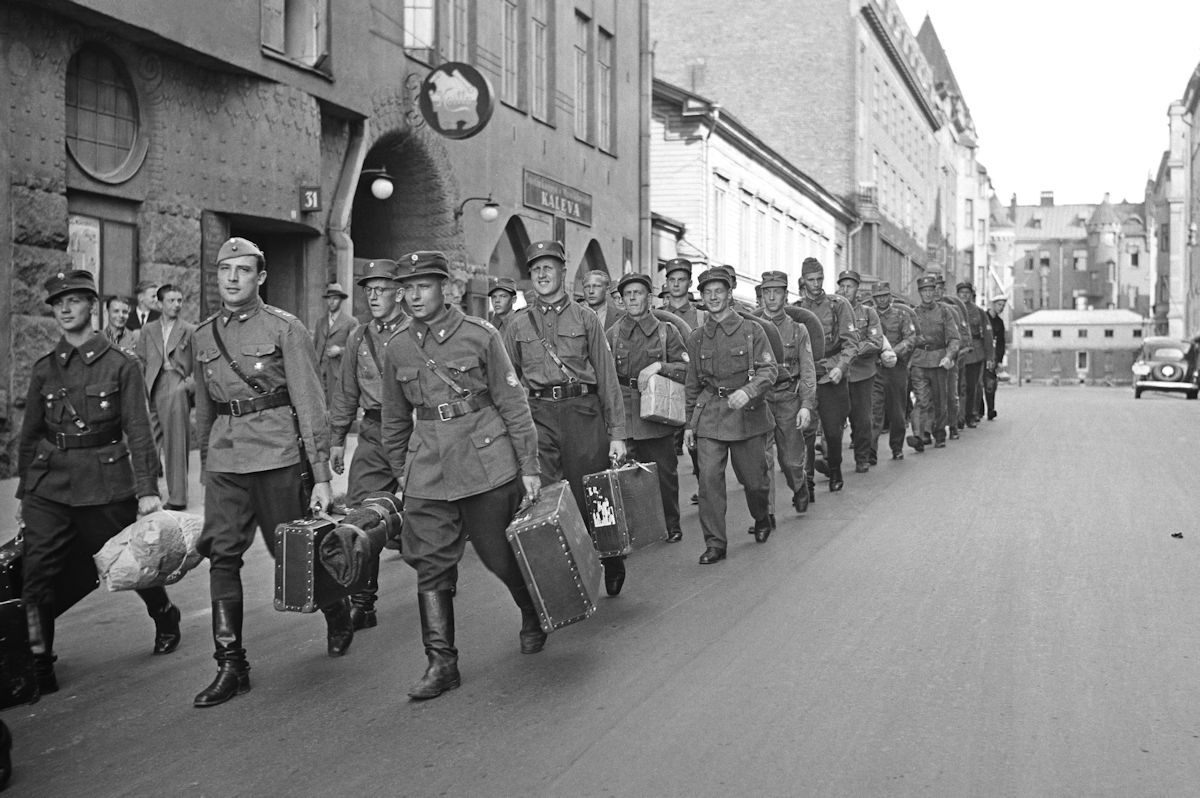
PICTURE: Officers and guardsmen of Civil Guard heading to voluntary work of building
fortifications at year 1939. Photographed in Helsinki. Photographer Hugo Sundström. Photo source
Finnish Heritage Agency (Museovirasto), acquired via finna.fi and used
with CC BY 4.0 Creative Commons license. CLICK
THUMBNAIL TO SEE LARGER PIC (189 KB).
The Winter War (1939 - 1940):
The Finnish mobilization for the Winter War was accomplished in good time and succeeded well. Finns ordered Suojajoukot (Protective troops) ready near the border on the 6th of October 1939, so they could secure the further mobilization. The next day (7th of October) partial mobilization of other troops was ordered with YH-orders (YH = Yliääräinen Harjoitus = Additional rehearsal training). The rest of the troops were also mobilized with YH-orders a few days later (12th of October). When the war started on the 30th of November 1939 Finnish troops were ready for it.
Moving from peace time into wartime mode changed also organization of Civil Guard. Home Front Troops (Kotijoukot) were formed from Civil Guard organization and Home-replacement troops (Kotitäydennysjoukot). General Headquarters of Civil Guard (Sk.Y) was transformed into the Headquarters of Home Front Troops (Kotijoukkojen Esikunta). The HQ of Home Front troops started to work on the 12th of October, but the actual name change from General Headquarters of Civil Guard to Headquarters of Home Front troops only happened only after the fact on the 2nd of December. The Lotta-Svärd organization (female auxiliary organization of Civil Guard) also belonged under its command.
When Finnish military was mobilised for Winter War weapons that Civil Guard had got transferred to the Armed Forces, but guns were not the only thing transferred by Civil Guard organization to the Army for the war. Civil Guards guardsmen serving in the Field Army (about 65,000 men) took their Civil Guard uniforms with them, but also all other clothing materials purchased with State funding and clothing acquired by Civil Guard District HQs, local Civil Guards and their members were at year 1939 handed over to the Finnish Army to alleviate existing shortage of military uniforms. Those Civil Guard uniforms and other equipment allowed equipping of about 15,000 men total. Other equipment gathered and supplied by Civil Guard organization to the Finnish Army for Winter War were also huge in number on a Finnish scale. A few examples: 72,000 horses; 45,000 horse-towed sledges; 120,000 pairs of skis; 29,000 axes; 15,000 hand saws and 7,630 tons of barbwire.
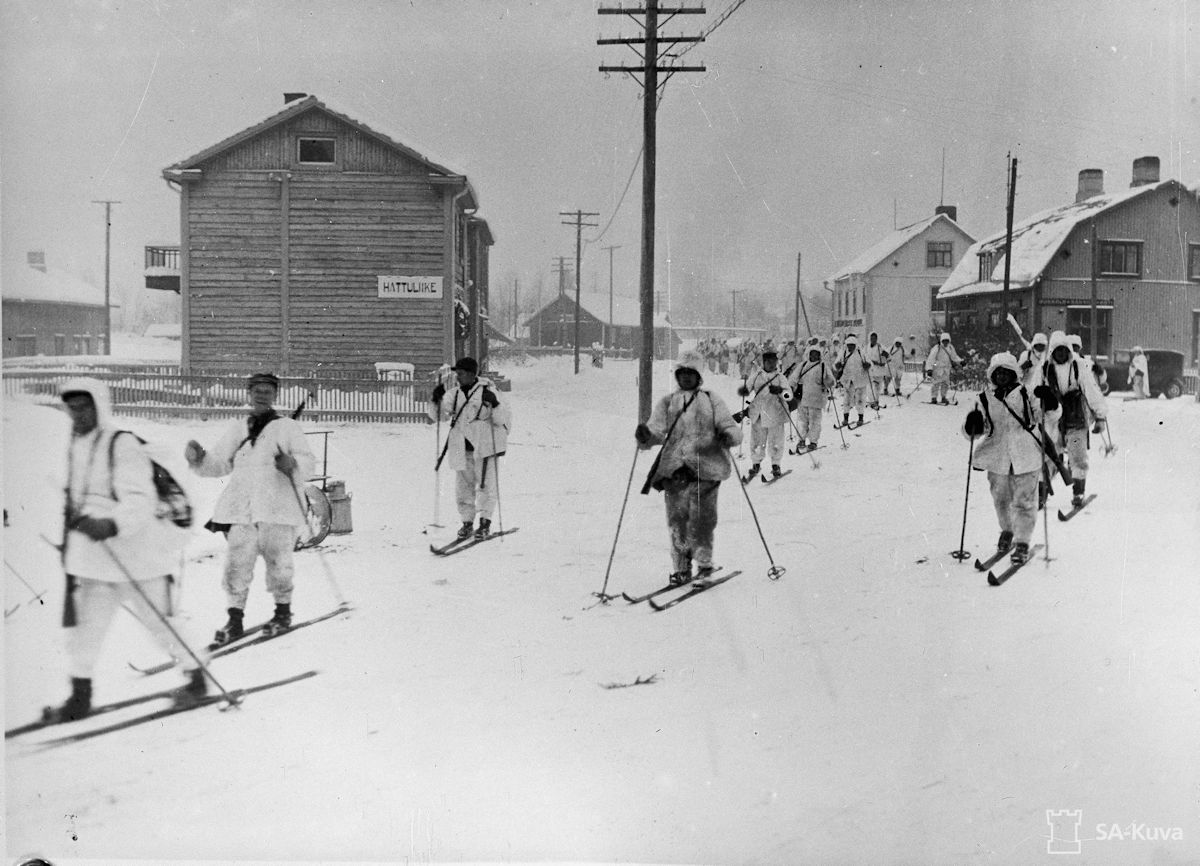
PICTURE: Burning team in Suvilahti of Suojärvi municiplity north of Lake Laatokka /
Ladoga. Burning teams temporarily organized from guardsmen of local Civil Guard had responsibility of burning
down buildings, which would have otherwise offered shelter from the elements for the enemy. Being locals
guardsmen selected for these teams had local knowledge of each building. In beginning of Winter War Finnish
Army used burned down buildings that were in between border and its line of defense, where it tried stopping
the enemy. This version of "burned ground" tactics proved highly effective due to season (winter)
and Soviet troops usually lacking proper winter clothing and even basic equipment needed for sleeping outside
at winter (such as tents). Photographer unknown, photo taken in early days of Winter War. (SA-kuva.fi photo
archive, glass negative fu_2180). CLICK THUMBNAIL TO SEE LARGER PIC (165 KB).
After the mobilization had been completed and the Field Army transported to its areas of operations the HQ of Home Front troops started handling its new missions:
1) Securing Home Front areas against enemy attacks.The Commander of Civil Guard organization became Chief of Home Front Troops. The organization used for Area Mobilization dispersed after mobilization as the bulk of the Military Districts HQs personnel left and joined the Field Army. Basically the Military District HQs disappeared and Civil Guard organization, which was another part of the Area Mobilization System still remaining, took over its remaining tasks. For this purpose the whole Civil Guard District system was replaced with a new one and distribution of the new one was an exact replica of the Military District system it now replaced. The new wartime Civil Guard district HQs handled both their old tasks and the new ones, which had earlier been responsibility of Military District HQs. When it came to military issues, the HQ of Home Front Troops was directly under command of GHQ of Finnish Armed Forces and in administrative issues it was under command of the Defense Ministry.
Civil Guard cadres forming the core of mobilized units added cohesion to their units in vital first battles and were able to guide less trained reservists early on. As the troops gained experience this become less important. About 16 % (49,000) of reservists mobilized for Field Army of the Winter War were its guardsmen. The total number of Civil Guards guardsmen who served in the Finnish Field Army during the Winter War was about 65,000. This meant that Civil Guards were in theory left with about 55,000 guardsmen who were either too young, too old, or were needed to work for the State, a municipality or an industry necessary for war effort. Training provided by Civil Guard organization shrank considerably for the duration of the war. Training personnel still remaining in home front was needed for training more soldiers for Armed Forces and had no time for Civil Guard.

PICTURE: Infantry training for new officers in Niinisalo at July of 1942. Wooden
footpath bridge (polkusilta) has been pushed across a creek in cover of smoke screen and now
infantry is crossing it. Reserve Officer School was transferred to Niinisalo in beginning of December
of 1939 and run officer training courses in there until end of World War 2. Some 15,350 men received
training in these courses and were promoted directly as 2nd lieutenants upon completion of
course. Photographer unknown. (SA-kuva.fi photo archive, photograph number 95863). CLICK THUMBNAIL TO
SEE LARGER PIC (119 KB).
As Winter War went on first reserved called to serve were home reserve of 1st class (nostoväen 2. luokka, which were rank-and-fire and non-commissioned officers who had military training and were over age 40 - in total some 37,000 men. But this was not enough and more troops were needed. The Home Front Troops were responsible for training more troops during the Winter War with training centers soon faced major burden in training huge number of new soldiers. The Finnish State had saved money in the 1930’s by classifying a lot of men as unfit for peace-time military service for minor health problems, leaving them without military training. Now these men previously considered unfit and placed in home reserve 2nd class (nostoväen 2. luokka) needed to be swiftly given military training . Hence home those in reserve 2nd class and born in 1897 - 1919 were called for recruitment procedure in February - March 1940 and in total some 71,000 men were called to serve - this took place so late that they would not complete their training and see combat yet in Winter War, but would later serve in Continuation War. Also men conscripted in the autumn of 1939 started their military service in February of 1940 along about 4,000 men, who had earlier received postponement for military training. Combined this meant that during Winter War in total some 34,000 men were trained for frontline service.
During Winter War volunteers also appeared by the thousands and needed training. Luckily, not all new recruits had need for military training starting from point zero: About 20 % (6,000) of the new recruits trained for Finnish Army during Winter War were guardsmen of Civil Guard and the share of their percentage was also very large among those volunteering to military service. When the Finnish Army found itself with too few officers, third major training mission was created to train more officers with training courses, which had duration varying around 9 - 14 weeks. In addition conscription cycle kept running also during war. The largest new Finnish military formations created during the Winter War mainly from freshly trained soldiers were the 21st, 22nd and 23rd (Infantry) Divisions.
As the area mobilization system introduced in year 1934 had marked an end to the idea of pure Civil Guard units. Such units fighting at the frontline were extremely rare during the Winter War. There were only few cases in which more troops were needed desperately at the frontline and new conscripts from training centers could not be sent fast enough or were not otherwise available, which saw use of units hastily created from those Civil Guard guardsmen, which were still on the Home Front and not yet placed in other duties. It is worth noting that at the time (as had been set in legislation of year 1932) the minimum age from which men became liable for military service was age 17, at which point they were included to home reserve 3rd class (nostoväen 3. luokka) and maximum age was age 60, at which point even officers (other than Generals) were retired from military duty. During peace time conscript service normally happened around age 20 - 21 and was followed by transfer to the reserves. No men younger than 17 or older than 60 years of age were supposed to be called to military duty and the mobilization plans did not include pure Civil Guard combat units for frontline use either, but during Winter War there were some rare exceptions. The best-known examples of these rare cases of pure Civil Guard units that saw frontline duty include 2nd Civil Guard Battalion formed (also known as Battalion Hildén) from remaining guardsmen of Viipuri Civil Guard as reserves for the Summa sector of the Mannerheim line (main Finnish line of defense in Carelian Isthmus) at February of 1940. The battalion also known as 2nd Civil Guard Battalion, was not supposed to be used in frontline, but ended up being used in combat in battle of Summa Sector for couple of days in February of 1940 before being pulled in the rear. The battalion had been created mostly from young boys with youngest being only age 16 and unlike normal infantry battalion, the battalion consisted rifle companies only. Summa was the key point of Mannerheim-line - location where both Viipuri - Leningrad highway and railway passed through lines and in mid-February of 1940 became the location of major battle, in were the Soviets succeeded breaching Mannerheim-line.
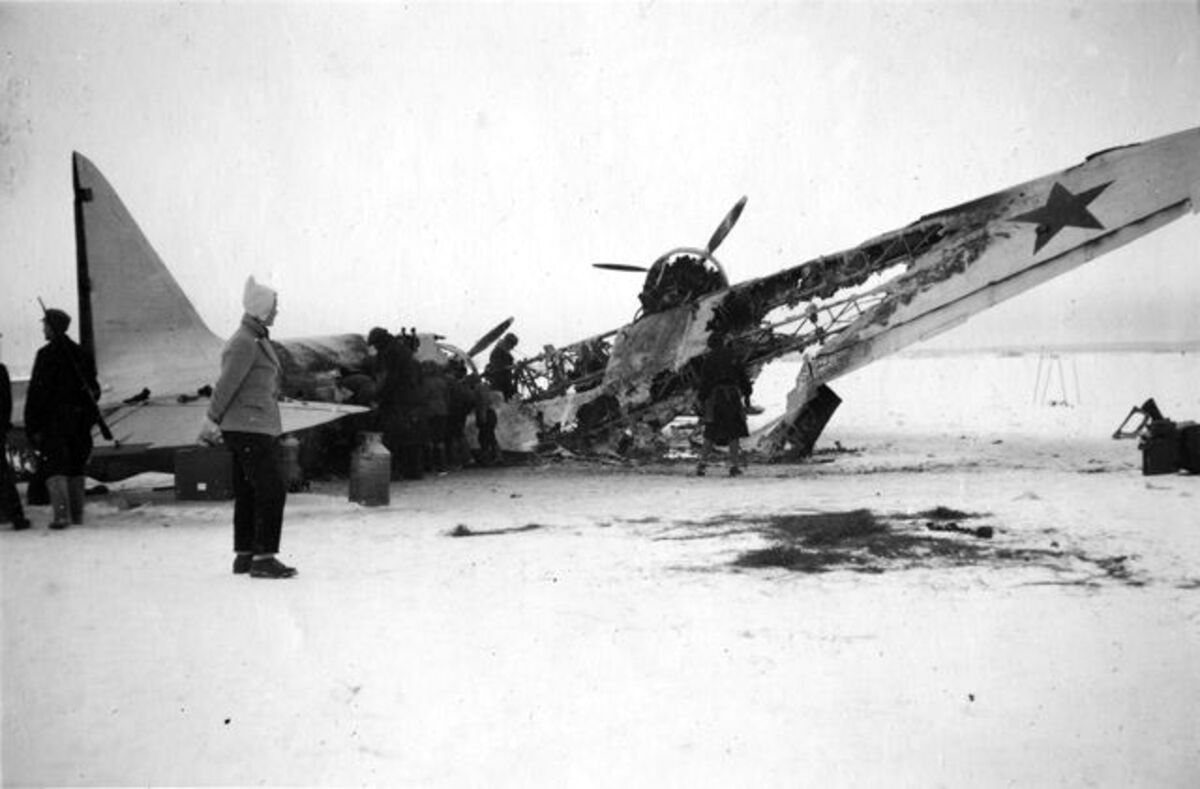
PICTURE: Destroyed Soviet DB-3 bomber on ice of Lake Köyliönjärvi
during Winter War. The plane had done forced landing on ice. Finnish soldiers form nearby Pyhäjärvi
Air Base and guardsmen of local Civil Guard were sent on scene and had a firefight with three crewmen,
from which two were KIA and third one surrendered. The plane had been set on fire by its crew and was
destroyed by fire. Photographed by Kurt K. Karlsson. Photo source Satakunta Museum (Satakunnan museo),
acquired via finna.fi and used with
CC BY 4.0 Creative Commons license.
CLICK THUMBNAIL TO SEE LARGER PIC (123 KB).
Wartime conditions during Winter War saw Civil Guards and Home Front Troops organizing new sort of units. Civil Guards started organizing sentry companies (vartiokomppania), platoons (vartiojoukkue) and detachments (vartio-osasto) already at October of 1939 for duties such as guarding locations of military importance (bridges, factories, powerplants etc.)and hunting down enemy desantti (spies & sabouters) and crews of downed aircraft. In addition during Winter War anti-desant detachments (desantintorjuntaosasto) were formed in the home front for the purpose suggested by their name, but apparently found more often in duty of hunting down crews of downed enemy aircraft, due to number of desantti sent by the Soviets during Winter War still being quite small. These units turned out to be temporary, being disbanded after Winter War. Helsinki Civil Guard District was a notable exception to mentioned above due to having more manpower and locations that needed to guarded and hence formed its own detachments and companies for the purpose. Guardsmen of Civil Guard proved also highly useful when came to providing crewmembers for gun crews of anti-aircraft weapons, which number of cities, towns, industry and institutions financed to improve air-defense of their geographic area just before or during Winter War.

PICTURE: 20mm anti-aircraft gun crewed by guardsmen of Civil Guard working in Tampella
factory being used for air-defense of the factory during Winter War. Tampella had manufactured two
20 ItK/39T prototypes based on Aimo Lahti's 20mm automatic cannon design.
During Winter War the two guns were equipped for anti-aircraft use and used for air-defense of the factory.
Notice that most of the gun crew is wearing Russian m/1917 steel helmets painted black and equipped with
Tampella logo. During World War 2 these helmets were mainly in use of civil defense and fire departments.
Photographer unknown. Photo source Photo Achive of Vapriikin (Vapriikin kuva-arkisto), acquired via
finna.fi and used with
CC BY 4.0 Creative Commons license. CLICK THUMBNAIL TO SEE LARGER PIC (197 KB).
Second maybe even better known case of pure Civil Guard units in Winter War were somewhat ad hoc infantry battalions created by Kymenlaakso Civil Guard District from its guardsmen remaining on the home front and sent to defend islands in Kotka Coastal Sector in March of 1940. Finnish coastal artillery units, which were defending the coastal sector originally had three infantry battalions, but by March of 1940 those three infantry battalions were long gone, having been sent to frontlines in Carelian Isthmus, which left the Coastal Sector as target, threatening of which Soviets hoped to force Finnish military to divert its reinforcements, which were desperately needed for battles of Viipurinlahti Gulf. The personnel of battalions created by Kymenlaakso Civil Guard District was mainly 17 – 19 year old boys, who had not yet been called for their conscript service in Armed Forces, but had already received some basic military training in Civil Guards before the war. But the complete age scale for guardsmen that served in them seems to have covered at least ages 15 - 63 and it is possible that some may have been men even younger or older than that. From these battalions, which got marked as battalions of Hamina Sector (Haminan lohko) 1st Battalion was created from guardsmen of Virolahti and Miehikkälä Civil Guards, 2nd Battalion had its men from Civil Guards of Vehkalahti and Hamina and 3rd Battalion from Civil Guards of Kymi, Kotka and Pyhtää. Soviet troops sent to march on ice across frozen Gulf of Finland from islands of Lavansaari and Tytärsaari were also somwhat ad hoc, having been mainly created from units of Baltic Sea Fleet, whose ice-bound ships were unable to take part in battles in March of 1940. In total the Soviet units sen towards Finnish coastal defenses of Kotka Coastal Sector in March of 1940 included three (1st, 2nd and 3rd) Marine Battalions, 50thBattalion, two (111st and 112nd) Ski Battalions and Battalion Granin created from sailors plus tanks and some supporting field artillery. It is maybe somewhat ironic, that while the three Soviet Marine Battalions were apparently created from ship crews of Baltic Sea Fleet, the only large military unit sent by Finnish military to face the threat in the coastal sector at February of 1940 was Battalion Aaltonen (Pataljoona Aaltonen) created from personnel of Helsinki Naval Base.
Those three Civil Guard Battalions joined Battalion Aaltonen and various coastal artillery units to defend the islands along the coast with battles mainly being fought for Island of Kiuskeri (Bolshoy Fiskar), Island of Kinnari (Kopytin) and some smaller nearby islands. When the Soviet attacked to the coastal sector 4th Battalion was about to be formed by Kymenlaakso Civil Guard District, but at the time still existed only at paper. Three Civil Guard battalions created by Kymenlaakso Civil Guards District were also unusual in that sense, that each of them contained only three rifle companies and when compared to normal Finnish infantry battalions they had very few automatic weapons. They were mainly equipped with Swedish infantry rifles M/96 acquired during the war, in addition of which they received in total 34 Bergmann submachine guns, three Lahti-Saloranta M/26 light machine guns and six Maxim machine guns. For example 3rd Company of 1st Battalion had 121 rifles, two Bergmann submachine guns and one Maxim machine gun. Supporting fire of coastal artillery batteries from Islands of Mustamaa, Kukio, Rankki and Kirkonmaa provided decisive for the coastal defense, with the Soviets succeeding to capture only Island of Kiuskeri and some islets.
One of the dramatic events of Winter War with a large effect on the Finnish nation was official reconciliation between Civil Guard organization and the leading Finnish leftist political party, the Social Democratic Party (SDP). In the 1930's the events showing rising totalitarian dictatorships in Europe, and other similar dangerous developments had affected opinions inside the SDP and towards end of 1930’s the party had started to gradually gain more positive views towards national defense. Earlier guardsmen of Civil Guard had not been welcome in the party, but by year 1939 the opinions had been changing. When the Winter War started, it created the spirit of national unity, which made both sides ready to take the first step for ending hostility between the SDP and Civil Guard organization. In February of 1940, the SDP party committee made contact with GHQ of Civil Guard and the two were able to find common ground very fast. Only the way of publishing the news of reconciliation between the two needed some negotiating. The formal event welcoming Social Democrats to Civil Guard and guardsmen to SDP was on the 15th of February 1940. The symbolic significance was large, but the actual results for members of both organizations were less significant. By the 10th of April 1940, only about 1,000 Social Democrats joined Civil Guard organization. The larger practical effect of this reconciliation took place with younger generation. While men of moderate left did not rush to join Civil Guard in large numbers, they and their wives generally no longer refused their sons from joining Civil Guard Boys or Sotilaspojat (Soldier Boys) organization, which for practical purposes was the very much the same thing.
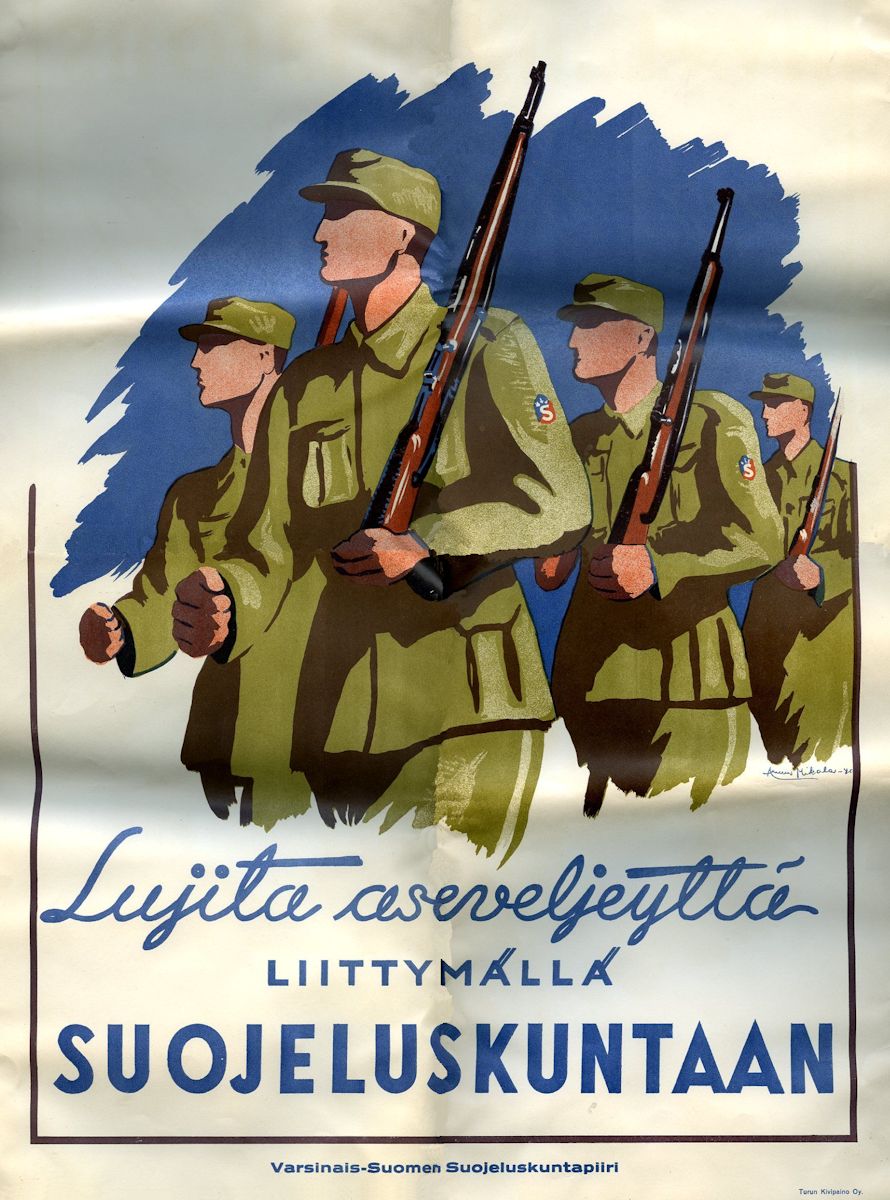
PICTURE: Civil Guard recruitment poster belonging to Varsinais-Suomi Civil Guard District. The text
Lujita aseveljeyttä liittymällä Suojeluskuntaan translates as Strengthen brotherhood in arms by
joining Civil Guard. This poster originates from circa 1940 - 1941. It was created by artist Armas Mikola and
printed by Turun kivipaino Oy. Picture re-built from four sections scanned or photographed with missing parts
recovered as well as possible. Photo source Turku City Museum (Turun kaupunginmuseo), acquired via
finna.fi and used with CC BY
4.0 Creative Commons license. CLICK THUMBNAIL TO SEE LARGER PIC (194 KB).
The Interim Peace (1940 - 1941):
During the Interim Peace, the Finnish Army went through reorganization. The position of Civil Guard organization in Armed Forces, however remained pretty much the same. The mobilization system was changed so that the mobilization task of a separate Area Mobilization System (in which Civil Guard organization had an important part) was now transferred completely to Civil Guard organization. Because the mobilization for the Winter War had succeeded so well, now Civil Guard organization would handle the mobilization work for the next war. The new Finnish wartime Army as planned was to have 16 infantry divisions, with 48 infantry regiments (JR) and 48 field artillery battalions. The 13 peacetime infantry brigades left behind from demobilization after the Winter War would each form one infantry regiment and one field artillery battalion. Mobilization handled by Civil Guard organization would mobilize 35 infantry regiments, a similar number of field artillery battalions, and a large number of other military units. Civil Guard district system was changed again and became identical to system of Military Districts. The new district system had 34 districts and 33 of them were to form one infantry regiment and one field artillery battalion. Helsinki Civil Guard District was the exception, as it would form two infantry regiments and two field artillery battalions. Two or three Civil Guard districts would form a Military County.
The number of officers at Civil Guard Area HQs and Civil Guard District HQs was increased considerably. The number of training personnel was increased dramatically (for example: the amount of junior training instructors increased over 10-fold). But it is uncertain how much this substantial increase of training personnel actually achieved. Once Winter War ended much of the Civil Guard officers did not return to their former duties, with in particular most capable officers being needed in the military. At the same time Army kept the equipment transferred to it and certain level of fatigue remained among guardsmen after the war. Hence finding good training officers to fill up the task, equipment for training the troops and guardsmen interested for training was a challange. One essential part of training programs, which was kept running was training program for Civil Guard privates. The program provided new guardsmen basic training of Civil Guard private.
The mobilization system was also made even more decentralized than before. Finnish military started the largest construction project in Finnish history in form of new fortified defensive line, which was named as Salpalinja (Salpa-line). To improve chances of defense against sudden Soviet invasion, positions for fortification artillery were built to suitable locations behind Salpa-line, guns placed in them and crews for the guns gathered from local Civil Guards. One small detail bringing together Army and Civil Guard organization was introducing military uniform m/36 previously only used by Army and Air Force also for Civil Guard use. Before that Civil Guard organization had first used its own variation of m/22 uniform and later on field uniform m/27. While the two uniforms m/22 were closely related Civil Guard uniform m/22 differed from military uniform m/22 of Army (last of which were in process of being replaced by military uniform m/36 in year 1939)- And while Army had never widely adopted field uniform m/27, in 1930's it had become de facto standard uniform for Civil Guard. Both Armed Forces and Civil Guard going with military uniform m/36 allowed more effective use of resources, but also irradicated main notable visual difference between their troops.

PICTURE: While Civil Guard struggeled trying to re-start its training programs during Interim Peace,
its Helsinki District succeded arranging only notable Civil Guard manoeuvres of that time in April of 1941. Photograph
from the manoeuvres showing 37 PstK/36 anti-tank gun being used in the particular
military excercise. Having anti-tank gun being used by Civil Guard was extremely rare. Notice how the group of
guardsmen operating the gun are wearing mix of field uniforms m/27 and
uniform m/36. Photographed by Hugo Sundström. Photo source Finnish
Heritage Agency (Museovirasto), acquired via finna.fi and used with
CC BY 4.0 Creative Commons license. CLICK THUMBNAIL TO
SEE LARGER PIC (123 KB).
The Continuation War (1941 - 1944)
Mobilization for the Continuation War was as successful as the one for the Winter War had been. If stories are to be believed, some foreign embassies did not even notice this Finnish mobilization for some time. YH-orders (YH = Ylimääräiset harjoitukset = Extra Rehearsals) were again the method used. The mobilization started on the 16th of June 1941 with mobilization orders for units formed at Pohjois-Pohjanmaa, Peräpohja and Karjaa Military Districts. At the same time one infantry regiment and one field artillery battalion were transported to the demilitarized Ahvenanmaa / Åland Islands to secure them against possible Soviet invasion. The second stage of mobilization in which all military units were mobilized, started two days later (18th of June) and the mobilization was completed in 10 days. The Civil Guard organization was ready as it could be and this time no large changes were needed. The earlier Civil Guard District and Military District system was kept as it was. Home Front troops included Civil Guard organization, war schools of the home front and military training centers.

PICTURE: Civil Guard patrol about to head out somewhere on Ahvenanmaa / Åland Islands sometime
during Continuation War. While particular islands were demilitarized during peace time, they were not during war. Civil
Guards had no presence on the islands either before World War 2. Locals organized their own Civil Guard like organization
named Ålands Hemvärnet (Home Guard of Åland) during Winter War. Civil Guard of Ahvenanmaa /
Åland was formed in August of 1941.Photographed by I Vasenius (SA-kuva.fi photo archive, photograph number 64326).
CLICK THUMBNAIL TO SEE LARGER PIC (139 KB). The highest priority task for Home Front Troops was supporting combat troops by supplying men and equipment. Hence
much of the main missions done by Home Front Troops revolved around supplying Field Army. These included training new
troops with majority of trainining centers being run by Home Front Troops and helping to create conditions in which
industry could provide materials needed for the war effort. Home Front Troops were also responsible for running prisoner of war camps in 1939 - 1940 and 1941 - 1943. Finnish Army
took some 5,700 prisoners of war during Winter War (1939 - 1940) and about 64,200 during Continuation War (1941 - 1944).
While the mortality among Soviet prisoners of war in Finnish prisoner of war camps was low during Winter War, later during
Continuation War their mortality climbed notably higher with in total 19,085 prisoners of war dying in Finnish prisoner
of war camps. Mortality rate among prisoners of war was exceptionally high particularly in winter of 1941 - 1942 mainly due
to the food rations of prisoners of war at the time being too small. That winter whole of Finland was suffering from
food shortage with sizes of food rations reserved for civilian population dropping at alarming level - being reduced to
level which caused also other people locked up (in prisons, mental hospitals etc.) and hence unable to acquire additional
food by growing it or obtaining it from relatives or black market to start dying to malnutrition. The food supply situation
was ultimately resolved with Germany supplying Finland with food supplies, most important part of which were 228 tons of
grain, but because particular winter was exceptionally cold and Baltic Sea froze in its entirety, shipping the food
supplies to Finland proved slow and difficult. Year 1942 prisoner of war camps were transferred from HQ of Home Front
troops directly under command of General Headquarters of Armed Forces and in September of 1943 under HQ of POW Commander
(Sotavankikomentajan esikunta) specifically created for the purpose of running prisoner of war camps. Another
source of help was International Red Cross, which during rest of the war provided in total 20 tons of food and medical
supplies for the POW camps. Once the food situation improved and food rations were enlarged for the rest of the war
the mortality among Soviet prisoners of war dropped to about the same level as it was among Finnish civilian population. PICTURE: Nakkila Air Raid Defense Company (Nakkilan ilmasuojelukomppania) line up and in
front of them Stefan Bobroff, who was found with stolen chicken and tin of milk. Bobroff was a Soviet prisoner of war, who
had escaped and whom the company had been sent to search. Notice how most of the company is wearing civilian clothes, but does
have armbands around their left arm. Photographer by Kurt K. Karlsson. Photo source Finnish Heritage Agency (Museovirasto),
acquired via finna.fi and used with CC
BY 4.0 Creative Commons license. CLICK THUMBNAIL TO SEE LARGER PIC (173 KB). During the Interim Peace in between Winter War and Continuation War new unit type for Home Front Troops was introduced -
air raid protection company (ilmasuojelukomppania). While the actual name of this unit type could also be translated as
civil defense company, its actual duties were far wider in nature than only traditional civil defense. Basically its duties
covered wide variety of preparations performed beforehand for reducing damage of raids and tasks, which were performed during
and after air raid to limit the damage that it has caused plus number of other Home Front duties for which manpower was needed.
Municipal fire departments were joined into air defense raid units. In addition to duties involving air raids and firefighting
their tasks including duties such sentry duty, hunting down escaped prisoners of war, desantti and crews of downed
enemy aircraft and even helping in evacuations of civilian population and assisting in gathering harvests. During Continuation
War the Soviets started using desantti much more frequently, due to which hunting them down often employed Home Front
Troops. As to be expected personnel available for air raid protection companies were mainly young boys and old men, who were
outside the age frame of men from which Armed Forces recruited its soldiers. Although this time apparently there was intentional
attempt of trying to limit more dangerous duties of home front such as sentry duty and hunting down enemy personnel for only
those who were at least 17 years of age. Quality of manpower varied widely in air raid protection companies, with some units
being fortunate to have number of veterans of Winter War, while younger men often lacked experience & training and older men
could suffer from physical problems. While air raid defense companies had guardsmen of Civil Guard in them, they appear to have
been a minority among their ranks, experience and training level of which varied considerably. During early Continuation War
17 - 19 year old guardsmen of Civil Guard represented the best manpower material available for these units, but during the war
their availability got gradually worse and worse. Men born in year 1923 were called to military service starting January of
1942, at which time grand majority of them was 18 years of age. By end of Continuation War even 17 year old men were called into
service, with those being born at 1926 being the last age group of Finnish men to enter into service during the war and
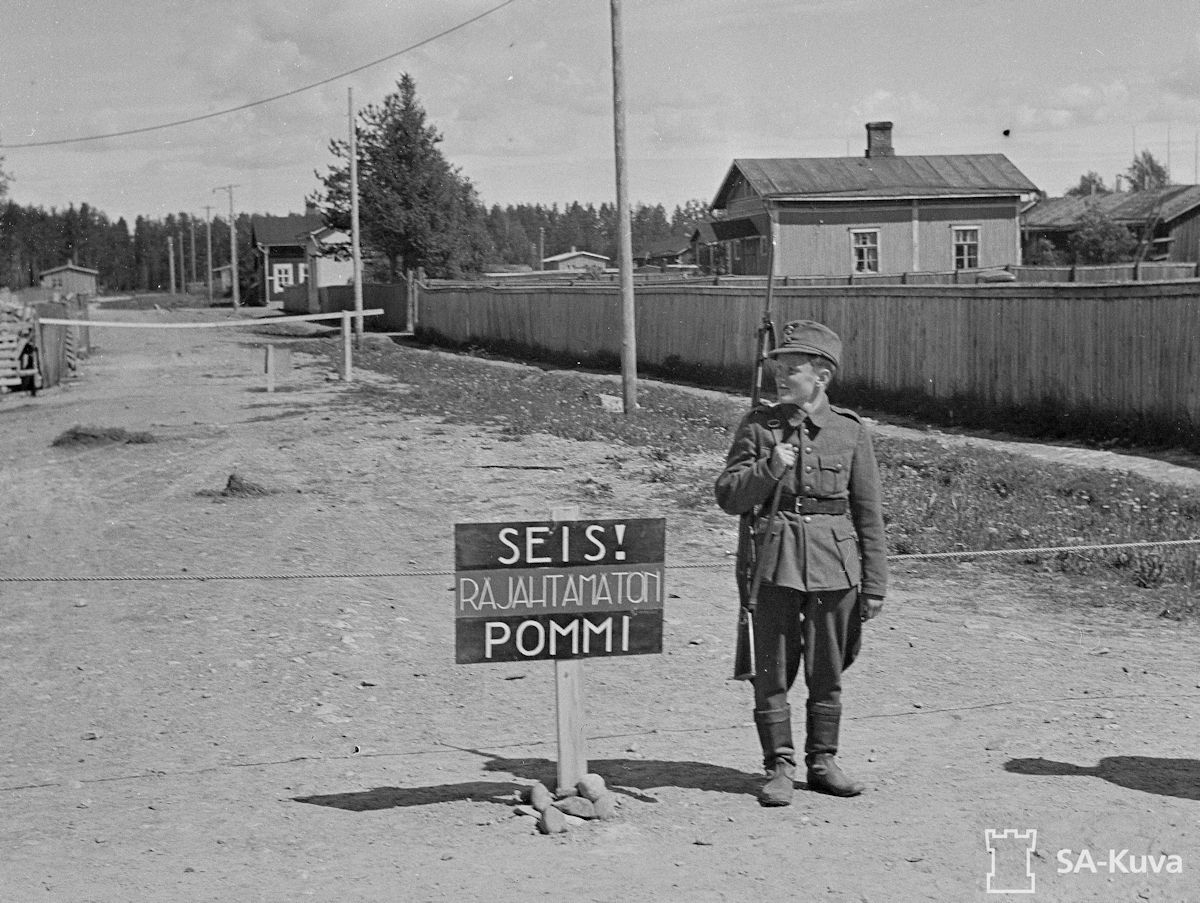
to see combat in substantial numbers. PICTURE: Young soldier guards unexploded bomb following first air raid during Continuation War to city of Joensuu.
The sentry placed to guard the unexploded bomb is a boy, who is wearing military uniform m/36
and is equipped with a rifle. He probably served in one of the air raid protection companies of the region. Text in the sign translates as
"STOP! UNEXPLODED BOMB". Photographed by N.J. Vuorela. Photo crop. (SA-kuva.fi photo archive, photograph number 21613).
CLICK THUMBNAIL TO SEE LARGER PIC (221 KB). Firearms needed for tasks such as sentry duty and hunting down desantti were rifles, which were received from Civil
Guard. These companies were usually very poorly equipped and instead of uniforms their men were routinely supplied only with
armband and maybe a cockade, with guardsmen of Civil Guard among them being the exception as they usually had their uniforms.
Men serving in air raid defense companies were under orders to use uniform if they had one, but apparently were not at least
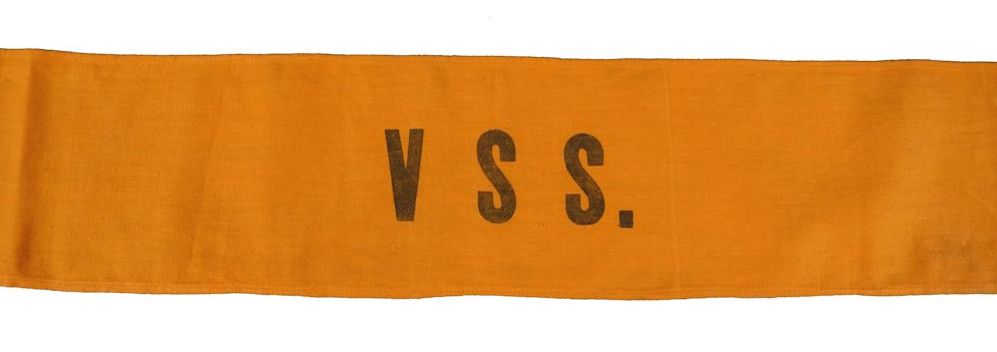
early in the war widely issued uniforms of any sort. Due to lack of uniforms yellow VSS (väestönsuojelu - Civil
Defense) marked armbands were often used for identification and some photos suggest that
field cap m/36 may have been common more in use of these units than complete uniforms. Especially early on air raid
protection companies also tended to be poorly trained, with situation gradually improving with Civil Guard arranged training
courses. Training courses arranged for them included both basic training course and more specialized training courses
providing deeper knowledge of particular duties. As noted level of training and specialization in air raid defense companies
appears to varied considerably with companies containing platoon and squad size subunits, which could have training more
specialized duties. These duties included sentry duty, firefighting, anti-chemical weapons duties, repairs and bomb disposal.
They could also be serve as units referred as strike companies (iskukomppania), which could be sent to operate outside
their own municipality or geographical area / when needed. Organization-wise raid protection companies along air surveillance
and anti-aircraft units were part of Air Defense. PICTURE: VSS armband. VSS is abbreviation of (väestönsuojelu - Civil Defense). Another
related armband of similar color commonly used in home front was Is. armband (Is. was abbreviation of Ilmasuojelu -
Air Raid Protection). This armband looks unusually orange in shade, which may have been caused by lighting, but exact shade
of color of the armbands apparently also varied quite a bit. Photographer unknown. Photo source Lotta Museum (Lottamuseo),
acquired via finna.fi and used with CC
BY 4.0 Creative Commons license. CLICK THUMBNAIL TO SEE LARGER PIC (49 KB). PICTURE: Home front troops in manhunt for desantti . The term desantti was based on
Russsian desantnik (parachutist) and referred to most of the spies and saboteurs being parachuted to their area
of operation. Their total number have been estimated as having been about one thousand from which 785 were caught.
Typically persons selected by the Soviets to be used as desantti spoke Finnish, with ethnic Finns and Ingrians
being most common. Desantti were practically always armed and when being hunted down firefights were common.
Treatment of desantti caught alive varied depending what they were wearing - those caught in Soviet military
uniform were commonly treated as prisoners of war, while those caught in civilian clothing or in Finnish or German
military uniform usually received death sentence. Underage and female desantti typically received prison sentence
instead of death sentence. Photographed by A. Neittamo in year 1941. Photo source Museum Services of Kerava (Keravan
museopalvelut), acquired via Finna.fi and used with
CC BY-NC-ND 4.0 Creative Commons
license. CLICK THUMBNAIL TO SEE LARGER PIC (170 KB). Military training centers were probably the most active part of the Home Front Troops during Continuation War. Year
1941 basically all remaining reserves were called and received training in them. During the war those of an age born
1921 - 1926 were called to service and trained. Year 1943 those men born 1909 - 1921, who had been earlier had been
exempt from peacetime military duty for minor reasons, were called to serve as well. In the summer of 1944 those of an
age born 1902 - 1908 who returned home circa 1942 were called back, received refresher training and were used as
replacements to fill the ranks of the Field Army to replace the losses it had suffered. The HQ of Home Front troops
(previous peacetime General Headquarters of Civil Guard) lead forming the bulk (Field Army training centers also formed
some units) of new military units for the Field Army. Most of the soldiers who had been wounded or become seriously
ill were also returned from their treatment to their units through Home Front troops. The total number of replacement
soldiers sent by Home Front troops to the Field Army during the Continuation War reached the total of almost 390,000 men,
from which almost 126,000 had been previously wounded. In addition, some 25,750 soldiers were used to form new military
units. Building up new military units did not end to mobilization of summer 1941. Following it, but by 19th of
September 1944 Home Front Troops build up in total 222 new military units. These included building up three new light
field artillery battalions in February of 1944 and creating of Detachment H (Osasto H) in summer of 1944.
Detachment H was notable for Civil Guard in that sense that it was created from troops of Civil Guard Districts of
Helsinki, Nyland Södra and Pohjois-Uusimaa and placed directly under command of Commander of Helsinki Military
District. Officially it was established as precaution for the case of the Soviets either attempting dropping paratroopers
or landing troops by sea directly to Finnish capital Helsinki, but real classified reason was preparing for possibility
of the Germans trying to capture Helsinki and try setting up puppet government. Fortunately Detachment H was never
needed - apparently neither its personnel or equipment reserved for it were exactly best possible quality.
Originally the idea had been get much of the necessary manpower for Detachment H from soldiers of Field Army, who
were in the city on leave, since it was typical to have few thousand of them around at any given time. But once Soviet
offensive summer offensive of 1944 started in Carelian Isthmus and East Carelia, all leaves were cancelled and after that
what was left for the detachment were overage men and underage boys - and with 17 - 18 years olds being called to military
service and older reservists called back to military even those came in short supply. As bad as the manpower situation was,
the detachment had even worse shortages of heavy weapons and vehicles - making it lack real firepower and mobility. One can
only consider it fortunate, that battle-worthiness of Detachment H was never put into ultimate test of combat. Finnish Military training centers during the Continuation War: Training centers by type and how many was there:
2) Training home front troops to such a level that they could also be used for frontline troops.
3) Securing home front areas against enemy attacks (guard duty, hunting spies and saboteurs, also anti-partisan duty
in some areas during this war).
4) Air surveillance and air defense (including searching downed aircraft and air crews).
5) Organizing traffic and transport (railways not included).
6) Organizing the civilian workforce for the military and also to some other jobs, in which the state was the
employer (over 68,000 persons during the war).
7) Guarding, supplying, and organizing work for prisoners of war located at the home front.


(Source: Suojeluskuntain historia, part 3).

PICTURE: Troops from Järvenpää Infantry Training Center on a road march in April
of 1942. Photographer unknown. (SA-kuva.fi photo archive, photograph number 82445). CLICK THUMBNAIL
TO SEE LARGER PIC (139 KB).
Just as during the Winter War training inside Civil Guard was almost non-existent during the Continuation War and for much the same reasons: Guardsmen of Civil guard who could have been trained and had been ordered to duties at the home front were busy and there was not much free training personnel for the purpose around either. As during Interim Peace training program of Civil Guard private was kept running if possible, but since wartime conditions rarely left days free for training, during Continuation War the training course was also made available as evening course with duration of 50 hours.
Civil Guard created its boy units already in 1920's. Year 1938 Boy Units of Civil Guards had some 28,000 boys. When Winter War started in November of 1939 there was need for activating larger number of boys for volunteer work that benefited national defence. The solution was establishing new temporary organization named Boys of Finland (Suomen pojat, which regardless of its name was for all practical purposes run by Civil Guard organization. Boys of Finland was intended as joined organization with Boy Scouts (Partiolaiset), but failed to gain necessary traction or reach real popularity. Hence boy units of Civil Guard continued their work in home front gathering materials such as metals and glass bottles to be recycled as materials for industry. Boys of the Civil Guard boy units also served in the home front as messengers, air surveillance, civil defence and sentry duty.
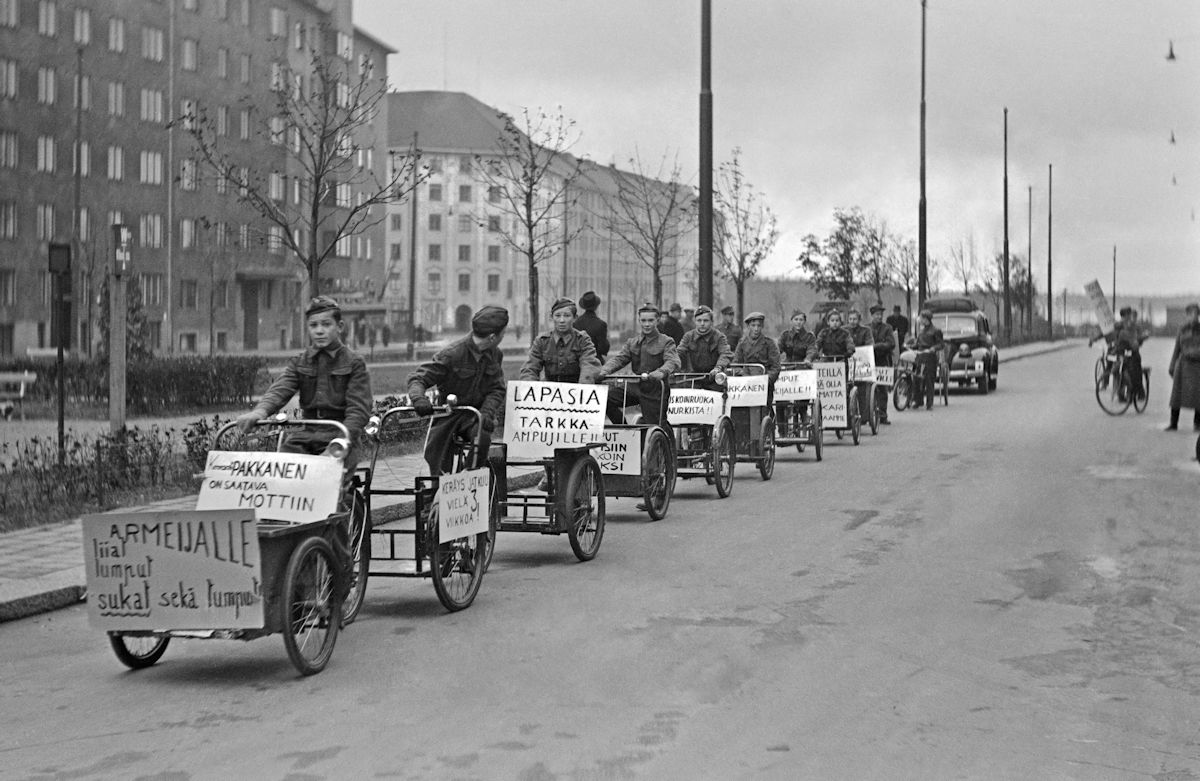
PICTURE: Group of Sotilaspojat (Soldier Boys) have lined up with cargo bikes and ready start
collecting items such as wool mittens, wool socks and various rags. Due to Finnish industry suffering from shortage of
materials for fabrics, recycled rags mixed with other materials were used for production of fabrics. Location where
photo was taken was next to hall of Helsinki Civil Guard District. Photographer unknown, photographed sometime during
Continuation War. Photo source Finnish Heritage Agency (Museovirasto), acquired via finna.fi
and used with CC BY 4.0 Creative Commons license. CLICK THUMBNAIL
TO SEE LARGER PIC (183 KB).
Year 1941 there were in total some 45,000 boys in Boy Units of Civil Guard and Boys of Finland, with about 90% of those in Boy Units of Civil Guard and only 10% in Boys of Finland. September of 1941 the title reserved for members of these units was changed from Suojeluskuntapojat (Civil Guard Boys) to Sotilaspojat (Soldier Boys). These units gained new importance during Continuation War as they were basically the only part of Civil Guard still present at the home front in real numbers and available for training. In fact, during World War 2 Sotilaspojat become the largest youth organization in Finland. Soldier Boy Units became very popular among boys who had not yet quite reached the required age for military service and the number of members in Boy Units increased considerably during the war: Year 1941 they had about 50,000 boys and year 1942 the number climbed to 70,000. Their role during Continuation War quite similar to what had been for Boy Units of Civil Guard and Boys of Finland organization. They received training, but also continued to collect materials, which could be recycled as raw-materials for industry and served as voluntary work-force when needed. But in addition during Continuation War they could volunteer in Home Front for wide variety of duties with younger boys being commonly used as messengers, while older boys could volunteer for air surveillance and numerous units of Home Front Troops such as air raid protection companies, parts of which handled more dangerous tasks such as sentry duty and when needed were sent to hunt down enemy air crews of downed aircraft, escaped prisoners of war and even desantti. During the Continuation War the Finnish military allowed 17-years old male volunteers, who had received military training to volunteer for frontline service. Those volunteers, who had received training in Civil Guard or Soldier Boy Units got through training given at training centers in more rapid manner and were able to enter frontline service sooner.

PICTURE: Civil Guard Boy Unit in Helsinki. According original captions boys seen the photo had
volunteered to serve as couriers in Helsinki. Notice how large majority of them are wearing
British battledress pattern 1937. Photographed by Neittamo (SA-kuva.fi
photo archive, photograph number 35720). CLICK THUMBNAIL TO SEE LARGER PIC (161 KB).
February of 1941 change was made into law about Civil Guards to allow volunteer boys 15 years of age or older with parental approval to be used for Home Front military duties, which were fitting to their capabilities and physical strength. But what were these duties that they now also legally fit? Finnish Armed Forces did not want to sent children into combat, but number of underage boys had succeeded getting into frontline troops in beginning of Continuation War and the problem became apparent. Finnish Armed Forces GHQ responded the situation by issuing orders in August of 1941 for all boys younger than 17 to be demobilized from Field Army and in September of 1941 further raised the minimum age in frontline troops to age 19, although this decision proved to be short-lived one. Not only did Finnish Army start calling 18 year olds to military service already in next January, but age limits did not always apply that well to units of Home Front Troops. Some volunteer units created from Soldier Boys were sent to gather materials from earlier battlefields, were they faced dangers of unexploded ordnance. As noted boys who volunteered to Home Front units or dangerous duty needed to provide documentation about approval or their parents concerning the matter, but the parents were not necessarily always aware about nature of the service in the volunteer unit. Finnish Air Defence was strengthened, but had problem finding enough manpower. Starting year 1942 volunteers from Sotilaspojat (Soldier Boys) were called to serve as assistant personnel in anti-aircraft artillery units stationed in Home Front - originally age-limit for the volunteers was age 16, but was raised to age 17 starting year 1943. The anti-aircraft unit in which volunteers from Soldier Boys played largest role was Ilmatorjuntarykmentti 1 (Anti-Aircraft Artillery Regiment 1), which defended Helsinki and which during Soviet bombing campaign against Helsinki at February of 1944 and at the time had about 4,500 people, from with some 400 were volunteers from Soldier Boys. Volunteer boys serving in anti-aircraft artillery units assisted storage personnel, mechanics, gun smiths, served as messengers, transported equipment with horses and used telephones, but sometimes also carried ammunition to the guns.
As a standard volunteers belonging to Soldier Boys were not normally armed, but depending unit in which served and they duties they could be armed temporarily when needed. Guns handed to them when needed were service rifles used by the military and this happened on temporary basis depending task at hand. In addition at least in theory only to older boys who were at least 17 years old, although later on the age limit for arming the boys was lowered to 15 years of age. Like Boy Units of Civil Guards in pre-war era Soldier Boy units also did have small bore rifles provided for them for training purposes.

PICTURE: Soldier Boys (Sotilaspojat) seen practicing taking proper sight picture with
supported .22 caliber GECO small bore rifles originating from Civil Guard
inventory sometime during Continuation War. Notice British battledress pattern
1937 worn by most boys in the photograph. Photo source NUOPERI, acquired via finna.fi,
public domain.. CLICK THUMBNAIL TO SEE LARGER PIC (190 KB).
Activities of Civil Guard Navy had been halted for the duration of the Winter War. Much of the personnel of Naval Civil Guards had been mobilized to Finnish Navy already before Winter War and boats owned by them were transferred to use of Finnish military units. Year 1941 further maintaining of Civil Guard Navy was noted unnecessary and hence its officers and equipment were transferred to the Finnish Navy.
Wartime Finnish Armed Forces were demobilized after the Continuation War and that included Home Front Troops as well. Only conscripts (privates & corporals born at year 1925 and reserve non-commissioned officers & reserve officers born in 1924), those who had not yet served 350 days and permanent staff remained in the Army and continued to take part into Lapland War against the Germans. As demanded by the Soviets in Armistice Treaty of 1944 practically all other Finnish troops (almost 430,000 men) were demobilized in between 30th of September and 4th of December 1944. The Home Front Troops were demobilized between the 20th of November - 30th of November 1944.
PICTURE: Civil Guard patrol about to head out somewhere on Ahvenanmaa / Åland Islands
sometime during Continuation War. While particular islands were demilitarized during peace time, they were not
during war. Civil Guards had no presence on the islands either before World War 2. Locals organized their own
Civil Guard like organization named Ålands Hemvärnet (Home Guard of Åland) during Winter
War. Civil Guard of Ahvenanmaa / Åland was formed in August of 1941. Rifles are Swedish
infantry rifles M/96. Photographed by I Vasenius (SA-kuva.fi
photo archive, photograph number 64326). CLICK THUMBNAIL TO SEE LARGER PIC (139 KB).
Weaponry and equipment of Civil Guard organization during World War 2
In mobilization for Winter War, Civil Guard organization transferred the majority of its useful weaponry to the Finnish Army, which used them to arm part of its mobilized units. Chart showing changes in Civil Guard inventory from 30th September 1939 and 15th of March 1940:
|
Weapon Type |
30th Sept 1939: |
15th March 1940: |
Transferred to Army: |
|
Rifle |
114,058 |
27,803 |
86,255 |
|
Light machine gun |
684 |
62 |
622 |
|
Sub-machine gun |
1,465 |
803 |
662 |
|
Machine gun |
548 |
138 |
410 |
|
Artillery piece |
170 |
0 |
170 |
|
Field kitchen |
292 |
2 |
290 |
(Source: Suojeluskuntain historia, part 3, page 363).
The weapons transferred in mobilization included not only weaponry received from the Finnish State and owned by Civil Guard organization, but also those purchased with private financing. Guardsmen who belonged to the Army Reserve and owned personal rifles took their rifles with them in mobilization. Basically all serviceable military small arms and not extremely non-standard heavy weapons were transferred to the Army. Even 1,200 M/28-30 rifles ordered by General Headquarters of Civil Guard from SAKO and manufactured during Winter War were transferred to the Army, which used the rifles for equipping new Divisions created during the war. Only some rifles, small number of Bergmann submachine guns, and mixed heavier weaponry reserved for securing defense in home front remained in use of Civil Guard organization. This proved problematic to Civil Guards when large number of volunteers wanted to join them during the Winter War and the organization had virtually no guns left for equipping them. In effort to remedy the situation Civil Guard gathered all possible rifles and ammunition, no matter how non-standard they were, the resulting added weaponry included:
(Source: Suojeluskuntain historia, part 3).
Needless to mention the number of guns gathered in this way was insufficient for the task. But weaponry purchased from foreign countries by Finnish military during Winter War provided much bigger help. From those guns Civil Guard organization received 17,415 of the Swedish Mauser infantry rifles M/96, while another 5,865 rifles were provided to training centers. Another newly acquired gun issued for use of Civil Guards in large numbers was the ill-reputed Chauchat M/1915 light machinegun donated by France. Civil Guard Districts received 473 Chauchat light machine guns, while 845 were provided to training centers. Swedish infantry rifle M/96 was long infantry rifle originating from pre World War 1 era - while it was long and heavy it proved to be very good weapon. French Chauchat M/15 light machine gun had been developed during World War 1 and had gained poor reputation already before being donated to Finland and its reputation did not improve in Finnish use either. Not only was it known for reliability, but it also had poor ergonomics, which Ordnance Department of Civil Guard partially tried to fix by moving the gun's sights to the left.

PICTURE: Swedish infantry rifle M/96 (top) and Italian rifle M/38 (below). Italian rifle has its folding bayonet attached - carrying this rifle with folded bayonet attached as apparently quite common during the war. (Photos taken in Sotamuseo). CLICK THUMBNAIL TO SEE LARGER PIC (72 KB).
When the Continuation War started, a large part of Civil Guard organizations weaponry was again transferred to the Field Army and military training centers. Civil Guard organization received some Swedish infantry rifles M/96 and Italian rifles M/38 as their replacements. Italian rifle M/38 was disliked by Finnish soldiers due to fixed rear sight, which did not allow properly zeroing in the rifle or adjusting its rear sight for various ranges. The problem was noted early on. But Ordnance Department in General Headquarters of Finnish Armed Forces did not start developing adjustable rear sight for the rifle until 1943 and when ending of Continuation War in September of 1944 halted all weapons production, new adjustable rear sights were still in production and never issued in wide scale. During the Continuation War, the Headquarters of Home Front troops (former: GHQ of Civil Guard) also now acquired some pistols for troops, which were under its command – 100 pistols Astra M/300 were acquired at year 1941 and 500 pistols Beretta M/34 got delivered in April of 1943. However the most important purchase of weapons for Civil Guard organization during the Continuation War was purchases of domestic new military rifles M/39, with in total 20,500 rifles being ordered from SAKO and about 10,500 of those being received by end of Continuation War.
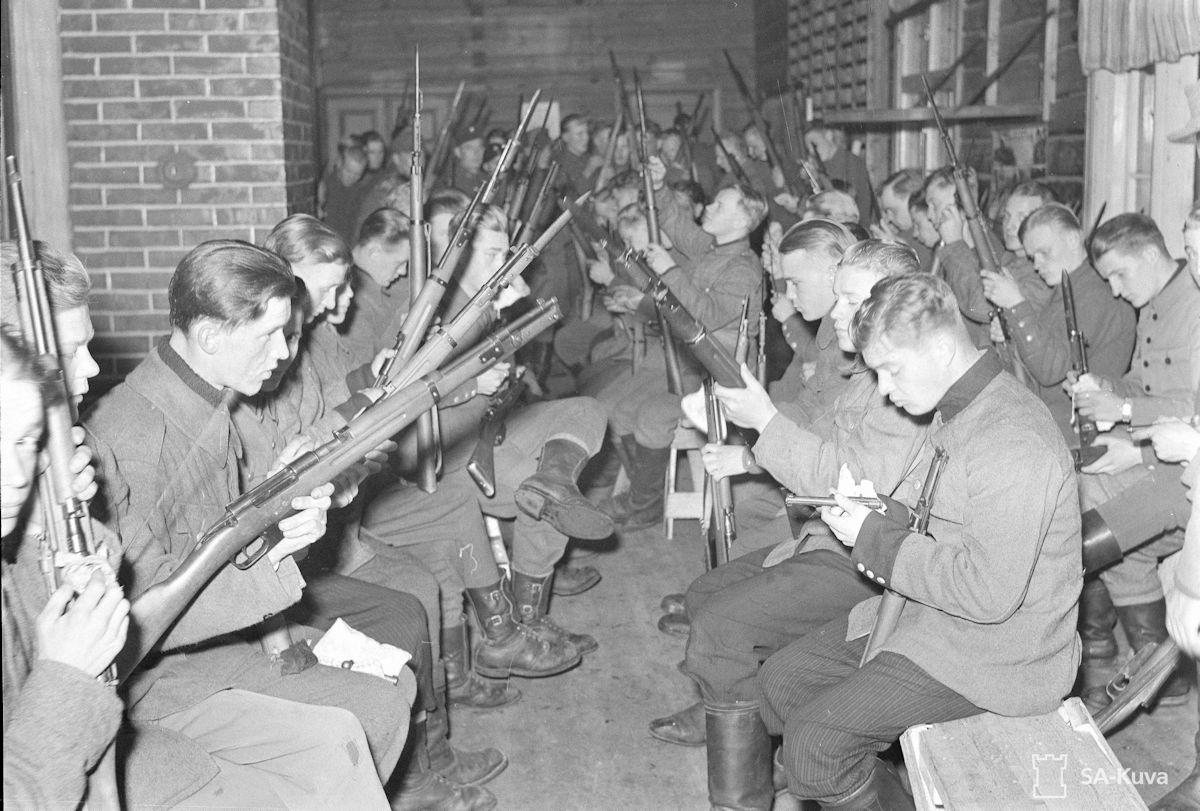
PICTURE: New recruits of Finnish Army seen cleaning rifles. Photographed in Utti Training Center in October of 1941. Rifles
are Italian rifles M/38. Photographed by Military official L. Johnsson.
(SA-kuva.fi photo archive, photograph number 64326). CLICK THUMBNAIL TO SEE LARGER PIC (184 KB).
Armistice and abolishing of Civil Guard
On the 19th of September 1944, Finland and Soviet Union signed Armistice Treaty, which ended the Continuation War. According to the 21st article of the treaty Finland committed itself to: "abolishing all Hitlerian-minded (fascist-natured) political, military-like and military-natured, and other organizations which practiced propaganda that was against the United Nations and in particular hostile towards the Soviet Union".
When the armistice treaty was signed, early on the Finnish Parliament and Finnish military did not consider that Civil Guard organization would be counted as such an organization due to it being part of Finnish military as Home Front troops. During the last days of September 1944 the Finns started to suspect that Soviet leadership was about to demand abolishment of Civil Guard and started their own preparations. The Finnish plan was to establish a new Aluejärjestö (Area-organization), which would have been under command of the Commander of Armed Forces. The Area organization would have been part of the Armed Forces with tasks quite similar as what Home Front Troops had handled during the war. Its members would have had uniforms, but weaponry would have been in stored in warehouses of the organization. The new Area organization would have basically replaced the old Civil Guard organization, which would have been abolished. Part of the plan was to hide the State-wide reservist organization for defending the country voluntarily inside the new Area organization. In this way the new Area organization would have continued the work of Civil Guard organization.
But the Soviets acted too fast, on the 30th of October Andrey Zhdanov, who was the Soviet leader of the Allied Control Commission (which officially controlled Finland following the Armistice Treaty) in Helsinki wrote a letter to Finnish Defense Minister Walden with strict list of demands. The Zhdanov's letter made clear that the Soviets considered Civil Guard organization as one of the "Hitlerian-minded" organizations mentioned in the 21st article of the armistice treaty and demanded abolishing the Civil Guard organization by the 7th of November 1944. Another reason given in this particular Zhdanov's demand was based on maximum size limitation of the Finnish Armed Forces set in the truce agreement. The armistice treaty set the maximum allowed size of Finnish Armed Forces at 37,000 men and Soviets claimed to fear that the Finns would be able leave large number of additional armed troops in Civil Guards. The Soviet reasons for the demand contained quite a contradiction - on the other hand they claimed that Civil Guard organization was a separate "Hitlerian" (fascist) organization, but at the same time they wanted to include its guardsmen as soldiers that were part of the Finnish Armed Forces. Part of the demand also made clear that Finland was forbidden to establish similar organization in the future.
The Finnish politicians did not have any options. If they wanted armistice treaty to hold, their only choice was to abolish Civil Guard organization and do it fast. Hence legislative process was set in motion at record-breaking speed. The Finnish government gave its proposal concerning abolishing of Civil Guard organization to the Finnish Parliament the same day.Key part of the legal abolishing process was rescending Civil Guard law enacted in year 1927. It took only nine minutes for the Finnish Parliament to forward the matter to the its Board of Defense. The next day Parliament spent only five minutes to forward the matter to the next Parliamentary Board, whose decision was also needed. The matter came back to Parliament less than an hour later and the final vote about the matter was taken at the Parliament on the 1st of November. During the process the matter had been addressed only twice in Parliament. The first speech (given by member of parliament, who had taken part in establishing of Civil Guard organization) thanked its guardsmen from their hard work and sacrifices, while the other speech (given by former Red Guard member of the 1918 Civil War) welcomed abolishing of Civil Guard organization.
Marshal Mannerheim had been commander of White Army in Finnish Civil, commander of Finnish Armed Forces in World War 2 and was the honorary commander of Civil Guards. As President of Finland he ratified the change of legislation by signing it on the 3rd of November 1944. The change of legislation concerning abolishing of Civil Guard organization was published in Official Journal (Virallinen lehti) of Finland in 4th of November making particular piece of legislation valid right away. The same day, Civil Guard districts become military districts. Two days later at 6th of November Finnish Armed Forces ordered Civil Guard organization to be disbanded - just day before the Soviet deadline. That same day former Civil Guard districts of the areas lost (Viipuri, Käkisalmi and Sortavala Districts) and the previously demilitarized Ahvenanmaa / Åland Civil Guard District were abolished. A special clearing organ handled the unfinished businesses of Civil Guard Organization. The property of Civil Guard organization and organizations supporting it was given in part or donated to the state and municipalities. The other part was donated to charity (for giving financial aid mainly to war invalids, war orphans and supporting family members of those who had died in combat) and other non-profit organizations. The largest individual recipient of Civil Guard property was Finnish Red Cross. Lotta Svärd organization, which had originally started as female auxiliary volunteer organization for Civil Guard was also abolished due to further Soviet demands at 23rd of November 1944 besides turning into during World War 2 non-combatant female auxiliary organization for Finnish military. Soviet demands kept coming and even the separate societies, which had provided support for Civil Guard were systematically abolished at 24th of November 1944 and 18th of January 1945.
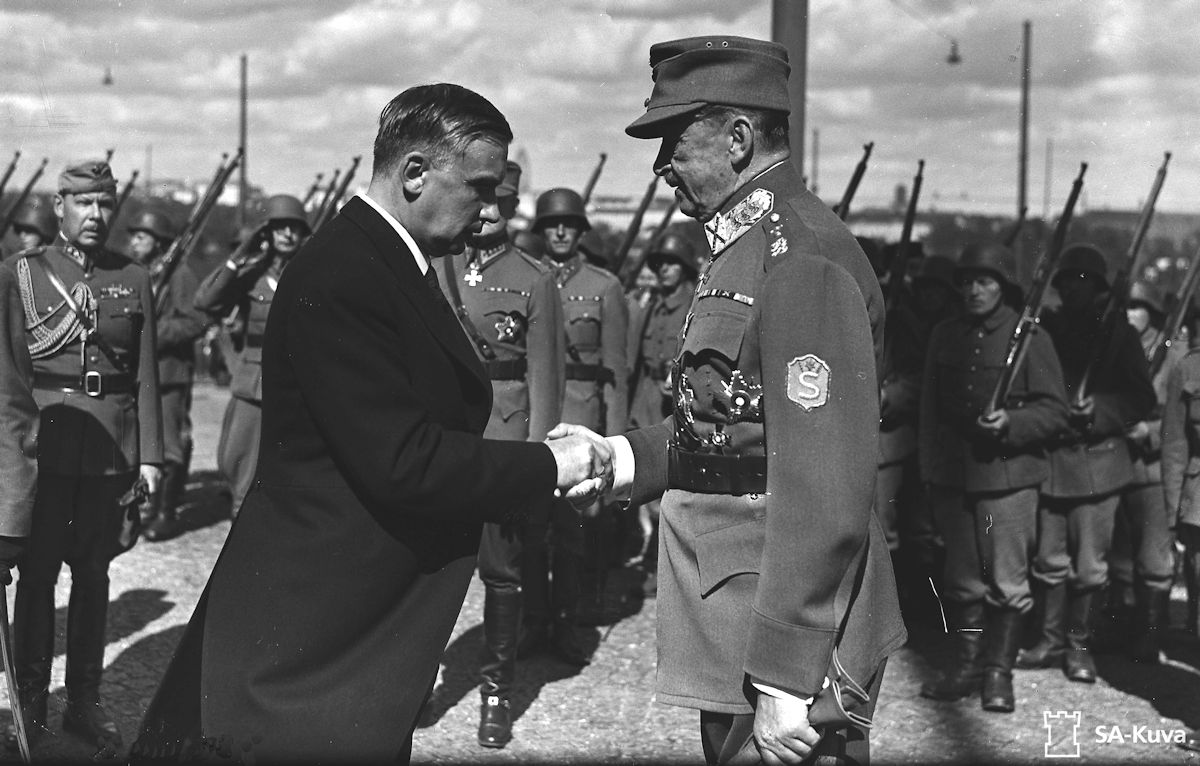
PICTURE: Prime Minister Linkomies and President Mannerheim in front of House of Parliament
4th of August 1944 after Finnish Parliament had just elected Marshal Mannerheim as President of the
Republic. Notice district shield belonging to General Headquarters of Civil Guard organization in Marshal
Mannerheim's left sleeve. Guard of honor on the background. Just three days before President Ryti had resigned
to provide option for peace talks with Soviet Union. Also Prime Minister Linkomies was to resign to create room
for new government selected for peace negotiations. That new government proved to be most short-lived in Finnish
history since the Soviets left Finnish peace delegation waiting in Moscow until Prime Minister Hackzell under
immerse psychological pressure suffered a stroke and was replaced by Castrén. Edvin Linkomies was a
Professor of Latin literature, who represented Kokoomuspuolue (National Coalition Party) in Parliament
and became Prime Minister in March of 1943. The Soviets demanded Finnish wartime political leaders to condemned
with prison sentences and in resulting War-responsibility trials received 5.5 year prison sentence for
"delaying achieving peace". He was pardoned after serving 2 years 9 months of his sentence and returned to
Helsinki University - ultimately becoming its Chancellor. Photographed by Hedenström (SA-kuva.fi photo
archive, photograph number 156452). CLICK THUMBNAIL TO SEE LARGER PIC (145 KB).
Marshal Mannerheim had introduced during Civil War a routine of when needed making daily orders (päiväkäsky), which were delivered to the troops in written format and had re-introduced the practice during Winter War. During World War 2 General Headquarters of Finnish Armed Forces produced in total 136 of these daily orders originating from Mannerheim. The very last of those 136 daily orders was published in 16th November 1944 and was used by Mannerheim for addressing former guardsmen of Civil Guard.
Here a translation of daily number 136 by Marshal Mannerheim:
"DAILY ORDER FROM COMMANDER OF CHIEF OF ARMED FORCES
No. 136
Following the bill from the government the Parliament has decided to rescent the law about Civil Guard organization enacted on 22nd of December 1927 along the changes later made into it. Hence Civil Guard organization has been abolished.
Former guardsmen!
In the past faithful days, born on iniative of people, without any foreign example, have Civil Guards of our country for more than a quarter of century done their voluntary work. The recently signed armistice and the ultimate peace coming into view after it require exerting all of our to unwavering work in all areas of life. This task will demand our full attention and arms of us all. Hence from now as a whole military training will be concentrated and limited to Armed Forces only. The birth of Civil Guard was begotten by noble patriotic influences and this fact and acts of sacrifice, which continued for decades had in eve of war reached the point, in which this was widely acknowledged. When Civil Guards have have now completed their mission I salute you, former guardsmen of Civil Guard representing various generations from Commander to the youngest rank-and-file, thanking you for your selfless voluntary service and your hard successful work.
The final daily order from your aged Honorary Commander to his most willing to serve and sacrifice-ready brothers in arms from days of wars and place, shall be ended to the motto, which has guided you: Everything for the Fatherland!

PICTURE: Marshal Mannerheim's daily order 136. Written down by General Headquarters of Armed
Forces (Päämaja) and printed by Printing House of Finnish Literature Society Ltd (Suomalaisen
Kirjallisuuden Seuran Kirjapaino Oy). Photo source Mikkeli City Museums (Mikkelin kaupungin museot), acquired
via finna.fi and used with CC
BY 4.0 Creative Commons license. CLICK THUMBNAIL TO SEE LARGER PIC (124 KB).
It is worth noting that while the Soviets tried to portray their reasons for demanding abolishing Civil Guard as political and shrouded the decision with their ideology, but what is known now suggests that the actual main reason may have been military one. If Civil Guard organization had not been disbanded, it would have been possible for Finland to move its immobilized military units under Civil Guard. And as it was Civil Guard was a powerful and well-organized militia force, which would have been serious hindrance for any Communist coup attempt or Soviet invasion. As a bonus abolishing of Civil Guard temporarily crippled Finnish mobilization system by removing essential part from its machinery.
Once Finnish Army started its offensive against the Germans in Lapland and turned Lapland War into real shooting war with attack to city of Tornio the first Finnish unit to enter combat was ad hoc military unit created in Tornio from various home front units and military personnel which existed in the city and was commanded by District Chief of Länsi-Pohja Civil Guard District Thure Larjo. The unit contained 18 officers, 70 NCOs and 233 men, so 321 men total - admitted that contains military police platoon of 55 men, which refused to take orders and saw no action. From those some 140 men were from 961st Air Raid Protection Company (961. Ilmasuojelukomppania) transferred from Kemi, while the rest included soldiers on a leave and even convalescent soldiers gathered at the last minute. For the purpose of secreting task of the unit that he had gathered and possibly for identification purposes Larho equipped its men with white armbands, which had text Evakuointiesikunta (Evacuation Headquarters). This small force was lightly armed with only two machine guns and small arms. The unit succeeded captured bridges, which had strategic importance and provided distraction, which allowed Finnish Army to land Infantry Regiment 11 unnoticed from cargo ships to nearby Röyttä harbor and the regiment to advance to the city. But at the same time the unit proved too weak to capture railway station and numerous other key buildings. This Larho's motley crew of a unit created in Tornio was apparently the last time that Home Front Troops intentionally were sent to combat. Even if Civil Guard Organization had been abolished, large number of its previous guardsmen continued serving in Finnish Army and fighting a war against the Germans in Lapland.
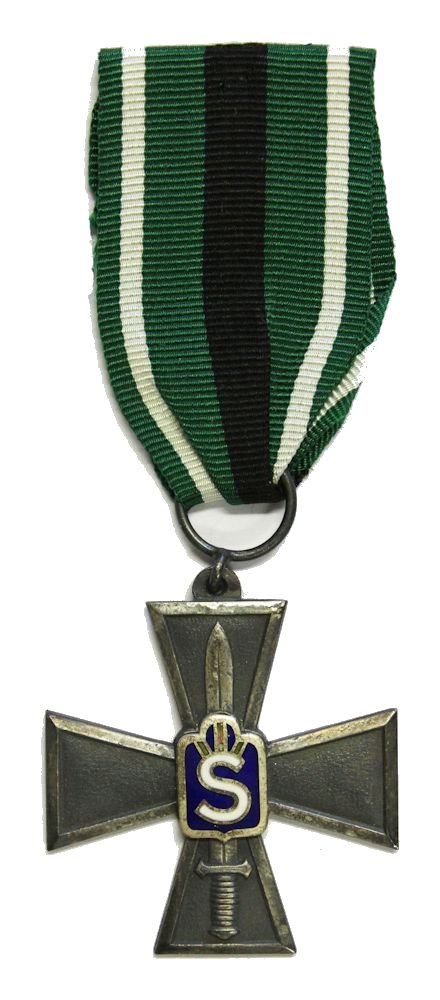
PICTURE: Civil Guard's silver cross of merit (Suojeluskuntain hopeinen ansioristi). Cross
of merit (ansioristi) was the highest decoration that Civil Guard had for awarding people. It was introduced in
yar 1922 and existed in three versions - iron cross, silver cross and gold cross from which the version made from iron
was most common. Some 1,300 of these crosses had been awarded before Winter War and another 2,000 in total were awarded
during World War 2. The last time these merit crosses were awarded was in 5th of November 1944, at which
time it was already known that the organization was to be abolished and at that day 900 crosses were awarded - more
than had ever before awarded in a single day. Photo source Turku City Museum (Turun kaupunginmuseo), acquired via
finna.fi and used with CC BY
4.0 Creative Commons license. CLICK THUMBNAIL TO SEE LARGER PIC (86 KB).
After World War 2 public view towards Civil Guards and its former guardsmen started to change and the left-wing radicalism of the 1960’s further spread old Soviet propaganda in Finland. Some parts of that communist and Soviet propaganda were so widely spread that they hampered objective research of Civil Guards in Finland. Since the 1980's more objective research about the subject has become possible.
Author's notes:
This article was originally written from a request. I took the mission of writing after noticing that at the moment there did not seem to be any extensive articles about Finnish Civil Guard online and there were (still are not) really no books about the subject in English either. Books used as sources for this article are listed below, unfortunately for non-Finnish readers all are only in Finnish. Both the Finnish Civil War and Civil Guards can still be very much subjects of debate in Finland, so I do not expect all my countrymen to agree with this article, but tried to handle the most debatable subjects in such way that a reader can form his own opinions. Reading with thought and willingness to question motives is recommended with books dealing about Finnish Civil War or Civil Guards.
SOURCES:
Suojeluskuntain historia (History of Civil Guard) book series of three volumes written by those who had served in Civil Guard. First two volumes were authored by Major-General Niilo Hersalo and third volume by Colonel Hannes Raikkala.
Kari Selén: Sarkatakkien maa, Suojeluskuntajärjestö ja yhteiskunta 1918 -1944 (Land of Coarse Cloth Jackets, Civil Guard Organization and Society 1918 - 1944).
Kari Selén: Sarkatakkien armeija, Suojeluskunnat ja suojeluskuntalaiset 1918 -1944 (Army of Coarse Cloth Jackets, Civil Guards and Their Guardsmen 1918 - 1944).
Ali Pylkkänen: Suojeluskuntalaiset, keitä he olivat? (Guardsmen of Civil Guard, Who Were They?)
Martti Sinerma: Lauri Malmberg ja Suojeluskunnat (Lauri Malmberg and Civil Guards).
Esko Lammi: Tuli ja liike. Urheilu maanpuolustuksen ja maanpuolustus urheilun tukena. (Fire and movement. Sports as Support of National Defense and National Defense as Support of Sports).
Jarl Kronlund: Suomen Puolustuslaitos 1918 - 1939 (Finnish Military 1918 -1939).
Markku Palokangas: Sotilaskäsiaseet Suomessa 1918 - 1988 (Military Small Arms in Finland 1918 - 1988).
Risto Alapuro (editor): Raja railona, näkökulmia suojeluskuntiin (= Border as Crevasse, Viewpoints to the Civil Guards).
Pekka Tiilikainen and Ilmari Pusa: Talvisodan Jäinen loppunäytös (Icy Epiloque of Winter War).
Jaakko Hakala and Martti Santavuori: Summa.
Pentti Luutinen: The Imperial Russian Army and Navy in Finland 1808 - 1918.
Erkki Fredriksson: Kätketyt kiväärit, veriset pistimet (Hidden Rifles, Bloody Bayonets)
Mika Kulju: Lapin Sota 1944 - 1944 (Lapland War 1944 - 1945).
Article Ilmasuojelujoukkojen toiminta Joensuun alueella 1941 - 1944 (Home Force in Joensuu Area during Continuation War in 1941 - 1944) by Elli Kiuru in Sotahistoriallinen Aikakauskirja 45 (Journal of Military History 45).
Lars Westerlund (editor): Sotaoloissa vuosina 1914 - 1922 surmansa saaneet, tilastoraportti (Those Killed in Wartime Conditions of 1914 - 1922, statistical report).
Pentti Mäkelä: Vuosien 1917 - 1919 kulkutaudit, espanjantauti ja vankileirikatastrofi (Years 1917 - 1919 Pestilence, Spanish Flu and Prison Camp Disaster).
Finnish National Archives (Kansallisarkisto), archive folder Sk-2513/258, Civil Guard small arms inventories 1921 - 1939.