


PART II: SUOJELUSKUNTA DURING THE 1920'S AND 1930'S
From early uncertainty to position guaranteed in legislation
The end of the Civil War brought Suojeluskunta to a new situation. Finland was now independent, but having an organization which would guarantee safeguarding it against outside and interior enemies was also seen as vitally important. At the time Finnish Army was still very small and not capable to fight any real foreign Army on its own. The existing Suojeluskunta organizations, which had been originally organized in 1917 - 1918, were no longer up to date for the situation and after Civil War much of their men considered their work done and returned to civilian life. At the same time situation in Finland's eastern border and behind it was anything but peaceful with Russian Civil War going on and Russian Red Guards being turned in Red Army starting to launch offensives for capturing former parts of Russian empire starting from November of 1918. The one from these offensives that effected to Finland was Red Army's attack to Estonia in that month, which sparked powerful Finnish support to Estonia with shipment of weapons and some 4,000 volunteers. At the time Finland and Bolshevik Russia were de facto in state of war against another until Peace Treaty of Tartto / Tartu being signed at October of 1920. Finnish White Army had launched excursions to Russian Carelia during Civil War and after it there were several attempts of trying to raise support of local Carelian population to rise against the Bolsheviks for Russian Carelia to join into Finland. These military actions performed with limited support of Finnish state are known as heimosodat (Wars of Kindred Peoples) were just part of the restlessness. Finnish prohibition was incompatible with existing culture, reducing respect for letter of law, made smuggling alcohol very profitable business and caused making moonshine spread widely. Eastern border in particular was highly dangerous place early on with in addition of smugglers also foreign spies and White Russian emigrants and Russian Bolsheviks operating across it. In addition Finnish Reds who had fled from Finland in end of Civil War were now receiving military training from Bolsheviks and plotting for round two. Finnish Armed Forces had barely been created and still too weak to handle any major war. In that situation there was obvious need for redesigning and uniformly rebuilding Suojeluskunta as nationwide voluntary militia organization. Redesigning the new organization raised a number of questions, some of which continued to remain being debated well into the 1920's.
These questions included matters such as:

PICTURE: Armband of Alavieska White Guard / Civil Guard. White armband with Civil Guard insignia
was/is the best known identification of Civil Guard, although it was not its only Finnish user. Finnish Armed Forces
used white armband with coat of arms lion insignia as part of holiday and dress uniform. This armband represents
insignia design introduced in November of 1918 and used by Civil Guards early on. Early Civil Guard armbands were such
as this were typically printed and hence producing them required access to suitable printing press. Unusually also
printing house (Liiton kirjapaino) has been marked into it. Photo source Helsinki City Museum (Helsingin
kaupunginmuseo), acquired via finna.fi and used with
CC BY 4.0 Creative Commons license. CLICK THUMBNAIL TO SEE
LARGER PIC (66 KB).

PICTURE: Armband belonging to Chief of Liperi Civil Guard. This armband features district shield patch,
which were introduced for Civil Guard uniforms in year 1919 with each Civil Guard district having
its own colors in the patch. Year 1921 earlier armband design shown above was replaced with armband equipped with district
shield patch. Notice district shield patch peaking above the armband - feature reserved only to chiefs of Civil Guard and
Civil Guard officers. Photo source Lotta Museum (Lottamuseo),
acquired via finna.fi and used with CC
BY 4.0 Creative Commons license. CLICK THUMBNAIL TO SEE LARGER PIC (62 KB).
On the 4th of July of 1918, representatives of 171 Civil Guards gathered in town of Jyväskylä, and the decisions made there had profound impacts on the future of Civil Guard. There solutions made in Jyväskylä that day greatly influenced the first piece of legislation made for Civil Guards, which was a statute legislated by the Finnish Senate (government) at August of 1918. The statute was short in text and rather vague in some matters, but it created the groundwork needed for creating the new organization. At the same time, it showed official recognition of its status from a part of the state. Matters covered in it included: Suojeluskunta was defined as a State-wide voluntary organization with local and district levels. Each locality would have local Civil Guard and the country would be divided to Civil Guard Districts, all of which would include several localities. Civil Guard organization would not be part of the Army, but a separate entity having its own Commander subordinate only to President of Finland and Minister of Defense. Membership eligibility requirements (trustworthy males of at least 17 years of age). The process of selecting members / guardsmen (volunteers with recommendation). Members could be active or passive ones. The basic organization (local chief and district HQ levels and how to create them). Civil Guard oath was introduced for use of all for those who joined Suojeluskunta. The Suojeluskunta was given rights to accept donations and own property.
Later on at year 1927 law about Civil Guards was enacted. The law not only clarified matters beyond those determined in statute, but bound Civil Guard organization tighter into Finnish state, with offices of Civil Guard Area chiefs and Civil Guard District chiefs being attached into Armed Forces system of appointments. At the same time it also provided Civil Guard organization stronger legal position, since hostile left-wing government could have rather easily changed or nulled the legal statute, while chancing existing law without wider support of other political parties in Parliament would have been far more difficult.

PICTURE: District HQ of Etelä-Häme Civil Guard District and lower level chiefs of the district
circa 1932 - 1933. Second from the right in front row District Chief Lieutenant-Colonel E. Suojärvi (original surname:
Palander, 1873 - 1947), who had been a school teacher before dedicating himself to career in Civil Guard in mid 1920's.
He had obtained training similar to officer training of Finnish Army in year 1927. Three other men sitting in front row were
also leaders of the district - from left to right Captain O. Paloheimo, mayor O. Lyytikäinen and S. Honkala. Second row
second from the left fifth man belonging to district leaders - master of laws O.I.A. Oja. Others seen behind include number
of chiefs for civil guard areas and local civil guards of the district. The District Chief and several other men are wearing
light uniform m/27, which can be identified from open collar and necktie worn
with it. Photographed by Enok Rytkönen. Photo source Finnish Heritage Agency (Museovirasto), acquired via
finna.fi and used with CC BY 4.0
Creative Commons license. CLICK THUMBNAIL TO SEE LARGER PIC (157 KB).
The basic organization structure of Suojeluskunta
The legal statute also made the leader of the Senate's Committee of Military Matters, General-Major Wilhelm Thesleff the Chief of the Civil Guards and gave Civil Guards their own representative in the Ministry of Defense. At the start Civil Guard did not yet have a General Headquarters and the organization was directly subordinate to the Defense Ministry. For all purposes Suojeluskunta-districts were the same as mobilization districts of Finnish Army. Colonel Georg Didrik von Essen was named as the first Leader of Suojeluskunta Office and later (1919) as the first Commander of what by that time had become independent Civil Guard organization.

PICTURE: Colonel (later: Major General) Didrik von Essen (1864 - 1936) was first Commander of Civil Guards
in 1919 - 1921. He had served in Army of Autonomic Finnish Grand Dutchy, last serving as squadron (company) commander of
Suomen Rakuunarykmentti (Finnish Dragoon Regiment) before it was disbanded at year 1901 as part of disbanding Finnish
military units as part of Russification campaign. Von Essen belonged to old military family. He had served as commander of
Helsinki White Guard at year 1906 during revolt of Russian military and Hakaniemi Riot. He served briefly in Finnish Army
in 1918 - 1919 as Lieutenant-Colonel before being named as Commander of Civil Guard. He was fired to refusing to
follow orders during Civil Guard Strife at June of 1921. Photo source Finnish Heritage Agency
(Museovirasto), used with CC BY 4.0 Creative Commons license.
CLICK THUMBNAIL TO SEE LARGER PIC (73 KB).
Civil Guard was highly popular immediately after the Civil War and its organization effectively spread to the whole country. Year 1919 it became an independent organization tied to Finnish defense. By year 1920 about 93 % of Finnish municipalities and towns had local Suojeluskunta. Being nation-wide volunteer organization with tens of thousands of men, it needed organization of several levels. Civil Guard it got its own independent Headquarters, first named Suojeluskunta toimisto (Civil Guard Office) to the Ministry of Defense, but already at April its headquarters were renamed as Suojeluskuntain Yliesikunta (General Headquarters of Civil Guard). In the beginning the office had only two sections - Military and Financial. Once it was fully developed, the organization of Civil Guard was to have four levels - General Headquarters, district-level, area-level and local level.
The basic command structure of structure of Civil Guard organization starting from the top:
General Headquarters of Civil Guard (Suojuskuntain Yliesikunta - SY / Sk.Y): The high command of Suojeluskunta organization was lead by the Commander of Suojeluskunta organization. Its organization grew with CG-organization When GHQ was first established at year 1919 it had four departments, but in less than a year their total number had climbed to seven.
Suojeluskunta District (Suojeluskunta Piiri): Each of these contained two or three Civil Guard areas. Each district had a small District Headquarters lead by the District Chief (Piiripäällikkö). Most of the time Civil Guard District HQs had 4 members and 2 alternate members.
Civil Guard Area (Suojeluskunta Alue): Each of these contained severas local Civil Guards and had a small Area Headquarters. Typical Civil Guard area had 2 - 4 local civil guards.
Local Civil Guard (Suojeluskunta): Civil Guard of one municipality or town. Cities often had several Civil Guards, which could represent different service arms (infantry, field artillery, sappers etc). Lead by Local Chief (Paikallispäällikkö).
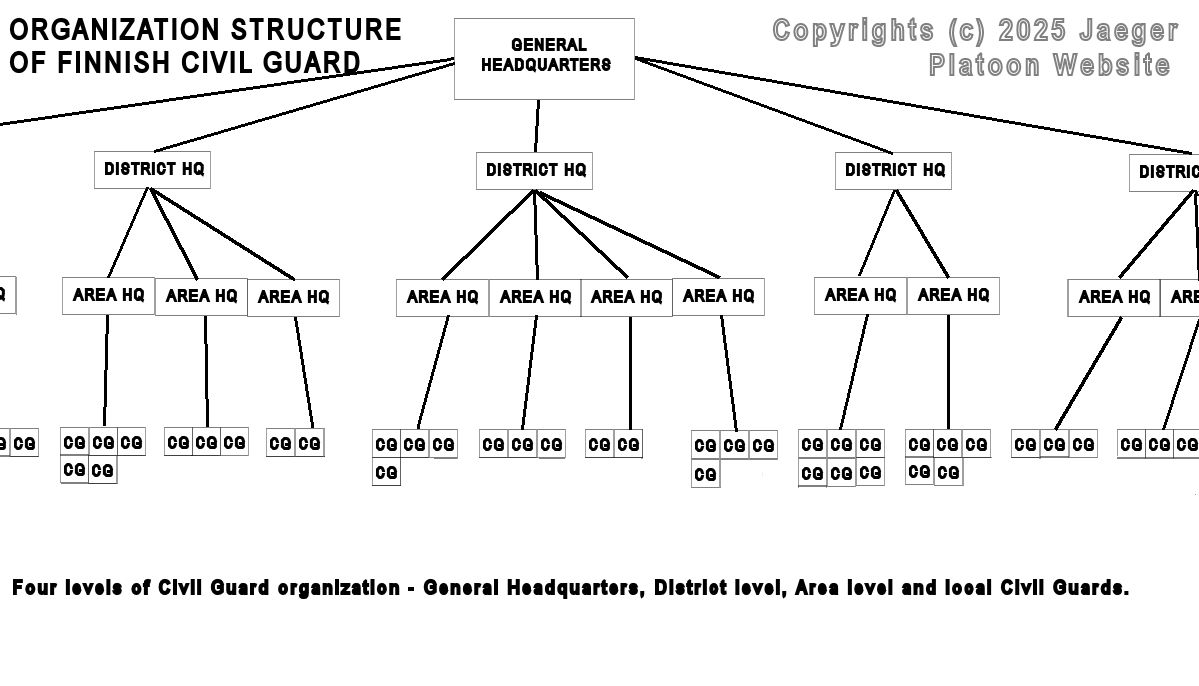
PICTURE: Organization structure of Civil Guard organization. (Copyrights (c) 2025 Jaeger Platoon Website).
CLICK THUMBNAIL TO SEE LARGER PIC (142 KB).
Finances
Civil Guard organization and its parts received their financing from four main sources:
Voluntary funding: These included donations, membership fees and money collected by Civil Guard and Lotta Svärd organizations as entrance fees to functions they had organized and so on. This was the largest source of funding for local Civil Guards.
Funding from State budget: This started when the Finnish State decided to pay wages of some hired personnel of (national) Civil Guard organization. The sums increased as Civil Guard organization grew larger in size, but ultimately it was an inexpensive tool for helping to maintain the defense capability for the Finnish State. The sum annually provided for Civil Guard remained always as less than 2% of the yearly State budget and less than 12% of annual defense spending of Finnish State.
Funding from municipalities, towns and cities: These typically financed local Civil Guard as long as left-wing parties did not have a majority in local politics).
Business profits from enterprises owned by Civil Guard organization: Three parts of Civil Guard organization were organized as quite independent companies early year 1927 and also did business with outsiders. They were: Suojeluskuntain Ase ja Konepaja Oy (Civil Guard's Gun and Engineering Works Ltd - better known as SAKO), Suojeluskuntain Kauppa Oy (Shop of Civil Guard, better known as SKOHA and officially as Oy SKOHA Ab starting year 1935) and Suojeluskuntain kustannus Oy (Publishing House of Civil Guard Ltd).

PICTURE: House of SKOHA (Skohan talo) was a building in center of Helsinki across the street from
facade of Helsinki railway station. The house was commonly known with that name due to being location of largest SKOHA shop
starting year 1930. At that time SKOHA had in total three shops - two in city of Helsinki and one in city of Vaasa. Year 1944
Oy Skoha Ab was donated to Finnish Red Cross. The company ceased to exist when its last parts were merged to VALIO in year
1982. The building seen in the photograph had originally been built in 1870's and was replaced with new one in mid 1960's.
Photographed by Asko Salokorpi sometime in early 1960's. Photo source Finnish Heritage Agency (Museovirasto), acquired via
finna.fi and used with CC BY 4.0
Creative Commons license. CLICK THUMBNAIL TO SEE LARGER PIC (210 KB).

PICTURE: Civil Guards used large variety of sources for gathering of their financing. Poster of Riihimäki
Civil Guard advertising lottery. Title of the poster translates as 10 cars with 30 marks. It lists items and bank deposits, which
were prizes of the lottery. Assuming the poster is from 1920's the lot price of 30 marks equals about 12 euros in money of year
2025. Photo source Taideteollinen korkeakoulu (University of Industrial Arts) Aalto-yliopiston arkisto (Archive of Aalto
University), acquired via finna.fi and used with CC BY-NC 4.0 Creative
Commons license. CLICK THUMBNAIL TO SEE LARGER PIC (228 KB).
Selecting and naming of leadership and officials in Civil Guard
The Finnish President named the Commander-in-Chief of Civil Guard organization, who also had to be approved by Civil Guard organization delegates before selection. Meetings of delegates selected two delegates from each Civil Guard District and could be summoned by Civil Guard's Chief-of-Staff or by five Civil Guard Districts by written request.
Representatives of local Civil Guards of each Civil Guard District selected members of their District HQ in annual general meetings held in February. In these annual meetings of Civil Guard Districts each local Civil Guard of the particular district had 1 - 3 representatives depending on the size of the local CG they represented. Civil Guard District HQ members were selected for two years. Additional Civil Guard District meetings could be called by the District Chief and district HQ. Commander of Civil Guard was appointed the Chiefs of each Civil Guard District. Before being appointed, the candidate also needed to be approved by HQ of the district he was about to lead. The local Civil Guard HQ was lead by the Local Chief (Paikallispäällikkö), who lead local Suojeluskunta HQ, which had 4 members and 2 alternate members. Members of these HQs were elected for a period of one year in general annual meeting held in January.

PICTURE: This photograph showing Local HQ of Kirvu Civil Guard sometime in late 1920's - early 1930's gives
rather good idea about what sort of people would serve in local level leadership positions in Finnish Civil Guard. Kirvu was a
municipality in northern parts of Carelian Isthmus and was lost in Winter war. Local Chief Matti Kärpänen is standing
rear center, he was a farmer who had volunteered to Finnish White Army during Civil War in age 15 and served 29 years as Local
Chief of Kirvu Civil Guard. Occupations of other four men are rural chief of police, teacher of elementary school and two farmers.
One of the two other farmers was also captain of Finnish Army, while Matti Kärpänen hold military rank of 2nd
Lieutenant. Four of the men are wearing field uniform m/27, while one still has
civil guard uniform m/22. Use of white armband with
Civil Guard insiginia signifies use of uniform they are wearing as dress uniform. Small swastikas made from brass shown
in tunic collars were uniform insignia for members of local level HQ. Photo source Finnish Heritage Agency (Museovirasto),
acquired via finna.fi and used with
CC BY 4.0 Creative Commons license. CLICK
THUMBNAIL TO SEE LARGER PIC (170 KB).
Membership process for those wishing to join Civil Guard
Civil Guard members were divided to two categories: Actual members (guardsmen) and supportive members. Supportive members paid membership fee, but did not have right to vote in CG elections, no right to wear Civil Guard uniform and also had no responsibility for attending its training.
Information below concerns only actual members - guardsmen:
Conduct demanded from those willing to become guardsmen of Civil Guard was quite clear: They had to be Finnish males deemed
trustworthy and having at least 17 years of age (those wishing to join, but who were under 21 needed written permission from
their legal guardian). To be more precise, in this case being trustworthy meant not having a criminal past or the wrong kind of
political ideals. Ex Red Guard members of Civil War never had any chance to join and neither did Communists (who were basically
seen as the enemy). As a rule Social Democrats (moderate left) were also unwanted until a reconciliation between the Social
Democratic Party and Suojeluskunta organization in February of 1940. The existing members (especially the Chief of local
Suojeluskunta) decided who was considered trustworthy and who was not. If local Civil Guard was not familiar with the applicant,
then written recommendations from two trustworthy persons were needed.
Those wanting to join Civil Guard, but younger than 17 years of age could join its Boy Units (Poikayksikkö). Civil Guard Boy Units did not offer military or weapons training, but instead concentrated on sports. At First Boy Units had been the so called "Squirrel Companies" (oravakomppania) and were organized soon after the Civil War for 13 - 16 year old boys wanting to join Civil Guard. In that first try sports alone proved too little for maintaining interest, but in the 1920's interest reappeared and this time proved more long lasting. Officially, work with Civil Guard Boy Units was started in year 1928 and it continued until abolishment of Civil Guard. Boy Units also worked to aid recruiting of new members to CG. Once member of boy unit reached the age of 17, he could get transferred to normal Civil Guard unit. Sports and other activities of Boy Units got many boys to join and about 70% of them joined regular Civil Guard after reaching the required age. After year 1920, guardsmen of Civil Guard, who were at least 20 years old had one vote in elections of his local CG and until the statute of January 1934 could also be selected to a responsible position in his CG. After the Statute of January 1934, guardsman got one vote in Civil Guard elections after belonging to Civil Guard for one year. As kind of "old member bonus", they could also get another vote. This "old member bonus" vote was available to those who had belonged to Civil Guard for 15 years, or were over 40 years of age and had belonged to Civil Guard 10 years. The statute also required those selected for responsible positions to be at least 21 years of age. Starting year 1933 guardsmen of Civil Guard, who were at least 40 years old, had been members long enough (10 - 15 years) and had filled certain activity requirements could get transferred into veterans of Civil Guard, who no longer needed to take part in its training activities and hence returned equipment issued to them, but retained their membership status.

PICTURE: Photograph taken from Civil Guard camp in Kaltimo (now part of municipality of Eno) at year 1926.
Seen here is parade event as part of which new guardsmen would make Civil Guard oath. It was apparently common to either make
the oath in large-scale public events such as this or in a church. This camp was unusual due to local Workers hall
(työväentalo) being rented for its use. Notice four 75 VK/98 mountain
guns on the right. Photographer unknown. Photo source Finnish Heritage Agency (Museovirasto), acquired via
finna.fi and used with CC BY 4.0
Creative Commons license. CLICK THUMBNAIL TO SEE LARGER PIC (157 KB).
Guardsmen of Civil Guard - Who and what kind of men were they?
Suojeluskunta was not a political organization on its own, but its guardsmen generally belonged to a specific side of spectrum when it came to political views. Namely political views of its guardsmen covered the spectrum from the political center to the extreme right. However, the difference in political views between average guardsmen and average Finnish citizen of the time was not as large as one might expect. In the 1920's and 1930's, Finnish political views in general were more right-wing orientated than at later times.
Unlike suggested by Soviet propaganda and also as often claimed by Finnish Communists, guardsmen of Civil Guard were not all from well-to-do families, rich or even from "bourgeois" professions. Generally speaking, what could be at best nowadays considered middle-class formed a majority in its ranks. The share of farmers among its membership was quite large, but this was not very surprising as at the time the large majority of Finnish population lived in the countryside, covered by small farms owned by their farmers. The professions of Civil Guard's guardsmen could vary considerably from one local Civil Guard to another and could also change over time. For example, 92% of members in Lemi Civil Guard were farmers and 60% of Uuraa (with harbor for nearby city of Viipuri) guardsmen were working class. The other largest social classes of guardsmen were lower middle-class and working class. The proportional share of workers among guardsmen of Civil Guard climbed little by little as their share among new guardsmen was on the rise.
Professions and occupations of Civil Guard s guardsmen in the year 1933
Profession/Occupation Percentage from guardsmen of Civil Guard:
I. Entrepreneurs:II. Public
servants and officials:
1. State, municipal and church officials 6,81 %
2. Industry and business personnel 7,43 %
3. Other 0,7 %
Total 14,99 %
III. Servants and
workers:
1. Servants 5,91 %
2. Agricultural workers 4,75 %
3. Industrial workers 4,92 %
4. Other workers 4,60 %
Total 20,18 %
IV. Other
1. Students 6,62 %
2. Other 0,92 %
Total 7,54 %
(Statistics gathered by the Educational Office of Suojeluskunta. Source: Suojeluskuntain historia, part 3 pages 260 - 261).

PICTURE: Some individual Civil Guards notably differed from average statistical values when it
came to percentages of social class or professions. The Civil Guard unit marching here at year 1919 as part of
Civil Guard parade commemorating victory of Finnish White Army is Civil Guard of Helsinki University. Guardsmen
seen in the photo are wearing early uniform of Helsinki Civil Guard District with its distinct "sport-cap"
(sporttilakki). Building on the background is main building of Helsinki University. Photographer unknown.
Photo source Finnish Heritage Agency (Museovirasto), acquired via finna.fi
and used with CC BY 4.0 Creative Commons license. CLICK
THUMBNAIL TO SEE LARGER PIC (162 KB).
Development in total number of guardsmen in Civil Guards:
|
year |
|
|
1918 |
59100 |
|
1919 |
93300 |
|
1920 |
94300 |
|
1921 |
85200 |
|
1922 |
? |
|
1923 |
80000 |
|
1924 |
79400 |
|
1925 |
? |
|
1926 |
77800 |
|
1927 |
? |
|
1928 |
79400 |
|
1929 |
80100 |
|
1930 |
86000 |
|
1931 |
88700 |
|
1932 |
89400 |
|
1933 |
90500 |
|
1934 |
92500 |
|
1935 |
95500 |
|
1936 |
101000 |
|
1937 |
106600 |
|
1938 |
111500 |
|
1939 |
119500 |
|
1940 |
113200 |
|
1941 |
126700 |
Notice: Numbers have been rounded to closest 100. Info based on part 2 of Suojeluskuntain historia and Suojeluskuntalaiset - keitä he olivat?

PICTURE: Father and four sons, who all belonged to Joensuu Civil Guard. It was not uncommon for
several family members be to be guardsmen while women of the family belonged to Lotta Svärd (female auxiliary
organization of Civil Guards). All five are wearing Civil Guard uniforms m/22
and are equipped with Japanese rifles, which suggest photograph originates from
circa 1922 - 1925. Photographer unknown. Photo crop. Photo source Finnish Heritage Agency (Museovirasto), acquired
via finna.fi and used with CC
BY 4.0 Creative Commons license. CLICK THUMBNAIL TO SEE LARGER PIC (229 KB).
Main functions of Civil Guard during peacetime
Assisting authorities in a wide variety of situations where organized and armed troops might be included. This included missions like searching large areas, guard duty and assisting apprehension of dangerous criminals. After the Civil War Finnish police had to be re-established - it took until 1919 1920 for it to get established and specially in countryside it lacked resources for combatting any major criminal discreditations. Hence in 1919 1920 Civil Guards had to cover the slack - providing assistance to police in 2.344 cases in total, from which about 700 (some 30%) were political in nature. While Civil Guards continued to provide assistance to police when asked, in the annual number of cases dropped to few hundred a year in 1920's and continued to decline also after that. In addition in 1920's Civil Guards of the border areas were often very busy plugging up holes to secure borders with far too few Frontier Guard units. In 1919 1920 about one out of seven requests of assistance originated from Frontier Guard, while this may not seem much, these requests cumulated to Civil Guards closest to border areas and often proved highly time-consuming for them. Early on duties for which police typically requested assistance of local CG included search of Red Guards members still hiding in forests after Civil War, search of escaped prisoners or deserters from military service, house searches and other searches of unlicensed guns or propaganda smuggled from Soviet Union. In addition, Civil Guards were often to provide personnel for maintaining public order in large-scale public or private events. The Finnish prohibition in 1919 - 1932 was major factor in requests for assisting authorities, since searching for illegal stills demanded a lot of manpower. According calculations about one quarter of requests of assistance made by police during those years was related to enforcing prohibition. Some Civil Guards proved enthusiastic about destroying illegal stills even without authorities asking them, while others were far less inclined.
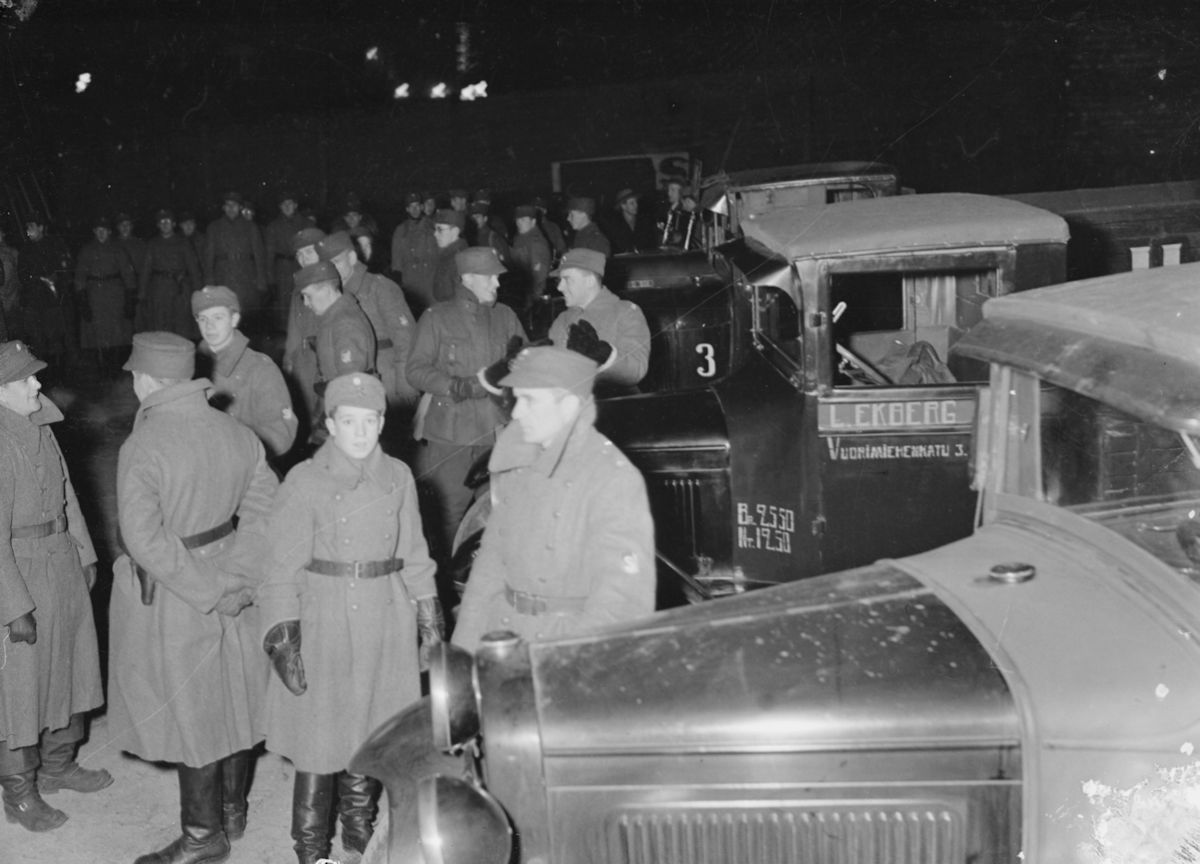
PICTURE: Guardsmen of Civil Guard and their cars taking part in manhunt of Toivo Tarviainen in
November of 1934. Convicts Aleksanteri Hytti ja Toivo Tarviainen had escaped prison camp of Malminkartano and
murdered farmer's wife Johanna Winberg with axe and short sword. Civil Guard was called to take part in the manhunt
and one of its patrols soon arrested Hytti, but Tarviainen succeeded evading capture for number of days before
finally being found and surrendering to police. Tarviainen who was still in his 20's ended up confessing in total
six homicides, which he had committed over the years. Photographed by Aarne Pietinen. Photo source Finnish Heritage
Agency (Museovirasto), acquired via finna.fi and used with
CC BY 4.0 Creative Commons license. CLICK THUMBNAIL
TO SEE LARGER PIC (123 KB).
Another area in which Civil Guards provided major help to Finnish authorities was gathering and reporting information about persons in their local communities. This had background in intelligence gathering about Red Guards that had in some places started already before Civil War and had continued through the Civil War, with gathered information being ultimately provided to state prosecutors, who after the Civil War prosecuted Finnish Reds for the wartime crimes. After this information gathering and reporting about persons doubted being politically dangerous continued for purposes of police, State Police (responsible for counter-espionage) and military intelligence. Two particularly noteworthy groups being reported about were former members of Red Guards, who were released from prisoner camps and prisons after Civil War and those Finnish Reds who had fled to Russia. In addition background reports were being provided to authorities about men called to military service or needing security clearance.
Propaganda made by Civil Guard organizations was typically quite subtle. Instead of derogatory and chauvinist speeches, it favored organizing popular public events with sports, chorus singing and orchestras as attractions, with event also typically including some patriotic parts (music, poems etc.) in the program. Civil Guard also had their own their magazines - Suojeluskuntalaisten lehti (Magazine of Guardsmen) published by Kustannusosakeyhtiö Suunta (Publishing-ltd Suunta), which was replaced with CG-organization published Hakkapeliitta magazine in year 1925. Hakkapeliitta magazine was named after Finnish cavalry soldiers of Thirty Years' War. From year 1926 on, Hakkapeliitta was weekly color magazine with tens of thousands of subscribers and remained as official magazine of the organization until year 1944. In addition many of Civil Guard districts published magazines of their own. Civil Guard publications had competition in form of Suomen Sotilas (Finnish Soldier) magazine, which was established in year 1919 and popular magazine among guardsmen. When it came to public opinion concerning Civil Guard, the fact that the large majority of opinion leaders of local communities, such as teachers and priests, of 1920's and 1930's either belonged or generally had positive attitude towards CG-organization did not exactly do it any harm either.

PICTURE: Cover of Hakkapeliitta magazine vol. 12/1927. Cover art seen here was created by artist
Arvo Kotilainen (1897 - 1949), who worked as illustrator in 1919 - 1931. Public domain. CLICK THUMBNAIL TO SEE LARGER
PIC (126 KB).
Halls of Civil Guard
Hall of Civil Guard (Suojeluskuntatalo was the base of operations for Civil Guard of local level. It was a house where ideally local Civil Guard had its office, typically some larger room used for events, storage rooms and in many cases also apartment for the Local Chief or Area Chief. In addition of its everyday use when needed the building could also be temporarily used as accommodation for guardsmen taking part in rehearsals, training manoeuvres or competitions. If building could be honestly called a hall or a house varied. Size and how well fitting the building the building was for the purpose tended to depend number of guardsmen, wealth and contacts of the particular Civil Guard - hence they varied from modest old small wooden houses to large purpose-built stone buildings. Having a large room suitable for public events allowed Civil Guard to easily arrange its own events and also rent it to other events that it see fit. It usually too some time to gather the financing needed for obtaining financing necessary for acquiring own hall, so early on many local Civil Guards had to rely hospitality of others, with gymnastic halls of local schools being usual early replacement for having place of their own. In many locations local level Civil Guards never acquired hall of their own or hold up with modest house with very little space or shared ownership of the building. When local Civil Guard lacked suitable premises they would often loan or rent space for their events from other halls typical to Finnish rural communities at the time. In was common for Finnish rural communities at time have three kind of halls, from which hall of Farmers Society (maamiesseuran talo) and hall of Youth Society (nuorisoseuran talo) were likely to be friendly towards local Civil Guard and probably even share much of their membership, while Workers Hall (työväentalo) usually run by social democrats and/or communists was likely to be less welcoming. Another common option was for local Civil Guard to either share ownership or rent its house from Farmers Society or Youth Society, while shared ownership with Lotta Svärd or even Lotta Svärd owning hall of local Civil Guard was not unheard either.

PICTURE: Hall of Hyvinkää Civil Guard. Photographed by unknown photographer at year 1933.
Notice shield of Civil Guard on wall of the house - marking a hall in this way does not seem to have been common. Year
1944 the building was donated to local associations and demolished for new buildings at year 1970. Photo source
Hyvinkää Town Museum (Hyvinkään kaupunginmuseo), acquired via finna.fi
and used with CC BY NC ND 4.0 Creative Commons license.
CLICK THUMBNAIL TO SEE LARGER PIC (241 KB).
According statistics gathered by General Headquarters of Civil Guard at year 1930 local Civil Guards owned 147 Civil Guard halls and were shared owners of 86 halls. At that time only about 40% of local Civil Guards had Civil Guard hall in their disposal, but the in 1930's the number climbed in rapid manner. By year 1933 the total number of Civil Guard halls owned by local Civil Guards had climbed to 236 and in addition to which Civil Guard districts owned 13 halls. At end of year 1939 some 60% of Civil Guards owned their own hall. Headquarters of Civil Guard Districts were located in cities and halls owned by them tended to be bigger and better than those of local Civil Guards, but they also had larger number of personnel and hence needed more space for their duties. In some cases large buildings built by Civil Guard also had room for businesses in them, with rent-income from those businesses being used to cover costs of running a large building. Also village units of local Civil Guards sometimes had houses of their own, but these tended to be modest in size. In addition of halls large number of Civil Guards owned also other buildings, among which shooting pavilions and storage building were apparently particularly common.

PICTURE: Hall of Lohja Civil Guard with guardsmen posing in front of it. Photographed by unknown
photographer sometime in between 1925 - 1930. The building was purpose-built for Lohja Civil Guard and building of it was completed
at year 1925. Originally it had downstairs office of local Civil Guard and bakery run by Lotta Svärd. Year 1944 the building
was donated to Farmers Association (Maamiesseura) and is nowadays in use of Laestadian religious community.
Photo source Lohja / Lojo City Museum (Lohjan kaupunginmuseo), acquired via finna.fi
and used with CC BY 4.0 Creative Commons license. CLICK
THUMBNAIL TO SEE LARGER PIC (139 KB).