


PART IV: SUOJELUSKUNTA TRAINING
Training in Civil Guards did not start well. There was a shortage of trained capable military officers after the Civil War and the Armed Forces picked best militarily educated and most competent officers and non-commissioned-officers. Meanwhile Civil Guard organizations had trouble finding well-capable officers and non-commissioned officers. Hence early on a low quality of training with Civil Guard officials handling training, also early on tended to manifest itself into a low quality of training in the whole organization.

PICTURE: Early close order drill of Civil Guard. Close order drills were apparently far too
common form of Civil Guard training early on. This may have been explained by them being easy enough to arrange
even by those with very limited military training and at the same time requiring very little resources. While
place and date for this photograph are not known, the armbands seen in it
were design introduced in November of 1918 and replaced with armband equipped with district shield insignia
in year 1925. Photo source Finnish Heritage Agency (Museovirasto), acquired via
finna.fi and used with CC BY 4.0 Creative Commons
license. CLICK THUMBNAIL TO SEE LARGER PIC (205 KB).
Overall major changes took place in 1920's and 1930's in personnel serving in leadership positions of Civil Guard organization. Increasing number of reserve officers trained by Armed Forces joined Civil Guard and started gradually filling lower officer ranks of in its organization, gaining majority status among its officers by year 1931. In addition, once being made Commander of Civil Guard in year 1921 Lauri Malmberg intentionally started little by little replacing old activists, who were often high-spirited but poorly educated in military matters from Area and District level headquarters with professional soldiers from the Army. In addition of officers trained by Finnish Armed Forces the organization also had Civil Guard officers, who had raised among its own ranks and had been trained in Civil Guard Officer School.
Over time the improving training level of its leadership reflected on training given at all levels of Civil Guard organization as an immensely improving quality of training in the whole organization.

PICTURE: Major General Niilo Hersalo (1895 - 1979, surname until year 1935: Sigell) did a
very long career in Civil Guard before World War 2 and was the person to do most for developing its training. He
started his military career at 1917 by establishing White Guards of Lappeenranta and Taipalsaari, serving as their
instructor. February of 1918 he helped to establish and became company commander for Hans
Kalm's Battalion. He belonged to small number of Civil Guard officers, which in secrecy received staff officer
training in Germany in early 1920's. He commanded Turku CG District in 1921 - 1924 and led Civil Guard Officer School
in 1925 - 1927 before being transferred to GHQ of Civil Guard. During Winter War he commanded 21st Infantry
Division and during Continuation War 15th Infantry Division. During his career he was author of eight military
manuals and later authored first two parts of History of Civil Guard book series. Photographed by T. Ovaskainen during
Continuation War. (SA-kuva.fi photo archive, photograph number 134916). CLICK THUMBNAIL TO SEE LARGER PIC (106 KB).
Civil Guard Officer training
As noted early on the poor training level of Civil Guard leadership caused overall training provided by the organization to its guardsmen be of poor quality a major problem, which needed to be swiftly solved.
First attempt for solving the problem were voluntary training courses for Civil Guard leadership arranged in Hämeenlinna, Viipuri and Helsinki with 100 persons being trained in each training course with opportunity for taking reserve officer s exam in end of training course and those passing it being promoted as 2nd Lieutenants. These early training courses were just a beginning.

PICTURE: Civil Guard Officer School (Päällystökoulu) had numerous
buildings in its campus. This building later named as Hersala after Major General Niilo Hersalo was a study
building, which was completed in year 1925. It originally had gunsmith's workshop, two garages and storage spaces
in first floor, while second and third floor had classrooms and 13 small rooms, each of which had accommodation
for two students. Photographed by photo studio Photo Roos. Photo source Helsinki City Museum (Helsingin
kaupunginmuseo), acquired via finna.fi, public domain
For its training needs Civil Guard organization needed its own Officer School. Its own Officer School (Päällystökoulu aka Sk.Pk) was established first in year 1919 to town of Hämeenlinna, but soon moved to Tuusula and remained there until Civil Guard was abolished. Civil Guard s Officer School started training officers for Civil Guard in Tuusula at in September of 1921, with its main work being training Civil Guard officers (suojeluskuntaupseeri). Rank-wise Civil Guard officer was placed in between ranks of 2nd Lieutenant and Sergeant Major. As a default persons selected for training of Civil Guard officer were typically guardsmen, who had already served several years as its non-commissioned officers. The training course for Civil Guard officer had duration of three months and was roughly comparable to that of reserve officer training of Reserve Officer School (Reserviupseerikoulu) of Armed Forces, but shorter and focused on combat training. Civil Guard s Officer School trained Civil Guard officers from 1921 to 1935, with in total 1.710 of the participants of the training courses being promoted to rank of Civil Guard officer. They included:

PICTURE: Participants of Civil Guard officer training course in year 1931. Photographed in front
of Helsinki railway station. Most guardsmen appear to be wearing summer uniforms of Civil
Guard. Photographed by Pietinen. Photo source Finnish Heritage Agency (Museovirasto), acquired via
finna.fi and used with CC
BY 4.0 Creative Commons license. CLICK THUMBNAIL TO SEE LARGER PIC (212 KB).
The educational standards for Civil Guard Officers was confirmed first in May of 1921. The required basic training for them was at least 5 years of secondary school or equivalent schooling with CG-officer courses and the CG-officers exam. Still having done all this did not necessary guarantee promotion. Year 1923 the courses and studies for CG-officers were also standardized. These studies included much book knowledge, so reading and studying listed books was an important part.
The subjects studied included:
The Civil Guard Officer School got several new buildings and the training it provided improved in quality and got more versatile. During the 1930's, 269 courses were given there with almost 12,400 participants. In the 1930's the average course length in Civil Guard Officer School was 8 months and contained about 800 hours of training.

PICTURE: New main building of Civil Guard Officer School, building of which was completed at year
1934. It replaced previous student hall and contained both classrooms and 18 rooms, each of which had accommodation for
10 students. Photographed by Pietinen. Photo source Finnish Heritage Agency (Museovirasto), acquired via
finna.fi and used with CC
BY 4.0 Creative Commons license... CLICK THUMBNAIL TO SEE LARGER PIC (126 KB).
Early on Armed Forces did not recognize training provided by Civil Guard. If mobilization had happened in the 1920's, Civil Guard officers would have been placed in units of Armed Forces based on old ranks and positions for which they had received when they had served in military. This neglected taking into consideration any Civil Guard provided training they had received since, was a clear weakness and would have been a waste of resources. Luckily the situation was to change over time.
Starting year 1926 Civil Guard started providing reserve officer training (of Armed Forces) for those of its Civil Guard officers, who were serving as Area Chief or as had been hired officer in Civil Guards and starting year 1934 any Civil Guard officers could volunteer for reserve officer training. These training programs resulted 516 officers of Civil Guard and 31 officers of Civil Guard Navy successfully passing the training and being promoted as 2nd Lieutenants of Finnish Armed Forces in reserve. After this only bit over 200 Civil Guard officers still lacking officer rank in Armed Forces remained in Civil Guard organization - and they were all promoted as reserve officers of Finnish Army during Winter War.
Introduction of new mobilization system in year 1934 had major effects to Civil Guard and what sort of training it provided. One of the new Civil Guard training programs was advanced training for reserve officers, in which they were to be trained as unit commanders for company / artillery battery level units, which Finnish Army had shortage at the time. By Winter War the training program had produced 540 of about 1,500 Finnish Army unit commanders to serve in that war.

PICTURE: At the time Civil Guard Officer school excelled in teaching of military tactics, offering
training of tactics equal if not better than what Finnish Army could provide and this was due to one particular teacher -
Wilhelm Bûckner. This photograph shows lesson of military tactics in training course for unit commanders arranged
by Civil Guard officer School at year 1931. Bûckner is the bald man in civilian clothing at far and of the map desk.
During World War 1 he had been officer of German Army and had gained very wide experience serving in France, Serbia and
Russia while rising in ranks from Lieutenant to Major. In early 1920's he was teacher of two clandestine staff officer
courses arranged for Civil Guard officers in Germany and proved to be such good a teacher that he was asked to move to Finland
and worked as teacher in Civil Guard Officer School in 1925 - 1934. Next to him in end of the table are standing two
senior officers, who later became Generals - Leonard Grandell and Einar Wichmann (later: Vihma). Photo source Finnish
Heritage Agency (Museovirasto), acquired via finna.fi and used with
CC BY 4.0 Creative Commons license. CLICK THUMBNAIL TO
SEE LARGER PIC (131 KB).
Training of Civil Guard Private
Starting year 1921 Civil Guard s guardsmen of were ordered to participate at least 12 days (about 100 hours) of training per year. The training would usually last one to several days at time and was organized as garrison/encampment-like. In theory the emphasis was on shooting and combat training. In reality however, the early training included lot of close order drill, while battle training was less common and shooting was a rare treat. Civil Guards also proved to have problems reaching the 12 days/year training levels for their active members. Only the very best of Civil Guards managed to get the average amount of yearly training to reach this level and they did not even succeed in that earlier than the late 1930s. Naturally each branch of arms giving training in Civil Guard organization had its own demands concerning training of their guardsmen. Maneuvers had a large part in CG training, and the first large maneuvers were held by Civil Guard organization in year 1929 with 283 officers and 3,841 non-commissioned officers and men near the town of Jyväskylä. In only a few years the maneuvers grew in size so much that annually they had tens of thousands of participants.
As the level of military skills expected from non-officer and non-NCO guardsmen were standardized, its men were divided into three categories:
Timetable of training courses of Civil Guard privates, showing the time reserved for its parts (based on the rules and regulations books of Civil Guard):
Total 13 hours
Formal training:
Total 20 hours
Combat training and field service:
Total 64 hours
Other training;
Total 68 hours
GRAND TOTAL 155 hours

PICTURE: Attach bayonets! Photograph taken in training of Civil Guard privates. Rifles seem to
be either infantry rifles M/91 or M/91-24
with their socket bayonets. All of the privates appear to be wearing
uniforms m/22. Photographed by E. M. Staf in year 1938 in
Hämeenkyrö. Photo crop. Photo source Photo Archive of Vapriikki (Vapriikin kuva-arkisto), acquired
via Siiri and used with
CC BY 4.0 Creative Commons license. CLICK THUMBNAIL TO SEE
LARGER PIC (241 KB).
Types of training:
It was typical for Civil Guards located in cities to have several companies, the largest ones also battalions and Civil Guard of Helsinki had even regiments. In the 1920's training in rural Civil Guard was typically exclusively for infantry. At that time only Civil Guards of largest cities units were also training other branches of arms, those special units being trained:
Field artillery training started in Civil Guard already in year 1919. First artillery pieces that it received for the purpose were old Japanese 75 VK/98 mountain guns. Starting in 1920 CG got also other field guns of considerable variety, while also old 75 VK/98 mountain guns remained in its inventory use 1930's. Training units of CG-artillery were 2-gun and 4-gun strong batteries referred as Civil Guard artillery batteries. Instead of being part of area and district system, these Civil Guard artillery batteries were directly under the command of General Headquarters of Civil Guard. Between 1918 - 1921 Civil Guard had also manned fixed artillery batteries of old Russian 152 K/77-120p fortification guns located to Carelian Isthmus in Suvanto - Vuoksi area due the Bolshevik threat, but this proved short-lived as local civil guards in the region had little resources for guarding and maintaining the guns on their own. Live-fire training for CG field artillery was quite limited as the oldest field gun types were typically in rather poor shape and number of shells made available for more modern artillery pieces was very limited. Only notable exception to limited number of shells were previously mentioned 75 VK/98, for which early on there were over 500 shells per gun in inventry, but also represented gun model for which Army saw no practical use and hence refused to acquire any additional ammunition supply.

PICTURE: 76 LK/13 or 76 LK/10-13 infantry guns in use of artillery training course of Finnish Civil Guard at year 1934. (Original photograph part of Jaeger Platoon Website photo collection. Unlicensed use of photograph prohibited). CLICK THUMBNAIL TO SEE LARGER PIC (113 KB).
Another interesting part of Civil Guard organization directly under GHQ of Civil Guard and having its own uniforms was Civil Guard Navy. The idea for Civil Guard Navy was based on the British Auxiliary Fleet and first immerged at year 1919, but of the idea took until year 1923 to materialize. Early on Civil Guard Navy contained only three divisions seagoing division with boats, sea mine division with fewer boats and coastal artillery division. The coastal artillery division was separated from Civil Guard Navy and turned into coastal artillery Civil Guards in year 1932. In total by end of year 1925 over 30 Navy Civil Guards with 42 divisions were established and in addition of Baltic Sea they operated also in largest Finnish lakes. The number vessels in use of Civil Guard Navy was quite small and highly varied being mainly whatever privately owned civilian motor or sailing boats were available for maneuvers, but their number was still notable on a Finnish scale. Largest and most wealthy Civil Guards of CG Navy were able to buy some boats in 1920's and 1930's, but only few of those were actually built specifically for their use. In addition they had occasionally few old motor boats, which Finnish Navy loaned to them. Participants of the first Civil Guard Navy maneuvers included: About 200 boats, 14 tugboats, and about 650 men. Their planned wartime use was supporting coastal artillery with guard duty, liaison and transport missions. Members of CG Navy had also received training for installing and clearing sea mines and were familiar with signalling, naval guns and torpedoes. The obligatory minimum amount of training for CG Navy members was 6 days/year.

PICTURE: Two of the armed motorboats of Civil Guard Navy photographed in manoevres on Lake
Pyhäselkä near city of Joensuu. These boats seem to be armed with Colt-Browning
M/1894 machine guns. Having machine gun for motorboat was apparently somewhat rare for boats of Civil Guard Navy.
Photographed by Erkki M. Aarnio presumably sometime in between 1927 - 1936. Photo source North Karelia Museum
(Pohjois-Karjalan museo), acquired via finna.fi and used with
CC BY 4.0 ND Creative Commons license. CLICK THUMBNAIL
TO SEE LARGER PIC (71 KB).
Civil Guard organization had also two aircraft, which were operated by Aviation Company (Ilmailukomppania) of Helsinki Civil Guard. Both were trainer aircraft bought by Civil Guard in year 1931 and could be used as float planes or be operated from land. VL Sääski II was two-seater biplane with aircraft registration OH-HEA. It was designed by State Aircraft Factory (Valtion lentokonetehdas) and was destroyed in a crash already in May of 1935. Finnish Coastal Guard used VL Sääski II aircraft for maritime surveillance, while Finnish Air Force used them as basic trainer aircraft. Finnish Air Force declared its remaining twelve VL Sääski II aircraft obsolete in November of 1942. Another trainer aircraft owned by Civil Guard organization was Junkers A 50 Junior with registration OH-SKY and bought from Germany at year 1931. The Junkers did not see much use, was also registered as SK-1 by Finnish Air Force, in year 1936 and in late 1930's was rented for Finnish Air Defence Alliance (Suomen ilmapuolustusliitto - civic organization, which promoted increasing funding of Air Force). While taken over to Finnish Air Force in year 1939, it did not see any real use with Finnish Air Force. On its first flight Junkers' engine stalled and crash landing resulted the plane being written off from inventory of Finnish Air Force in April of 1940.

PICTURE: Both aircraft of Civil Guard photographed in Santahamina sometime in early 1930's On the left
Sääski II and on the right Junkers A 50 Junior. In this photograph both aircraft are equipped with skis to
operate from runway of snow and ice. Unknown photographer. Photo source Finnish Aviation Museum (Ilmailumuseo), acquired via
finna.fi and used with CC
BY 4.0 ND Creative Commons license. CLICK THUMBNAIL TO SEE LARGER PIC (97 KB).
As far equipment used for training goes, maybe the most unusual item was Reposaari coastal artillery battery, which was built belonged to Reposaari Naval Civil Guard (Reposaaren merisuojeluskunta). Finnish coastal artillery had been planning coastal artillery battery to Reposaari Island apparently for providing protection for nearby Mäntyluoto Harbor, but had failed to find financing. Wealthy local businessman Werner Hacklin (1880 - 1958) provided funding and Reposaari Naval Civil Guard built as voluntary work the coastal artillery battery, for which Finnish coastal artillery provided two 120mm coastal guns. Building of the coastal artillery battery was completed in year 1935 and it contained two gun pits and fire control position built from concrete. Later at year 1936 also wooden observation tower was added and year 1939 ammunition storage, which was built from concrete. Year 1941 two 120mm coastal guns were replaced with three 152mm coastal guns. After World War 2 the coastal artillery battery remained in more limited use of Finnish coastal artillery, which did not completely end using its area until late 1990's. Being in Finnish west coast near city of Pori / Björneborg the buildings and trenches connecting them have survived to this day.
Shooting as part of training and guns of Civil Guard
Effective use of small arms and shooting with them was and is a vital part of military skill set. Civil Guard decided to include target shooting and competitions into its activities from the start and developed keen interest for marksmanship, but early on this was not easy. Hunting was popular among the Finns living in rural areas, but the usual hunting weapon had been a shotgun, not a rifle. Following Civil war Finnish Armed Forces standardized to Mosin-Nagant M/1891 rifles plus 7.62 x 54R cartridge and dumped much of their non-standard guns to Civil Guard.

PICTURE: Kneeling position in rifle shooting competition in between Civil Guards at year 1927.
Guardsmen appear be shooting from (150 meter?) rampart of rifle range and are wearing
Civil Guard uniforms m/22. Photographed by photo studio Union. Photo source Finnish Heritage Agency (Museovirasto),
acquired via finna.fi and used with CC
BY 4.0 Creative Commons license. CLICK THUMBNAIL TO SEE LARGER PIC (286 KB).
Rifle was the standard type of firearm for Civil Guard organization and each of its guardsmen was routinely issued one. Originally rifles issued by Civil Guard organization were either its property or had been loaned from Armed Forces, with later on also privately funded rifles being added to the mix. When Mosin-Nagant M/1891 was the standard rifle model for Armed Forces early on it was also de facto standard rifle model of Civil Guard organization from the start. But due to Mosin-Nagant M/1891 not being available in large enough numbers early on four of Civil Guard Districts were equipped with Japanese rifles captured during Finnish Civil War. Being non-standard for Finnish military Japanese rifles were gradually replaced with Mosin-Nagant rifles circa 1925 - 1928.
Early on Mosin-Nagant M/91 rifles issued by Civil Guard were often in very poor shape having gone through battles of World War 1 and Finnish Civil War. Between 1918 - 1923 Civil Guard organization also found it difficult finding rifle ammunition of acceptable quality (in particular for reasonable price). The basic necessities needed for shooting training were accurate rifles and good ammunition, so the rifles needed to be repaired and a supply of ammunition organized. When it came to repairing and building rifles Civil Guard established its own Asepaja (Gun Workshop) in year 1919 and it proved highly useful, although in large scale of things results of its hard work only appeared slowly. As Civil Guard's Gun Workshop got developed further and grew larger in size at April of 1921 it was renamed as Suojeluskuntain Ase- ja Konepaja Oy (Civil Guard's Gun and Engineering Works Ltd), which over time got better known for abbreviation of its name - SAKO. A temporary solution to the ammunition shortage was guardsmen loading ammunition for their own use in local Civil Guards with simple re-loading equipment supplied to them, and this continued until the ammunition shortage passed. Ultimately two Finnish companies started production of small-arms ammunition - Valtion patruunatehdas (State Cartridge Factory) in year 1925 and SAKO in year 1929. Not surprisingly SAKO became the main supplier of rifle and pistol ammunition for Civil Guard organization. The ammunition types it mostly supplied to Civil Guard before World War 2 were 7.62 x 54R ammunition needed for rifles and machine guns plus 7.65 x 21 ammunition for Bergmann submachine guns and Parabellum pistols.

PICTURE: Loading their own rifle ammunition was apparently quite popular among guardsmen of Civil
Guard, who were active in shooting competitions. Hence SAKO manufactured simple loading tool kits, which Civil Guard
was supplying to its guardsmen. Unfortunately the loading tool kit seen here is neither complete or in best possible
condition, but it does give some idea about the rudimentary and still functional design of these loading kits.
Loading their own ammunition was often a way for guardsmen to obtain higher quality rifle ammunition, that what was
readily available. Photo source The Hunting Museum of Finland (Suomen metsästysmuseo), acquired via
finna.fi and used with
CC BY-NC-ND 4.0 Creative Commons license.
CLICK THUMBNAIL TO SEE LARGER PIC (59 KB).
Shot-out or otherwise worn-out rifle barrels were a major problem with Mosin-Nagant M/1891 early on. Civil Guards also had plenty of units, which had need for carbines, so number of M/91 infantry rifles with sub-standard section of bore in muzzle-end of their rifle barrel were in early 1920's shortened into loosely defined carbine-like version of the rifle, which became known as "Uhlan carbine" (Ulaani-karbiini). Only in few years SAKO had turned out from repair-shop to factory with capability for building new rifles, which proved very handy. Civil Guard organization ended up solving the problem of infantry rifles M/91 with worn-out barrels by acquiring batches of new rifle barrels for the purpose and at the same time slight improvements were made to the re-barreled rifles. The new improved rifle model with heavier rifle barrel profile was named as infantry rifle M/91-24. Infantry rifles M/91-24 were build by SAKO and due to Lotta-Svärd collecting much of the money needed for the project the rifle became generally also known as "Lotta rifle" (Lotta-kivääri). While M/91-24 was the first rifle model designed for Civil Guard, it was long and clumsy. With target shooting and marksmanship as driving forces for rifle development, Civil Guard put effort into trying to get best possible shooting accuracy out of Mosin-Nagant rifle with new improved rifle models and new match-grade ammunition, which were both developed by SAKO. The next to rifle models developed for Civil Guard organization represented more modern universal rifle concept and were military rifles M/28 and M/28-30. The last rifles ordered by GHQ of Civil Guard from SAKO were 20,500 military rifles M/39, from which some 10,500 rifles were delivered before halting of rifle production at end of Continuation War.
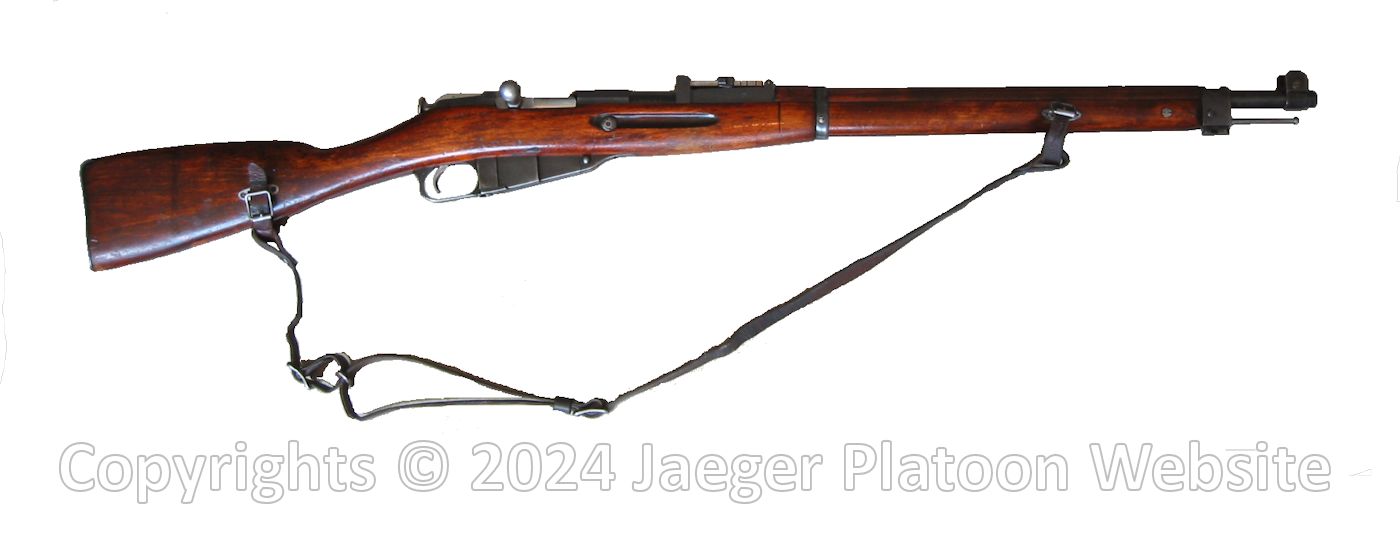
PICTURE: Military rifle M/28-30 was the last pre
World War 2 rifle model, which Civil Guard developed with SAKO. Notice rifle sling M/30, which was another
Civil Guard development, based on US rifle sling M1907 but better and used with variety of Civil Guard rifle models
in 1930's. CLICK THUMBNAIL TO SEE LARGER PIC (66 KB).
Finnish Civil Guard had also had small-bore bolt-action rifles, which it used for basic shooting practice, improvised indoor shooting ranges set up inside those Civil Guard halls which had enough space for it especially during winter months and for shooting practice of Civil Guard boy units. These small-bore rifle apparently included variety of rifle models usually chambered for .22 rimfire (.22 short and .22 long rifle), but there were also some specifically acquired by Civil Guard organization for the purpose - these included GECO rifles model 1923 and 1926 plus rifle marked as "Nalle M/37" (~" small bear M/37"), which was a rifle model, which Civil Guard had ordered from Anschutz. As a related matter at the time barrel inserts installed in barrel of Parabellum pistol and firing 4mm m/20 gallery cartridge enjoyed some popularity among guardsmen of Civil Guard and were also used for indoor shooting.

PICTURE: Guardsmen of Civil Guard with GECO small-bore rifle sometime in late 1920's.
Photographed by Bernhard Åström. Photo crop. Photo source The Society of Swedish Literature in
Finland (Svenska Litteratursällskapet i Finland), acquired via finna.fi
and used with CC BY 4.0 Creative Commons license. CLICK
THUMBNAIL TO SEE LARGER PIC (212 KB).
While rifle was the basic weapon for every guardsman, pistols were another matter. Simply put pistols hey were not something Civil Guard organization commonly acquired or issued for its guardsmen. Instead they were usually private property of guardsmen that they had bought with their own money or in some cases property of local Civil Guards, which had acquired them. Early on most common pistol models to see use with guardsmen were Mauser M/96 and Mauser M/1914. But with time pistol M/23 (Parabellum/ Luger in 7.65 x 21) became by far the most common pistol model privately acquired by guardsmen and officers. One might wonder why these specific pistols? Germany had supplied over 1,000 Mauser M/96 to Finnish White Army in 1917 - 1918 and after Civil War Finnish Army transferred remaining Mauser M/96 pistols to Civil Guard, so especially early on they were de facto the standard pistol model for Civil Guard. As to why Mauser M/1914 was so popular among guardsmen as privately purchased pistol one can only speculate - the brand was obviously well-known, the pistol was small enough for pocket carry, apparently did have rather good ergonomics, trigger and sights plus .32 ACP cartridge was commonly referred as powerful enough to be highly popular in police use and also used by number of militaries. As for Parabellum / Luger - its 7.65mm x 22 Parabellum (.30 luger) caliber version was introduced as new standard issue service pistol for Finnish military in year 1923, which is what likely made it rather obvious pistol of choice for guardsmen of Civil Guard.

PICTURE: Guardsmen in summer uniforms seen shooting
Mauser M/1914 pistols. While one of them is taking aim, another one who
holds a pistol in his hand is apparently waiting his turn. Photographed by Bernhard Åström during Civil
Guard manouvers in Hanko probably in 1920's. Photographed by Bernhard Åström Photo crop. Photo source
The Society of Swedish Literature in Finland (Svenska Litteratursällskapet i Finland), acquired via
finna.fi and used with CC
BY 4.0 Creative Commons license. CLICK THUMBNAIL TO SEE LARGER PIC (233 KB).
Civil Guard organization did not really spent money acquiring pistols in any real numbers before World War 2. Instead as noted, the pistols used by its guardsmen were mainly privately purchased by its guardsmen and hence their private property, although some inventory of their pistols have survived - likely due to firearms permit system of the time. Finnish legislation required firearms permit for each firearm. Generally firearm permits were handled by Finnish Police, but there were two national organizations who had legal rights for providing firearm permits for their people - Armed Forces and Civil Guard. Hence for guardsmen to have firearm permits for their privately acquired firearms licensed by Civil Guard was common at the time.

PICTURE: Pistol shooting competition of Finnish Civil Guard at year 1931. Shooting position
seen here was the standard done for pistols at the time. Pistol was gripped with one hand only, while second
hand was placed either to hip or in waist pocket to stabilise shooting position. As to be expected all pistols
visible are Parabellums / Lugers. Photographed by Pietinen. Photo source
Finnish Heritage Agency (Museovirasto), acquired via finna.fi and used with
CC BY 4.0 Creative Commons license. CLICK THUMBNAIL
TO SEE LARGER PIC (191 KB).
Submachine guns also had in Civil Guard a status that differed from rifles and pistols. They were far less common, but were considerable financial investment of Civil Guard organization for short-range firepower in age when submachine guns had not yet become popular with armed forces. Finnish Civil Guard was world-wide among first military organizations to widely adopt submachine guns with Bergmann submachine gun being introduced in year 1922 and in total it acquired 1,415 Bergmann submachine guns by year 1932. Admitted this early adaptation of submachine gun have been partially related to sort of para-military role of Civil Guard, with submachine gun being generally often seen at the time as police weapon, while universally wide-scale military adoptation happened only later on. During mobilization for Winter War in year 1939 Bergmann submachine guns were transferred to Field Army. At late 1920's Civil Guard also acquired small number of Suomi M/26 and then in early 1930's settled as Suomi M/31 submachine gun as its new standard submachine gun to be purchased from that on, but acquired it in only rather limited number before Winter War. 30th of September 1939, mere two month before Winter War, Civil Guard small arms inventory contained only 25 Suomi M/26 and 20 Suomi M/31 - and earlier mentioned 1,415 Bergmann submachine guns. When Winter War started in 31st of November 1939 Finnish Army had only about 4,000 Suomi M/31 submachine guns in its inventory, so Bergmann submachine guns transferred from Civil Guard proved highly useful at that point.

PICTURE: 7,65 mm Bergmann M/20 submachine gun and its 50-round box magazine. (Photo taken in
Sotamuseo). CLICK THUMBNAIL TO SEE LARGER PIC (65 KB).
Unlike submachine guns grand majority machine guns, along all heavy weapons such as mortars and field artillery pieces were loaned from Armed Forces. Madsen M/20 and Lahti-Saloranta M/26 light machine guns appear to have been rare in use of Civil Guard and were practically all guns loaned from Finnish Army. Along them Civil Guard had in its use number of more miscellaneous light machineguns, which Army had transferred to it early on - most significant of these were 62 Lewis guns and at most about 20 Chauchat M/15 light machine guns. Machine guns commonly used by Civil Guard organization included mainly various models of Russian Maxim guns and number of Colt M/1895, which mostly saw use with Civil Guard Navy. German 76mm mine throwers and 81mm mortars loaned from Army were used in Civil Guard training in 1930's.

PICTURE: Messukylä Civil Guard seen practicing with 81mm
mortar in year 1938. Photographed by E.M. Staf. Photo crop. Photo source Historical Museums of Tampere
(Tampereen historialliset museot), acquired via Siiri
and used with CC BY 4.0 Creative Commons license.
CLICK THUMBNAIL TO SEE LARGER PIC (219 KB).
Rules used in early Civil Guard shooting competitions can sound bit odd to shooters of this day. Hits were measured as centimeters from the center of the target, and sighting in shots or using rifle slings for support was forbidden. Some guardsmen who had the money and wanted better rifle for their shooting purposes bought new (usually 7 x 57 or 6.5 x 55 caliber) Mauser rifles at their own expense. Because often Japanese and Mosin-Nagant rifles M/91 of Civil Guard and their ammunition were less than satisfactory quality early on, special handicap system was introduced for them. The handicap system basically worked like this: Shooters using Japanese rifle got 5% compensation and shooters using Mosin-Nagant M/91 rifle got 10% compensation, while those who used Mauser rifle did not get any compensation. In a way the compensation system did not always work as perceived. Many of the most successful shooters found their competitive edge and took trophies using self-loaded ammunition with Mosin-Nagant M/91 rifles. Work made for shooting sports and marksmanship paid off Civil Guards soon had the best shooters in Finland. When it comes to the overall plan of shooting training in Civil Guard organization, in principle it was to put emphasis on military shooting (fast and precise shooting at various distances), but in reality the emphasis remained on sports shooting (target-shooting accurately from pre-known distance).

PICTURE: Shooting shed in rifle range of Nurmes Civil Guard sometime in 1930's. This was one
of the proper 300 meter rifle ranges built by Civil Guards with the butts build from concrete, 150 meter rampart,
shooting shed seen here and even shooting pavilion (small house) near the shooting shed. Photographed by
Väinö Hämäläinen. Photo source Museum of Nurmes (Nurmeksen museo), acquired via
finna.fi and used with CC
BY 4.0 Creative Commons license. CLICK THUMBNAIL TO SEE LARGER PIC (122 KB).
To practice shooting in addition of guns and ammunition also location where to shoot is needed. When gaining independence Finland had only small number of shooting ranges, hence Civil Guards had to took it as their task to build shooting ranges, as not having a place where to practice with their rifles was utmost priority. Year 1930 Civil Guards reported to General Headquarters of having in their disposal total of 962 shooting ranges, which at the time was about 1.5 times the total number of local Civil Guards. But in reality quality of these shooting ranges varied considerably, about half of them were small shooting ranges established in rural villages and used by guardsmen of particular village, which often had little more than open batch of land large enough for rifle shooting from reasonable distance and hill-side to be used backstop. At that time (year 1930) 288 ranges, in other words less than third of those 962 shooting ranges had the butts (näyttösuoja) typical to military rifle range of the time with underground shelter for raising or lowering targets and showing hits. Gradually shooting range situation got better with Civil Guards improving their existing shooting ranges and also by building some new ranges. By year 1934 the total number of proper shooting ranges equipped with shooting shed and the butts had climbed to 486 and in year 1937 it reached 638 total either being built or in process of being built. Year 1938 Civil Guard had in total 734 proper 300 meter rifle ranges equipped with shooting shed and the butts. Especially early on Civil Guard shooting ranges were usually built with voluntary work, but larger and better equipped the shooting range with backstop, ramparts and possible berms requiring major earth moving work and the butts commonly being made from concrete, building them often required use of outside contractors. Starting year 1935 General Headquarters of Civil Guard provided some funding for Civil Guard Districts to assist building of shooting ranges. The number of Civil Guard organized shooting competitions and their participants skyrocketed starting the 1920's. One of the goals of Civil Guard organization was making shooting one the widely popular sports and one could say it succeeded to a large extent. Unfortunately from the hundreds of shooting ranges once built by Civil Guards, very little have survived to this day.

PICTURE: The butts of Malmi shooting range near their completion. Malmi shooting range in
Helsinki was maybe the best known shooting range built by Civil Guard. It was built for World Shooting
Championships of year 1937 and remained in use until late 1960's - early 1970's until settlements surrounded
and finally swallowed it. What remained from its buildings were demolished after year 1993 and nothing remains
of them now. Photographer unknown. Photo source The Hunting Museum of Finland (Suomen metsästysmuseo),
acquired via finna.fi and used with
CC BY 4.0 Creative Commons license. CLICK THUMBNAIL
TO SEE LARGER PIC (133 KB).
Civil Guard and sports
The reason why Civil Guard organization supported sports was quite simple: Physically fit people make better soldiers and, in general, wide spread sports which maintain fitness have positive effects on a community. For this purpose it concentrated to few key sports. Likely the most far-reaching effect of these sports was introducing pesäpallo (basically Finnish version of baseball, main developer of this sport was Civil Guard officer Lauri "Tahko" Pihkala) in year 1922 and successfully popularizing and it in such manner, that it still nowadays is the Finnish national sport. For Civil Guard organization popularizing pesäpallo had purposes beyond developing physical fitness and team spirit: Fast short spurts and dashes plus throwing a ball with approximate size of egg hand grenade also useful physical practice for war.

PICTURE: Game of pesäpallo played by Civil Guard in Hesperianpuisto Park in
Helsinki at year 1934. Finlandia Hall was later built in place of this ballpark. Photographed by Pietinen.
Photo source Finnish Heritage Agency (Museovirasto), acquired via finna.fi
and used with CC BY 4.0 Creative Commons license.
CLICK THUMBNAIL TO SEE LARGER PIC (196 KB).
The most important sports for Civil Guard were cross-country ski, field & track sports (triathlon in particular) and (obviously) pesäpallo with gymnastics also being popular and often used as routine in public evens. From these, cross-country ski slowly became the most important individual sport for Civil Guards. In fact, Civil Guard organization even developed of new kind of cross-country ski design (which was adopted as standard military ski design for Finnish military), which was better suited for forests than traditional Finnish skis. While these sports were well-suited for soldiers, in 1930's Civil guard's sports found even more fitting and militant choice as military pentathlon (hurdles, grenade throwing, bayonet fighting, combat shooting and digging in) gained popularity over other sports.

PICTURE: Guardsmen of Civil Guard on skis. Photographed by unknown photographer probably in 1920's considering all seem to be wearing uniforms m/22. There appears to be very little snow in the ground. (Original photograph part of Jaeger Platoon Website photo collection. Unlicensed use of photograph prohibited). CLICK THUMBNAIL TO SEE LARGER PIC (188 KB).
Civil Guard also started rewarding its best shooters and the most fit members with fitness badges in 1921. CG fitness badges were issued in three classes and naturally getting the 1st class badge demanded most fitness. One could way say that Civil Guard organization was the most important sports organization in Finland before World War 2 with number of its guardsmen being far beyond the total membership numbers of other national Finnish sports organizations, although one could question how many of the guardsmen were actively taking part to its sport activities. Another area in which Civil Guard played long-term role in Finnish sports scene was building sports fields, with huge number of sports fields build by local Civil Guards either alone or with local sport clubs. Number of the sports fields built by Civil Guard ended up serving local communities for decades and many of them are apparently still in regular use, although with later modifications.

PICTURE: Three examples of Civil Guard fitness badges. There were three classes of these badges and they existed in two patterns. Original pattern was introduced in year 1921 and replaced with new pattern in year 1934. From left to right pattern 1921 3rd class, pattern 1921 1st class with (either gold-plated or bronze-plated) ski fitness ring attached around it and pattern 1934 2nd class. (Copyrights (c) 2025 Jaeger Platoon Website. Unlicensed use of photograph prohibited). CLICK THUMBNAIL TO SEE LARGER PIC (119 KB).