


LIGHT MACHINE GUNS PART 1:
Lahti-Saloranta, DP and DT
7,62 mm Lahti-Saloranta M/26:

PICTURE: Lahti-Saloranta M/26 LMG. This particular weapon is late version, as it
has tube-like cocking handle. (Photo taken in Sotamuseo). CLICK THUMBNAIL TO SEE LARGER PIC (15 KB).
|
Calibre: |
7,62 mm x 54 R |
||
|
Length: |
1180 mm |
||
|
Barrel length: |
500 mm |
||
|
Weight: |
9,3 kg |
||
|
Fire-rate: |
450 - 550/minute |
||
|
Magazine: |
arch-shaped box: 20 |
||
|
Official abbreviations: |
"7,62 pk/26" and "762 PK 26" |
||
|
Country of origin: |
Finland |
||
|
Prototype: |
1925 |
||
|
Production: |
1930 - 1942 |
Finnish use: Used by Finnish frontline troops during World War 2. Finnish standard light machine gun during World War 2. But during Continuation War (1941 - 1944) number of captured M/27 Degtjarev light machine guns used by Finnish Army grew much larger than the number of Lahti-Saloranta.
After Aimo Lahti had developed M/22 submachine gun (prototype of Suomi M/26 submachine gun) General Heinricks suggested him designing light machine gun. Lahti got to work and the first blueprints were ready before end of 1923. October of 1924 a committee was named for choosing a new light machine gun for Finnish military. Another friend of Lahti, Hägglund, suggested adding Lahti's light machine gun among weapons it would test. After this Lahti received orders to continue development work of his light machine gun design in Weapons Depot 1 (AV 1, in Helsinki) and (as he had no engineering degree) technical expert was sent to assist him. The technical expert was Lieutenant A. E. Saloranta, who had just returned from weapons-technical course held in Denmark. The first prototype was made between June and August of 1925 in Weapons Depot 1 (AV1) in Helsinki. It was in 7.92-mm calibre and used recoil-action (with short barrel-recoil) already used in older Chauchat and Madsen light machine guns.
First testing done during this had included nine foreign designs, from these Colt-Browning was evaluated to be the best. However as many of the weapons were in some other calibre than 7.62 mm x 54 R (which had been decided as standard rifle calibre for Finnish military already earlier) new tests with only weapons in this calibre were required. A new prototype of Lahti-Saloranta light machine guns was made in 7.62 mm x 54 R and it participated to the new tests. It won the new tests while Vickers-Berthier came second, Hotchkiss third and Colt-Browning forth. However some improvements still had to be done before mass-production and Lahti made them immediately after the tests. After this additional two new Lahti-Saloranta test weapons were made and tested.

PICTURE: Magazine pouch for Lahti-Saloranta M/26 in use. Photographed by Private K. Kivi in
August of 1941. (SA-kuva.fi photo archive, photo number 30084). CLICK THUMBNAIL TO SEE LARGER PIC (197 KB).
As mentioned Lahti-Saloranta M/26 was recoil-action weapon using short barrel-recoil. As usual to light machine guns it is equipped with a folding bipod. The gun also had flash hider, which was very much needed as it has relatively short 50-cm (20-inch) barrel. This light machine gun is select fire, meaning it is capable for both semiautomatic and full-automatic fire. Spent cartridge cases are ejected to the right. Barrel has quick-change capacity, which allows it to be replaced in some 25 - 30 seconds. The rear sight is fully adjustable and has settings 3 - 15 (300 - 1,500 meters). Safety switch is located in front part of the trigger guard. Selector switch is located right in front of it and has two settings: Front for full-automatic and rear for semiautomatic fire. With Lahti-Saloranta light machine gun its crew received variety of tools and spare parts (including spare barrel and bolt combination) packed to leather pouches. However maybe the most important of these tools were loading tools - without loading tool filling the magazines of this weapon even close to full capacity is notably difficult because of really strong magazine springs. The gun uses 20-round arch-shaped box-magazines, which were inserted into magazine well, which is in bottom of receiver. During Winter War and early Continuation War as many as 90 magazines were to be issued for each of these light machine guns, but as to be expected these were quite a burden for the whole squad (most of the Lahti-Saloranta magazines were to be carried in eight magazine bags made from canvas). Typically Finnish light machine gunner and/or his assistant usually carried two magazine pouches which each contained five magazines, while other soldiers of their squad carried magazine bags, which contained ten magazines each. Finnish military had two loading tool versions for Lahti-Saloranta magazines. The larger version had bulk and needed to be attached to tree trunk for using it, but it was also very effective. The smaller version was small enough to fit palm of a hand, but it was not quite as fast to use as the larger version.

PICTURE: Magazine bag for Lahti-Saloranta M/26
light machine gun. Each of these bags contained ten 20-round magazines. During Winter War eight of these bags
were to be issued to each light machine gun squad, which had Lahti-Saloranta light machine gun. (Photograph provided
by Lemmy). CLICK THUMBNAIL TO SEE LARGER PIC (106 KB).
Although, it must be noted that at least early on Finnish soldiers probably did not have very large need to start reloading Lahti-Saloranta magazines during firefight. Originally Finnish Army issued each Lahti-Saloranta M/26 with no less than 90 magazines per weapon - in other words Winter War era light machine gun squad (of seven men) were to carry whopping 1,800 rounds loaded in its magazines. Machine gunner and his assistant were to carry 10 magazines in two magazine pouches, spare parts and tools, while four other soldiers of the squad carried the remaining 80 magazines in eight magazine bags. Needless to say all these magazines burdened the squad to manner, which limited its usefullness in any other role and de facto resulted the whole squad being formed around the light machine gun. While the official number of magazines issued per weapon seems to have remained unchanged, if issued with Lahti-Saloranta, in reality Continuation War era rifle squad seem to have typically carried much smaller number of magazines with them.

PICTURE: Two magazine pouches for Lahti-Saloranta M/26 light machine gun shown from different sides
(front and back). Each of these pouches contained five 20-round magazines and the soldier with Lahti-Saloranta carried
one or two of these pouches. If he carried one his assistant usually had the second magazine pouch. (Photograph provided by
Lemmy). CLICK THUMBNAIL TO SEE LARGER PIC (141 KB).
There was obvious need for also Finnish Civil Guard (Suojeluskunta) to be able to train its guardsmen to use the new light machine gun. Lahti-Saloranta was a not a cheap weapon, but thanks to new mobilization system turning Civil Guard into training organization for reservist volunteers, Civil Guard had opportunity of loaning equipment from Finnish Army. Opportunity which it frequently used to loan heavy weapons, which it would have otherwise not been able to acquire with its limited financial resources. Earlier Civil Guard had been equipped with few dozen light machine guns total (such as Lewis and Chauchat, which Army had transferred to its use among other mixed automatic weapons circa 1919 - 1921, but year 1931 Finnish Army decided to start loaning Lahti-Saloranta light machine guns to Civil Guard. The first loaned batch received in year 1931 was just four guns, but it was followed by 2nd batch of 28 guns and 3rd of 50 guns - both of them in year 1932. By end of year 1933 Civil Guard had had total 320 Lahti-Saloranta M/26 loaned from the Army. The total number of loaned guns continued to climb also after that and by September of 1939 had climbed to 670 guns.

PICTURE: Spare barrel holster for Lahti-Saloranta M/26 light machine gun and its contents.
Below the spare barrel holster from top to bottom are: Cleaning rod, spare main recoil spring and spare barrel with
bolt combination. One of these spare barrel holsters with this contents was routinely issued with each
Lahti-Saloranta light machine gun. (Photograph provided by Lemmy). CLICK THUMBNAIL TO SEE LARGER PIC (89 KB).
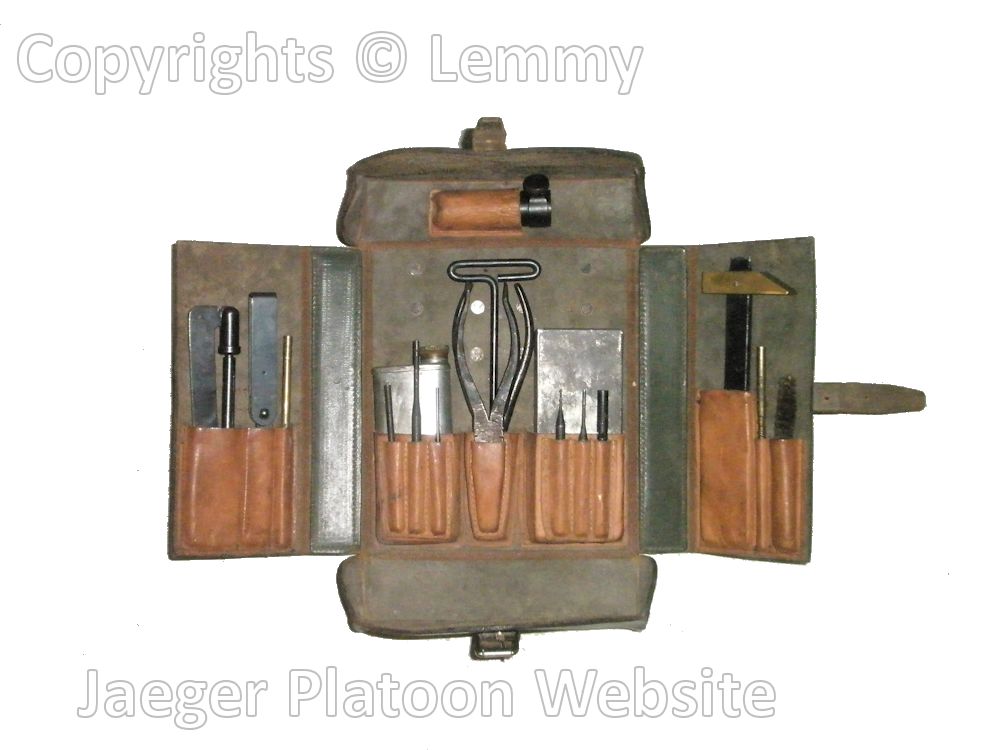
PICTURE: Tool pouch for Lahti-Saloranta M/26 light machine opened up to show its contents.
(Photograph provided by Lemmy). CLICK THUMBNAIL TO SEE LARGER PIC (89 KB).
VKT ("Valtion Kivääritehdas" = State Rifle Factory) was established and build to city of Jyväskylä in Central Finland for the purpose of producing small-arms to Finnish Army. The production in VKT started in year 1928 and Lahti-Saloranta M/26 light machine gun become the first weapon manufactured there. The first order was for Lahti-Saloranta light machine gun was for 200 weapons. For starting production A.E. Saloranta was sent to lead production of this new light machine gun in VKT at 1927. However starting of production had serious problems - the first light machine guns were not finished until February of 1929 and by end of March only 20 light machine guns had been made. Because of these delays a committee was sent to inspect and approve the first just manufactured weapons from this factory, but a scandal followed. The Committee arrived to Jyväskylä in 3rd of April 1929 and soon found that Saloranta had made several unauthorised changes to light machine gun blueprints - the newly made light machine guns were now different than the ones accepted to production and could not be approved. Saloranta was released from his duties and moved to much lower profile mission of leading Gunsmith School. Engineer K. Veltheim was ordered as new manager of VKT and Aimo Lahti was permanently ordered to supervise production of the Lahti-Saloranta light machine gun starting 17th of July 1929.
The parts modified by A.E. Saloranta in VKT without authorisation:
Saloranta claimed that he had made the unauthorised modifications to the design to improve its reliability, but the committee considered that because of these modifications the gun was no longer the same, which had been earlier approved for production. 4th of April 1929 the committee took part in test firing of the completed Lahti-Saloranta light machine guns in shooting range of the factory and the test results were anything but favourable. The tested light machine guns jammed constantly. Their extractors had been heat-treated improperly and were breaking all the time. In addition this many of the springs used in the weapons were poor quality and their magazines jammed often. Basically the test results suggested that whole production of Lahti-Saloranta light machine guns that far had failed quality-wise.

PICTURE: Closer look showing receiver area of Lahti-Saloranta M/26. Again this weapon is the late
version, as it has tubular cocking handle (A). Text in side of the receiver reads "VALTION KIVÄÄRITEHDAS
Jyväskylä" (State Rifle Factory, city of Jyväskylä). The most important switches in the weapon:
B - safety switch, C - fire selector switch, D - magazine release. CLICK THUMBNAIL TO SEE LARGER PIC (111 KB).
Changes made by Saloranta had also caused more problems and delays in starting of production, as his unauthorised changes demanded all blueprints and tools to be rechecked. Partly due to this the first production run of 200 guns was not finished until year 1930. Slowly the production started picking up speed. By autumn of 1939 about 4,000 Lahti-Saloranta light machine guns had been produced for Finnish Armed Forces. No Lahti-Saloranta were delivered for the Army in 1940 - 1941. The last production run of 500 guns was finished in summer of 1942. June of 1942 Finnish Army had some 4,600 Lahti-Saloranta M/26 light machine guns and the numbers did not climb much from that. During first days June 1944 their total number was about 4,760 guns. Quite a few light machine guns were lost in battles of summer 1944 and the hard combat use took its toll, so in August of 1951 only 3,377 guns remained. After World War 2 Lahti-Saloranta M/26 light machine guns remained mothballed until year 1985. Early 1990's most of the remaining guns were scrapped and some sold to collectors.

PICTURE: Lahti-Saloranta M/26 light machine gun. Notice bipod and shooting position with
weak hand placed under the gun's butt. Machinegunner's assistant with rifle on the left. Photographed by Private K.
Kivi in August of 1941. (SA-kuva.fi photo archive, photograph number 30082). CLICK THUMBNAIL TO SEE LARGER PIC (244 KB).
During the war Lahti-Saloranta M/26 gained very poor reputation among Finnish soldiers, who gave it nickname "accumulated malfunctions model 26". The opinion of Aimo Lahti was the main reason for malfunctions was soldiers lacking instructions for cleaning the storage grease properly from the guns. In this regard the main problem seems to have been recoil spring package inside butt of the weapon - disassembling of which had been specifically forbidden for normal soldiers. In theory specially trained ordnance personnel should have disassembled this part and carefully cleaned storage grease from there before the light machine guns were sent to military units in mobilisation, but in reality large number of Lahti-Saloranta seem to have been issued to soldiers without removal of storage grease from recoil spring package. How much of the Lahti-Saloranta's very poor reputation was caused by this or was simple exaggeration? The matter can be debated, but besides storage grease also other reasons for the poor reliability seem to have existed. The consensus seems to be that the weapon had also been build with too tight tolerances to begin with, which made it prone to jam. The 20-round magazine capacity also proved too small. When Lahti-Saloranta was also heavy and expensive to manufacture its lack of its popularity is not surprising. Only significant positive characteristic of M/26 light machine gun seems to have been its shooting accuracy, which was exceptionally good. In theory light machine gun M/26 could be fired from the hip or even from the shoulder, but typically it was used supported by the bipod. The weapon is simply too heavily and its muzzle climb too powerful, if fired from the shoulder. Shooting from hip seems to have worked (even if it requires some physical strength from the user due to weight of the weapon) relatively well, but when used this way aiming the fire was problematic was difficult to say the least.

PICTURE: Lahti-Saloranta light machine guns being cleaned. The two soldiers in the photo
each have a disassembled light machine gun that they are working with. Soldier on the left has barrel-bolt
combination in his hands. Photographed by Military official J. Taube in June of 1942.(SA-kuva.fi photo archive,
photograph number 91334). CLICK THUMBNAIL TO SEE LARGER PIC (390 KB).
Report sent by (Carelian) Isthmus (Army) Group (Kannaksen Ryhmä) in 11th of January 1940 about combat experience with various infantry weapons reported about Lahti-Saloranta M/26:
"The gun had proved not so good. Often it functions unreliably and requires as its user especially experienced soldier, which is often not particularly easy to find among Field Army. No more than 12 - 15 rounds can be loaded into magazine, if one wishes it to work reliably. Due to this magazine changes are frequent, which in critical (combat) situation can prove fatal. Frequent magazine changes also easily nerve the shooter and reduce accuracy of his fire. Using the gun's sights while wearing a gas-mask is practically impossible."
Even if Lahti-Saloranta M/26 gained poor reputation during the war, there were not enough captured Degtjarev M/27 to replace it, hence Lahti-Saloranta continued to serve along its side for rest of World War 2. It was issued to frontline infantry, hence as noted combat losses were quite high. In post-war era it remained in training use until late 1970's and continued to be included to small arms manuals of Finnish Defence Forces at least until 1980's. Although it seems that it may have been placed in somewhat of a secondary role for most of its post-war training era role. Still, the remaining inventory of Lahti-Saloranta remained mothballed for possible wartime use until late 1980's.

PICTURE: Lahti-Saloranta M/26 light machine gun. This is early production run variant of the gun.
Gripping the magazine with weak hand is another shooting position often seen in period photos. Soldier in this photo
has summer tunic M/36 and Hungarian m/38 helmet. Photographed by Military official V. Hollming in July of 1942.
(SA-kuva.fi photo archive, photograph number 97492). CLICK THUMBNAIL TO SEE LARGER PIC (102 KB).
Finland also offering Lahti-Saloranta light machine guns for export, but with little success. Prototypes were designed in variety of calibre options for this purpose. In fact Lahti-Saloranta light machine gun was advertised abroad as gun, which could be very easily modified from one calibre to another. But ultimately the only export deal which the Finns succeeded obtaining for it was for 30,000 M/26/32 light machine guns in calibre 7.92mm x 57 JS ordered to China. This was also the only significant export deal for small arms that Finnish industry got before World War 2 and would have had considerable financial influence to VKT (the manufacturer), if it would have gone through. But Japanese succeeded diplomatically pressuring the Finns and the deal was cancelled. Because of this only the first delivery batch of 1,200 Lahti-Saloranta light machine guns was delivered to China in year 1937 before the deal had to be annulled. Being improved version of light machine gun M/26-31, those light machine guns M/26/32 supplied to China were capable of using also both 75-round pan magazines and 20-round box magazines.
Lahti-Saloranta M/26-31 was version of M/26 designed to be able to use also 75-round pan magazines developed by Lahti. While the gun model was developed in VKT for Finnish military, Finnish Armed Forces were not interested about this new version. So the first test series of 50 guns also ended up being the last production series of M/26-31. Later even this small series M/26-31 was modified to work with standard 20-round box magazine only. In addition also total number of 30 light machine guns M/26/32 ended up to use of Finnish military. Those 30 guns had been left behind on the factory and during Winter War they were built as 7.62mm x 54R caliber guns, set up to use only 20-round box magazines with their magazine adapters permanently attached to the guns, which were then supplies to Finnish Armed Forces. It is rather ironic that the photo often used for Lahti-Saloranta M/26 light machine gun in non-Finnish publications often shows not standard issue M/26, but short-lived M/26-31 or M/26/32, which can be easily recognised from 75-round pan magazine. It is noteworthy that Aimo Lahti also used and further improved the same 75-round pan magazine design for many of his aircraft and anti-aircraft machine gun designs.

PICTURE: Two Finnish soldiers photographed in middle of using loading tool for loading
Lahti-Saloranta M/26 light machine gun with ammunition. Photographed by TK Uomola in November of 1941. Both
soldiers are wearing snow camo clothing and have ammunition bandoliers. Soldier that feed cartridges into loading
tool has infantry rifle M/27 on his back. The soldier has what is probably
Martiini Lynx-series puukko-knife hanging from his belt. Also partially visible the photo are tips of barrel for
Degtjarev M/27 light machine gun and what is likely
infantry rifle M/91. (SA-kuva.fi photo archive, photograph number 64416).
CLICK THUMBNAIL TO SEE LARGER PIC (180 KB).

PICTURE: Large version of the loading tool for loading Lahti-Saloranta M/26 magazines. Due to
very strong magazine spring loading Lahti-Saloranta 20-round magazines to full capacity is difficult with proper
loading tool. Magazine was inserted from below, ammunition added from the top and then the handle was cranked
manually. (Photo provided by Lemmy). CLICK THUMBNAIL TO SEE LARGER PIC (138 KB).
Writer's personal (limited) experiences concerning shooting with two individual Lahti-Saloranta M/26 light machine guns: Firsti time I was surprised how little I enjoyed shooting with this weapon in the first time. Second time it went quite a bit better, but still my experience did not exactly fill me with trust to its capabilies. When compared to modern military weapons Lahti-Saloranta M/26 did not do too well. The ergonomics seem somewhat clumsy, the bipod felt quite flimsy and single stage trigger proved very heavy. The bipod seems to move all over the place and getting the gun stable support on it is somewhat difficult. Leaving the weapon unattended on the bipod also does not guarantee that the weapon does not fall to its either side - the bipod is not stable enough to support it alone. The sights are the normal open sights configuration and the rear sight has wide U-notch, which works quite well. Changing magazine is easy. Cocking the gun requires not just pulling the cocking arm back , but also returning it forward. Having two important switches close to each other (safety switch and selector switch) does not exactly impress me after years of experience with weapons that had only one switch for both of these functions. This light machine gun may have repution for providing accurate fire, but its recoil is surprisingly strong and sharp considering weight of the gun. Shooting from a trench (standing on trench while weapon was on its bipod on side of the trench) was not too easy, but when shooting from prone position the recoil was much more controllable. After about 400 - 450 rounds (fired without cleaning) the first gun started jamming repeatedly - it failed removing cartridge cases and new cartridges started turning cartridges sideways while it was trying to feed them into the chamber. Shortly said Lahti-Saloranta did not inspire too much confidence.
7,62 mm light machine gun M/27 Degtjarev "Emma":
(Pulemet Degtjareva Pehotnyj - DP)

PICTURE: Degtjarev M/27 light machine gun Finnish style. All these weapons had been captured
from Soviet military during World War, but this individual weapon had been equipped with Finnish-manufactured
butt and universal issue gun sling. Also spare magazines are Finnish-made, while origin of magazine carrier
remains uncertain. Finnish-manufactured gun butt was replacement part produced for this gun and used as spare part, but most guns
retained their original Soviet gun butts. CLICK THUMBNAIL TO SEE LARGER PIC (116 KB).
|
Calibre: |
7,62 mm x 54 R |
||
|
Length: |
1270 mm |
||
|
Barrel length: |
605 mm |
||
|
Weight: |
9,1 kg (includes bipod) |
||
|
Fire-rate: |
500 - 600/minute |
||
|
Magazine: |
plate-shaped pan magazine: 47 |
||
|
Official abbreviations: |
"7,62 pk/ven." and "762 PK D" |
||
|
Country of origin: |
Soviet Union |
||
|
Prototype: |
1923 |
||
|
Production: |
1928 - 1944 |
Finnish use: Finnish military captured some 8,400 of these light machine guns during Winter War and Continuation War. During Continuation War Degtjarev m/27 became the most common light machine gun in use of Finnish front-line troops.
Also Soviet military noticed that Maxim machine gun was often too heavy for offensive use. They had some captured foreign light machine guns, but too few in number and acquiring spare parts for them was not exactly easy. So in 1920's they decided to do something about this. The first light machine gun the Soviets introduced was Maxim-Tokarev designed by F.V. Tokarev (who later designed also TT-33 pistol and SVT-38, SVT-40 and AVT-40 rifles). As the name suggests Maxim-Tokarev was basically lightened version of Maxim-machine gun modified somewhat in somewhat easier to transport form in the same spirit as German MG-08/15 and MG-08/18 machine guns. But just like MG-08/15 and MG-08/18 it served only temporary solution at best. Hence only 2,450 Maxim-Tokarev light machine guns were manufactured before its production ended in year 1927.
The weapon that replaced Maxim Tokarev was Degtjarev light machine gun, whose development Vasili Degtjarev had started in year 1923. Degtjarev's weapon had showed great potential already in tests made in summer of 1924, but at that point the design was still very much in need of further development. Further testing performed in September and November of year 1926 also revealed some problems, which needed for resolved. When tests for selecting light machine gun for Soviet Red Army were performed in January of 1927 the Detgjarev's light machine gun proved very good, but still the Soviets decided to improve the design before introducing it to production. Testing continued in summer and spring of 1927 with Degtjarev's light machine gun excelling in them - especially so when it came to reliability. Developing of the weapon still continued during these tests and the last improvement (reinforced bolt carrier) was not introduced to the design until October of 1927, when manufacturing the first field test series of 100 weapons had already begun. In fact the test results were so favourable that the Soviets decided to start mass-production in Kovrov Arsenal already, when the field testing was still unfinished. Manufacturing of DP (= Degtjareva Pehotnyj = Degtjarev of infantry) started in year 1928 and continued until improved version called DPM replaced it in production. It can be noted that the in case of DP light machine gun the long development history succeeded producing a highly successful machine gun - or a a family of machine guns to be more exact.

PICTURE: Degtjarev M/27 light machine gun. This individual gun has original Soviet gun butt, gun sling
and magazine. (Photographed by JTV for Jaeger Platoon Website). CLICK THUMBNAIL TO SEE LARGER PIC (85 KB).
DP light machine gun is full-auto only gas-action weapon with gas-piston. It has a flap-locking bolt. The barrel used in it is not really a quick-swap design, but it can be replaced quite easily in the field when necessary, although the typical Soviet issued equipment kit does not seem to have included spare barrel. Amount of gas going to gas-piston could be adjusted with gas-regulator. Both front and rear sights are adjustable. Front sight has height-adjustable front sight post and front sight base has horizontal adjustment - hence front sight adjustments are used for zeroing in the gun. Rear sight has tangent with range settings of 1 - 15 (for 100 - 1,500 meters). The only safety switch in this weapon is located behind trigger guard and blocks movement of trigger unless being pressed down along the trigger. Magazine release switch is located to base of rear sight. The gun uses 47-round pan magazine placed on top of receiver. The magazine is single layer pan magazine design, which weights 1,6-kg empty and 2,8-kg fully loaded.

PICTURE: Carrying of pan magazines for Degtjarev M/27 was difficult. This young machine gunner has
suspiciously full and heavy looking bread bag attached to his belt -
chances are he may have had some spare magazines in it. Photographer Military official P. Jänis in August of 1944.
(SA-kuva.fi photo archive, photo number 156792). CLICK THUMBNAIL TO SEE LARGER PIC (159 KB).
Due to their size (almost 27 cm / 11 inches in diameter) and shape carrying of 47-round pan magazines was not easy. The Soviets had solved the problem by equipping the gun with magazine containers made from sheet metal. The containers were built to carry three magazines each and have either leather or canvas carry handle providing a decent grip, but no other way for carrying it. Normally Finnish Army issued each of these guns with two magazine containers (made from sheet metal) - so either six or 9 magazines - with total loaded ammunition capacity of 282 or 423 rounds. Year 1943 the official number of issued magazines was six for each gun. In addition to these the Soviets could also carry the magazines in purpose-built canvas bags, which they started issuing at some point. Along the magazines Finnish soldiers were usually issued with two or three captured Soviet magazine containers, or Finnish-made copies of the container. These magazine containers made from sheet metal were bulky and could only be carried in hand - so they were normally carried by machine gunner's assistant(s) and did not offer machine gunner any option of carrying spare magazine or two in his person. Hence it is not a surprise, that Finnish soldiers also used variety of suitable issued bags for carrying pan magazines of Degtjarev M/27. These suitable issued bags include magazine bag for Lahti-Saloranta M/26, large gas mask bag and bread bag. Other equipment typically issued by Finnish military with each gun included two spare barrels and box, which contained tools.

PICTURE: Group of Finnish Army soldiers photographed in July of 1941. Machine gunner on the left
has Degtjarev M/27 and carries spare magazine for it in his belt. Soldiers in the middle have rifles with soldier in
the centre of photo having ammunition bandolier across his chest. Soldier on
the right has Suomi M/31 sub machine gun and its drum mags. Notice also
canteens carried in belts. Photographed by Hedenstöm.
(SA-kuva.fi photo archive, photo number 26172). CLICK THUMBNAIL TO SEE LARGER PIC (169 KB).
The Soviets made minor changes to DP light machine guns during production and they manufactured also several sub-versions designed for use in aircraft (DA, DA-2), armoured vehicles (DT) and as antiaircraft-weapons. The DPM light machine gun, which replaced DP in production was officially accepted to use of Soviet Red Army in late August of 1944. Later on DPM was replaced in Soviet use with RP-46, which is basically belt-fed version of DPM light machine gun equipped with heavier barrel. Starting from early 1960's PK light machine gun replaced both DPM and RP-46 in Soviet use. The total production of guns belonging to this family of machine guns (DP, DT, DA, DPM, DTM and RP-46) in Soviet Union was almost 800,000 guns. Kovrov Arsenal in Soviet Union was the sole manufacturer or DP light machine guns, while copies of DPM were manufactured also in China (as Type 53) and copies of RP-46 in China (Type 58) and North Korea (Type 64). While DPM and RP-46 are obsolescent, they have still recently seen use in variety of conflicts in places like Afghanistan and Ukraine.

PICTURE: Finnish soldier who is wearing snow camo suit test fires captured Degtjarev light
machine gun in February of 1940. Photographed in Impilahti (in northern shore of Lake Laatokka / Ladoga) by
unknown photographer in February of 1940.(SA-kuva.fi photo archive, photo number 3912). CLICK THUMBNAIL TO
SEE LARGER PIC (89 KB).
Finnish troops captured over 3,400 Degtjarev M/27 light machine guns during Winter War and during Continuation War some 5,000 additional guns were captured. Grand majority of the guns captured during Continuation War were captured in year 1941. Finnish troops started taking captured Degtjarev M/27 to their own use already during beginning of Winter War and continued to do so through World War 2. In addition repair for damaged captured guns was organized early on with State Rifle Factory (Valtion Kivääritehdas / VKT) serving as their repair facility. This being the situation Degtjarev light machine gun ended up outnumbering Lahti-Saloranta light machine gun in use of Finnish Army during early Continuation War. With more and more repaired guns being introduced to Finnish inventory June of 1944 captured Degtjarev M/27 light machine gun outnumbered Finnish domestic Lahti-Saloranta M/26 light machine gun by good 2 : 1 ratio. Considering how widely this gun was adopted in use of Finnish military, it should be no surprise that Finnish spare-part production and maintenance procedures were organised for it and VKT even started manufacturing new magazines for it.

PICTURE: Photograph showing Finnish machine gunner with Degtjarev M/27 and his assistant
during battle of Sortavala in August of 1941. Machine gunner has German steel helmet m/16 and his assistant
Czechoslovakian m/34. Machine gunner has short boots M/34. Photographed
by Manninen. (SA-kuva.fi photo archive, photo number 34117). CLICK
THUMBNAIL TO SEE LARGER PIC (176 KB).
Finnish troops favoured LMG M/27 as their light machine gun, as it was much more reliable than Lahti-Saloranta M/26 and had larger magazine capacity. The weapon itself is accurate, structurally simple, effective and durable. Maintaining and repairing it was also easy. However the magazines are quite difficult to load with ammunition and the ergonomics are not too great if used any either way than from its bipod. Aiming this light machine gun from the shoulder was basically impossible - firing from the hip by using the sling as support is quite possible, but even then supporting arm does not have much of a choice for suitable grip for the supporting left hand. Spent cartridge cases get extracted below the weapon, so supporting hand cannot be placed there and the barrel gets hot quite fast as well. Basically this leaves two possible contact points for the supporting arm - extreme forward part of sling or bipod. With fully loaded the magazine the weapon is also quite top-heavy and when fired from the hip its centre of balance is not convenient. Needless to say considering the weapon weights over 9-kg firing it from the hip is not for physically weak and the bursts fired this way are not really well-aimed either. According Finnish manuals the barrel also needed to be replaced with cool one only after 200 - 300 shots of constant fire to prevent the weapon overheating. Regardless, Finnish soldiers were very happy with the gun and nicknamed it as "Emma" after popular Finnish waltz - when plate-shaped magazine of this light machine gun rotated on top of the weapon during shooting just like record in record-player the visual connection is quite easy to comprehend.

PICTURE: Finnish soldier in a foxhole with Degtjarev M/27 light machine gun. Photographed
by Military official P. Kinnarinen near River Syväri / Svir in April of 1942. (SA-kuva.fi photo archive,
photo number 94598). CLICK THUMBNAIL TO SEE LARGER PIC (99 KB).
Like all weapons also Degtjarev M/27 light machine guns had their own share of issues. The tendency to overheat quite fast has already been mentioned. Besides heating the whole weapon all the way up to the receiver this could jam the barrel to rest of the weapon, which made replacing barrel difficult or even impossible. In addition getting overheated could ruin the spring locking barrel to its place, which in turn could result whole weapon malfunctioning. Even more serious problem is that the parts are not necessarily interchangeable between individual weapons, which required spare parts to be hand fitted for each individual weapon. Due to poor ergonomics of the weapon replacing magazine was also difficult and arming the weapon impossible without lowering it from shoulder. In addition both magazines and bipod attachment were considered somewhat fragile. If too worn out the fire control group will often cause the gun to go into uncontrollable fire, in which situation the gun will empty the magazine as one long burst even if the safety and trigger have been released - in such situation the only way to stop it is gripping the magazine and physically stop it from rotating.

PICTURE: Degtjarev M/27 light machine gun (without magazine) and with Soviet-made magazine
container (notice the star in side of container). When magazine is removed the hole that is used to feed ammunition
into the weapon can be closed with a sliding hatch. In this case it has been closed. CLICK THUMBNAIL TO SEE LARGER
PIC (237 KB).
During World War 2 for Finnish troops Degtjarev light machine guns were among the favourite weapons to capture and if intact Finnish soldiers often took it immediately to their own use. As mentioned during World War 2 VKT (Valtion Kivääritehdas = State Rifle Factory) became the main Finnish repair facility for this gun. Besides doing repairs VKT also manufactured numerous spare parts and copy of its 47-round pan magazine. Guns repaired by VKT typically have its factory marking stamped on top of rear receiver. However most visible of these Finnish-manufactured spare parts was Finnish-manufactured wooden replacement butt, which was placed in production during World War 2 and lacks the bulge, which is characteristic to original Soviet butt. VKT-manufactured parts and 47-round magazines were marked with VKT-logo, in addition to which the VKT-made magazines can often be easily spotted due to their superior fit and finish. In addition of other equipment Finnish industry seems to have also manufactured copy of the magazine box for the gun. Like the original it had had been made from sheet metal and contained three magazines, but obviously lack Soviet markings.
Finnish military issued light machine gun M/27 mostly to frontline infantry during World War 2 and during most of the war it was the most numerous light machine gun in its use. After World War 2 Finnish Armed Forces continued using Detgjarev M/27, until more modern belt-fed light machine guns begun replacing them starting from 1960's. Hence this machine gun played very important role in weapons reserved for Finnish infantry during the Cold War era. Removal of M/27 light machine gun from use of Finnish Armed Forces started in late 1990's, but relatively large number have remained warehoused until recently. According latest news the process of removing them from warehouses of Finnish Defence Forces Weapons Depots has now been done if not completely at least mostly. Large number of them were sold to Canada, while smaller number was sold to collectors. The de facto Finnish replacement for M/27 light machine gun is PKM, which is modernised version of PK light machine gun.

PICTURE: This Finnish wartime photo shows correct shooting stance used with Degtjarev M/27.
Photo taken by Corporal A. Pötinen in July of 1941. (SA-kuva.fi photo archive, photo number 40523). CLICK
THUMBNAIL TO SEE LARGER PIC (139 KB).
Writer's personal experiences shooting with Degtjarev M/27 light machine gun: The contrast when compared to Lahti-Saloranta is really something. This was my grandfather's favourite gun during Continuation War and I can easily understand why. Loading magazine is a two man job and changing it is not really very fast either, but once it is time for some trigger action the things go smoothly. The gun should always fired from its bipod. When using weapon on bipod the only correct place for the left hand is supporting butt of the weapon - placing it anywhere else is just asking to be hurt. When used on bipod the ergonomics proved otherwise surprisingly good - very much like any normal rifle. Sight picture is open enough (plenty of space on both sides of front sight post) for automatic weapon and allows fast & easy target acquisition. Correct use of safety is instinctive (index finger of right hand presses it down when right hand is in shooting position) and single stage trigger is also ok. While the bipod may look clumsy and in fact is so in some ways and the weapon just plain ugly. it is remarkably stable - I tried shooting the weapon from its bipod with one hand only - which caused no problem for controlling the weapon. This light machine gun is very controllable when on its bipod also partially due to quite slow rate of fire. Due to slow rate of fire it is also easy to shoot accurate short bursts. Shooting with the gun was a real pleasure - in very rapid pace the falling plate targets each got a short burst of two rounds and went down. Over the years I have succeeded gathering shooting experience with multiple guns and never have experience any sort of reliability issue with them. These have included some range sessions with over 500 rounds fired from a single weapon without any cleaning. This is one of the few World War 2 era weapons I would definitely still feel confident to take into battle. It is not a surprise that even nowadays some Degtjarev M/27 keep popping up in photos and videos taken in places like Afghanistan and Libya.
7,62 mm tank-machine gun DT:
(Pulemet Degtjareva Tankovyj - DT)

PICTURE: Detgjarev DT light machine gun installed to armour plate with flexible ball mount.
This was the manner as it was often installed to armoured vehicles. Notice removable brass catcher bag for
cartridge cases attached under the gun. (Photo taken in Sotamuseo). CLICK THUMBNAIL TO SEE LARGER PIC (82 KB).
|
Calibre: |
7,62 mm x 54 R |
||
|
Length: |
1150 mm |
||
|
Barrel length: |
605 mm |
||
|
Weight: |
8,5 kg |
||
|
Fire-rate: |
650/minute |
||
|
Magazine: |
preserve tin shaped pan magazine with three layers: 60 |
||
|
Official abbreviations: |
"7,62 pk/ven. psv" and "762 PK D PSV" |
||
|
Country of origin: |
Soviet Union |
||
|
Prototype: |
1927 |
||
|
Production: |
1929 - late 1940's |
Finnish use: For all practical purposes the standard Finnish machine gun for tanks, armoured cars and assault guns during World War 2. However, small number of guns also saw use as light machine gun with Finnish infantry.
This tank version of Soviet DP light machine gun entered production in year 1929, after which production continued until late 1940's. Actual parts of mechanism are similar in both of these gas-action machine guns, but the butt, barrel, sights and magazines of the two weapons have considerable differences. While DP light machine gun has rather typical butt and no pistol grip DT has folding metal butt and pistol grip. What made DT machine gun suitable for infantry use as well, was that even if was normally used in armoured vehicles, it was routinely issued with equipment kit, which allowed it to be used as separate machine gun. The equipment kit contained removable bipod and front sight. Admitted the sights used in DT were much more suitable for use in armoured vehicle, than in infantry light machine gun role. By this I mean that the rear sight design sticking out from top of receiver like a sore thumb was an obvious weak point for infantry use and while the removable front sight seems to index quite nicely, it is not a terribly sturdy design either. In general the ergonomics of DT are not as good as those of DP and the weapon does seem somewhat top-heavy, although DT also is a more compact gun.

PICTURE: Captured DT light machine gun with infantry equipment kit attached. Photo taken by
Pietilä in June of 1942.(SA-kuva.fi archive, photograph number 172652). CLICK THUMBNAIL TO SEE LARGER PIC
(126 KB).
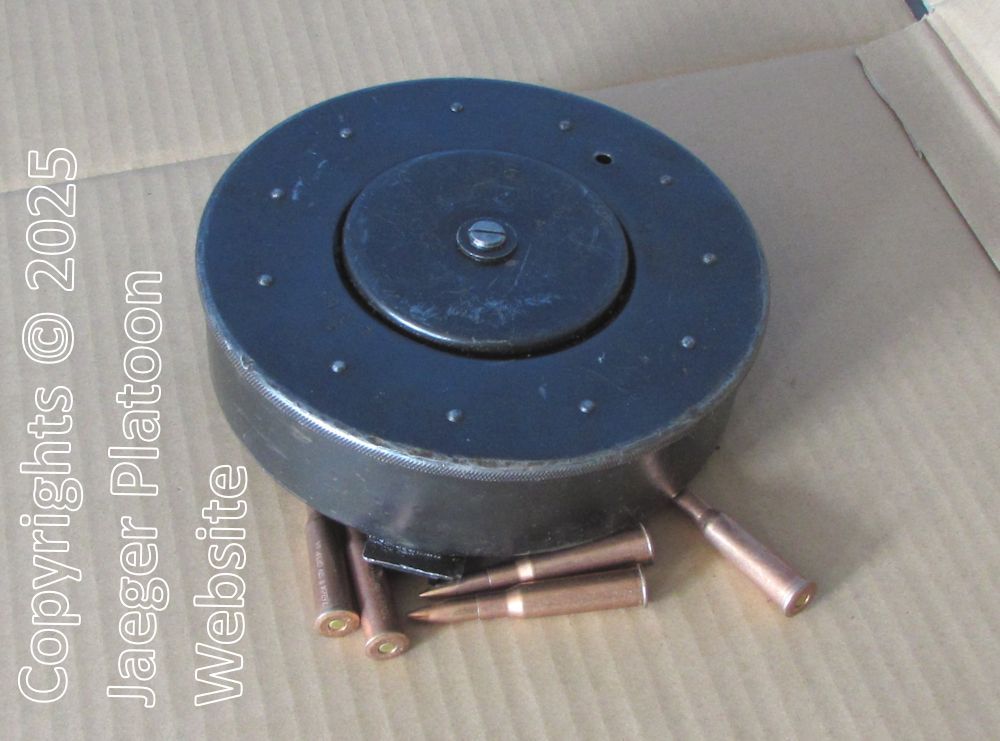
PICTURE: Magazine for DT light machine gun (Photographed by JTV for Jaeger Platoon Website). CLICK THUMBNAIL TO SEE
LARGER PIC (106 KB).
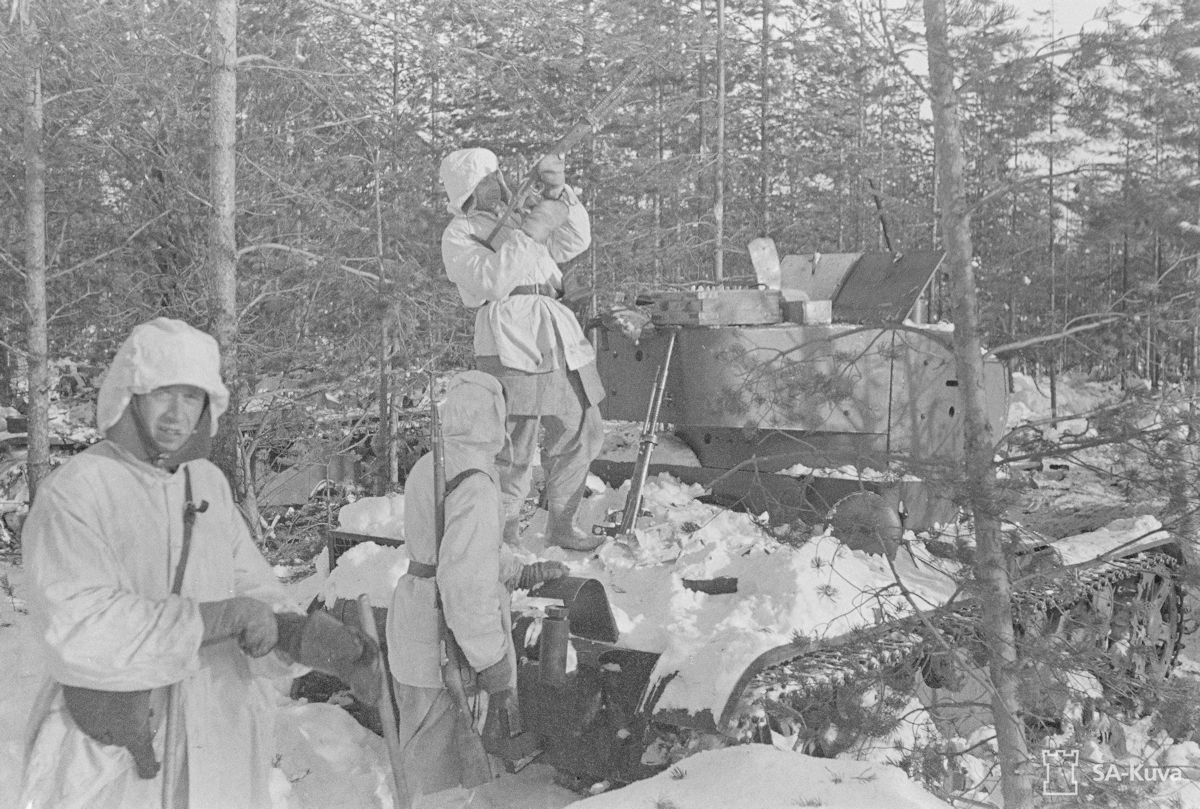
PICTURE: Finnish soldiers salvage DT machine guns from knocked out Soviet T-26
tank model 1933 in Lemetti during Winter War. All other firearms seen in this appear to be captured as well - soldier
on the left has holster for Nagant M/1895 revolver and rifle of another soldier appears
to be rifle M/91-30. Common half-joke is that during Winter War Soviet propaganda
claimed that "a great power" was supplying military weapons to the Finns, but failed to mention that the great power was
Soviet Union, from whom Finnish Army captured a great deal of modern weapons. Photographed by unknown photographer in
February of 1940. SA-kuva.fi archive, photo number 4796). CLICK THUMBNAIL TO SEE LARGER PIC (242 KB).
Finnish troops captured more than 450 DT light machine gun already during Winter War. Finnish Army took these captured machine guns to its own use. More were captured during early part of Continuation War and the total number of DT machine guns issued by Finnish military peaked at over 650 guns in June of 1944. Typically DT light machine guns were used installed in armoured vehicles but these guns also saw some use with infantry as light machine gun. For all practical purposed DT became the standard Finnish tank machine gun for World War 2, since it clearly outnumbered all other machine guns used in Finnish armoured vehicles. And for this purpose it performed in very satisfactory manner. DT was equally ultra-reliable, more compact, slightly lighter and had larger magazine capacity than more common the infantry-version of Degtjarev light machine gun. These qualities made it also popular as light machine gun among Finnish infantry, although it was far less common in that use than DP. Typically Finnish Army issued ten magazines with each of these machine guns, but this obviously varied if used in armoured vehicle. Other equipment normally issued with each weapon included spare barrel and box of tools. In addition of being used in armored vehicles and by infantry DT-machine guns were also used in Finnish fortifications. Some of the Finnish bunkers build to Salpa-line after Winter War had small tank turrets (originating from captured Soviet tanks), which had been equipped with these machine guns. During Continuation War Finnish Army also started using machine gun cupolas manufactured from steel in various field fortifications. Some of these steel cupolas had been designed to be equipped with DT machine gun. After World War 2 DT light machine guns remained in training use with armour vehicles to which they belonged, their number decreases slowly but certainly as long as this continued (late 1950's - early 1960's). After their training use ended DT light machine guns remained mothballed for possible further use until year 1986. After that some were sold to collector's market(mainly in between 1987 - 1990) and the rest were scrapped.

PICTURE: Finnish soldier is using captured DT as light machine gun. The bag hanging on his back is
bread bag and visible on his left hip is pistol holster, which might be for
TT-33 pistol. The soldier also has Czechoslovakian m/34 steel helmet.
Photo taken by 2nd Lieutenant V. Hollming in July of 1944 in Vitele. (SA-kuva.fi
archive, photograph number 154579). CLICK THUMBNAIL TO SEE LARGER PIC (189 KB).
SOURCES:
Markku Palokangas: Sotilaskäsiaseet Suomessa 1918 - 1988 osat 1 - 3 (= Military Small Arms in Finland 1918 - 1988 parts 1 - 3)
Timo Hyytinen: Arma Fennica 2, sotilasaseet (Arma Fennica 2, military weapons)
Markku Palokangas and Maire Vaajakallio: Aimo Lahti, asesuunnittelun suuri suomalainen (= Aimo Lahti, the great Finn of weapons designing)
D.N. Bolotin: Soviet Small-Arms and Ammunition.
Jan Kronlund: Suomen Puolustuslaitos 1918 - 1939 (= Finnish Defence Department 1918 - 1939)
Aleksandr Borisovitsh Zhuk: Ase-Atlas, Maailman käsiaseet (= Weapons Atlas, World's Handguns)
Bruno Bogdnovic and Ivan Valencak: Das Groze Buch der klassischen feuerwaffen
Lahti-Saloranta LS-26: Finland's Domestic LMG on Forgotten Weapons channel in Youtube.
Stalin's Record Player: The DP-27 Light Machine Gun on Forgotten Weapons channel in Youtube.
Light Machine Guns in Finland: DP-28 and LS-26 on Forgotten Weapons channel in Youtube.
DTM: The Soviet Tank Version of the DP-27 LMG on Forgotten Weapons channel in Youtube.
Article: Lahti-Saloranta pikakivääri 26 by Janne Pohjoispää in Kaliberi magazine vol. 1/2000.
Article: Degtjarev Suomen sodissa ja maanpuolustuksessa by Markku Palokangas and Timo Martelius in Kaliberi magazine vol. 3/2002.
Military manual: Pikakivääri 7,62 D (Pk D) by Puolustusvoimien Pääesikunta (1950).
Military manual: Jalkaväen pikatuliaseiden käyttöopas (1941).
Military manual: Aseopas I, Venäläisiä aseita by Päämaja (1940).
Military manual: Upseeri by P. Huhtala (1941).
Inspection and test firing reports of the committee sent to inspect VKT and its light machine gun production in April of 1929. Finnish Military Archives, archive folder T-17814/47.
Report concerning common Soviet small arms dated 7th of January 1943. Ordnance Department documents, Finnish Military Archives, archive folder T-19052/32.
Finnish National Archives, archive folder T-19045/6. Report of Kannaksen Ryhmä about combat experience with infantry weapons.
Inventory documents of Civil Guard small arms 1921 - 1939. Finnish National Archives, archive forder Sk-2513/253.
Special thanks to Sotamuseo (Finnish Military Museum), Helsinki
Huge thanks for everybody involved in organising Perinneasekurssi (Course for traditional military weapons) in Helsinki in 2006 - 2007.