


REVOLVERS & PISTOLS PART 2:
Mauser M/96, Nagant and TT-33:
7,63 mm and 9 mm M/96 Mauser "Ukko-Mauser":
(Mauser-selbstladepistole C96)

PICTURE: 9-mm Mauser M/96 pistol model 1916. Red "9" carved to handle indicates caliber
(9 mm x 19 Parabellum/Luger). (Photo taken in Sotamuseo). CLICK THUMBNAIL TO SEE LARGER PIC (72 KB).
|
Calibre: |
7,63 mm x 25 Mauser / 9 mm x 19 Parabellum/Luger |
||
|
Length: |
295 mm |
||
|
Barrel length: |
140 mm |
||
|
Weight: |
1140 g |
||
|
Magazine: |
10, non-removable (typically) |
||
|
Official abbreviations: |
"7,63 pist/Mauser" and "765 PIST MAU" |
||
|
"9,00 pist/Mauser" and "900 PIST MAU" |
|||
|
Country of origin: |
Germany |
||
|
Prototype: |
1895 |
||
|
Production: |
1897 - 1939, over 1 million made in about 30 variations. |
Finnish use: Used by both sides in Finnish Civil War of 1918, used by home-front troops during World War 2.
Mauser C96 pistol was the first commercially successful mass-produced automatic pistol. Brothers Fidel, Friedrich and Josef Feederle designed the pistol for Mauser factory. Mass-production of C96 started in 1897. Some 300,000 pistols C96 of 7,63 mm x calibre were manufactured between 1897 - 1918. From 1907/1908 to 1914 the Mauser pistol was also manufactured in more powerful 9 mm x 25 Mauser caliber, but that caliber did not achieve much of a success. One of the later famous early users of Mauser C96 was Winston Churchill, who used privately purchased C96 pistol in Sudanese campaign and Boor War. The design of C96 pistol went through several improvements during the production, maybe the most important was new safety (Neues Sicherung = NS) introduced in 1912. German Army was not interested about the Mauser pistol before World War 1, but once the war started the situation changed. During World War 1 German Army needed much more pistols that what it already had and when Parabellum P-08 (standard issue German Army pistol at the time) production was not nowhere sufficient enough, they turned their attention to Mauser C96. Since German Army did not want to complicate their ammunition supply by introducing 7.63 mm x 25 cartridge to their ammunition inventory, new 9 mm x 19 caliber version of C96 (already used with P-08) was designed and placed into production. This 9 mm x 19 caliber version is also known as model 1916, although it seems to have been introduced to production only in year 1918. The German Army ordered some 150,000 pistols C96 in calibre 9 mm x 19, from these only about 65,000 were delivered in year 1918 with production continuing until year 1920, at which point it had reached total of about 130,000 pistols. Year 1920 Mauser started production of 7.63-mm calibre "bolo"-version (Russian Bolsheviks were one of the main customers for this pistol), which had shorter barrel (as Versailles treaty forbid German industry manufacturing 9 mm x 19 caliber pistols or pistols with 100-mm or longer barrels). Further improved safety known as Universalsicherung was introduced in 1930's. Also in 1930's Mauser introduced new select-fire (capable to both full-automatic and semiautomatic fire) version Reihenfeuer Pistole also known as "M 712". The success of select-fire "M 712" Mauser pistol was reasonable, but not huge - some 100,000 were manufactured before its manufacturing came to an end. The main market for the select fire version was China, whose markets Spanish Royal and Astra had already earlier flooded with their own select-fire versions only very loosely based on Mauser C96. The select-fire version typically had 10- or 20-round removable magazines. The other versions of C96 usually had 6- or 10-shot non-removable magazine, which was loaded with cartridge clip from the top. Typical equipment for Mauser C96 contained wood holster, which could also be used attached to pistol to give it rifle-like butt. All in all Mauser C96 was produced in about 30 main variations and remained in production until year 1940 with the last delivery being 7,800 produced for German Luftwaffe. During early part of World War 2 German Luftwaffe and Waffen-SS issued C96 pistols. Direct copies and pistols based to Mauser C96 were also made in Spain (Astra, Royal and Azul), China and Korea.

PICTURE: 7.63-mm Mauser M/96 pistol with wooden holster stock typical to this pistol.
(Photo taken in Uusimaa/Nyland Brigade). CLICK THUMBNAIL TO SEE LARGER PIC (51 KB).

PICTURE: Heavily worn 9 mm Mauser M/96 pistol with wooden holster stock attached.
(Photo taken in Uusimaa/Nyland Brigade). CLICK THUMBNAIL TO SEE LARGER PIC (75 KB).
Mauser C96 pistols are commonly known as "broom-handle" in English-speaking countries. This nickname comes from their pistol grips, which remind end of the broomstick. From technical point of view Mauser C96 pistols are rather unusual pistol design using short barrel recoil - besides more or less exact copies there has been very little trying of developing their structural design for a very long time. The obvious reason for this the complexity of their structural design and certain few details, which never gained too much popularity. For example both barrel and slide of these pistols are one single piece machined from solid steel - and a very complicated piece of steel for that. Mauser C96 has adjustable tangent-type rear sight. Mauser manufactured the pistol in small numbers also in 9 mm x 25 Mauser Export caliber, later some Chinese copies of Mauser C96 were also manufactured in .45 ACP caliber.

PICTURE: Soldiers of Finnish Army with their Mauser C96 pistols during or right after
Civil War. They have their left elbows in snow, but one has visible white
armband with "S inside a circle", which was standard insignia of Finnish Civil Guard. Three of
the four soldiers have shoulder stock holsters attached to pistols. Photographer J.H. Aho. Photograph
provided by Finnish Heritage Agency (Museovirasto) via finna.fi and
used with CC BY 4.0 license. CLICK THUMBNAIL
TO SEE LARGER PIC (208 KB).
Finnish natialist activists had smuggled small number of these pistols to Finland already before World War 1. During the war Germany was delivering military hardware first to Finnish Jaeger Movement (Jääkäriliike) and later to Finnish White Army. German submarine UC-57 and German freight ships delivered weapons to Finland for Finnish White Army in 1917 - 1918. Among weapons that they delivered were over 1,000 Mauser C96 pistols of both 7.63 mm x 25 and 9 mm x 19 caliber. What is known suggests that majority of the pistols were in 9 mm x 19 caliber. Finnish Red Guards and Russian Gendarmes managed to intercept some of the weapons deliveries and also used these pistols in smaller numbers during Finnish Civil War. Finnish White Army issued Mauser C96 pistols mostly to its officers and leadership of various levels, with some issued as personal defence weapons. When Civil War ended in May of 1918 large number of men issued with these pistols did not return them, but took them home as war souvenirs.

PICTURE: Three Finnish Army soldiers. Sergeant on the left has Mauser M/96 pistol
in its wooden holster stock hanging from his belt. The pistol holster is open and shows "9" marked
into pistol's grip panel. Photographed by Nuorto in Nuijamaa in July of 1941. (SA-kuva.fi archive, photo number
30140). CLICK THUMBNAIL TO SEE LARGER PIC (139 KB).
After pistols M/19 and M/23 had been bought in large numbers Finnish Army came to conclusion that old Mauser M/96 pistols were not needed anymore, so they were transferred to Suojeluskunta (Finnish Civil Guard). During World War 2 the remaining M/96 pistols were mostly used in home front. Summer of 1940 still 614 Mauser M/96 pistols remained, this included 271 pistols in 7,63 x 25 and 343 in 9 x 19 calibre. Finnish soldiers gave the pistol nickname "Ukko-Mauser" (= Old man Mauser. Smaller 7,65 mm Mauser M/1914 pistol was known as "Akka-Mauser" aka "Old woman Mauser"). While these pistols can quite accurate I doubt anybody would claim their pistol grip ergonomic. As to be expected from first successful automatic pistol structure of the weapon is also quite complicated and therefore both disassembling and putting the pistol back together quite difficult. It seems that on the long run especially 9-mm version had slight durability problem: Often their slides started to stretch in specimens, which had been fired a lot. However this might be at least partly due to 9 mm x 19 caliber hot submachinegun ammunition misused by Finnish military also in pistols during World War 2. Year 1960 the remaining Mauser M/96 pistols were sold to Interarmco and shipped abroad.

PICTURE: Group of Finnish soldiers with captured light machine gun
M/27 (DP). Soldier on the right has Mauser M/96 in this hand and appears to be wearing items of
Civil Guard summer uniform m/36 . Photographed by P. Kortteinen in Kitee sometime during World War 2.
(SA-kuva.fi archive, photograph number 26458). CLICK THUMBNAIL TO SEE LARGER PIC (190 KB).
Writer's limited personal shooting experiences with 7.63-mm Mauser M/96 pistol: As noted, the structural design and basic operating principle of this pistol are rather unusual. This is one large, clumsy and quite heavy pistol with weird point of balance. Fixed magazine that is located in front of the trigger is filled with 10-round stripper clip reminding the ones used in bolt action rifles of the era. Fixed magazine can also be loaded without stripper clip, but that is even more difficult and time-consuming, since bolt is being locked back by magazine follower. Hence using proper stripper clips for the purpose is highly recommended. Removal of the clip from top of the fixed magazine allows bolt to move forward, leaving the pistol ready to fire. Ergonomics-wise the pistol is very challenging to shoot well. The "broom-handle" pistol grip is very small, round and tapered, while the pistol is also front- and top-heavy compared to other pistol designs, which makes holding and aiming it properly quite difficult. Surprisingly ergonomics are not all bad - for right-handed shooter Neues Sicherung type safety is easy and natural to use with a thumb. During shooting the pistol shows noticeable muzzle climb, which somewhat slows down pace of shooting, but recoil is rather mild. Sight picture is manageable or even good compared to other military pistols of the same era - wide notch in rear sight and sharp front sight post. Trigger is rather typical to military service pistols - not light or heavy and as a bonus trigger travel is relatively short. If shooting in indoor shooting range or from a cot, wearing a hat is recommended - the pistol extracts cartridge cases straight up and if there is a ceiling from which they can bounce back, some of them will fall on shooter's head. The 7.63-mm caliber version also tends to extract cartridge cases with quite a bit of energy. Disassembly of this pistol and in particular putting it back together are not for those that are faint in heart - this may be the most complicated pistol to disassemble and re-assemble to ever accepted in large-scale military use.
7,62 mm Revolver M/1895 Nagant:
(Revolver sistemy nagana obr. 1895 g.)

PICTURE:Nagant m/1895 revolver manufactured by Tula arsenal in year 1900. This revolver originally
had blued finish, but it has worn off long time ago. The design of Nagant m/1895 did not change much during its
production. When compared to Izhevsk-manufactured year 1944 revolver below notice different shape of front sight bead
(half-moon vs. shark fin) and less aggressive texture of wooden grip panels on this early sample. Photographed by Anni
Minkkinen. Photo source The National Museum of Finland
(Suomen Kansallismuseo), acquired via finna.fi and used with
CC BY 4.0 Creative Commons license. CLICK THUMBNAIL TO
SEE LARGER PIC (88 KB).
|
Calibre: |
7,62 mm x 38 R Nagant |
||
|
Length: |
244 mm |
||
|
Barrel length: |
144 mm |
||
|
Weight: |
770 g |
||
|
Magazine: |
7 |
||
|
Official abbreviations: |
"7,62 rev/Nagant" |
||
|
Country of origin: |
Russia/Soviet Union |
||
|
Prototype: |
1892 |
||
|
Production: |
Belgium 1895 - 1898, Russia/Soviet Union 1899 - 1945. |
Finnish use: Nagant M/1895 revolvers saw use in Finnish Civil War in year 1918. In 1920's and 1930's Finnish military did not issue these guns. Even if they were probably captured by the thousands during World War 2, grand majority of them did not find their way into military inventory and were officially issued only to some home-front units. Unofficially these revolvers saw more unofficial use with Finnish soldiers who had captured and decided to keep as personal secondary weapons.
Russian Armed Forces accepted this revolver designed by Belgian brothers Émile and Henri-Léon Nagant to their standard issue sidearm in year 1895. In their use Nagant revolver replaced earlier Smith & Wesson and Galand revolvers. The Nagant brothers had already earlier experience dealing with Russia from development of Mosin-Nagant M/1891 rifle. Russia followed recent French example and decided to require its new service revolver in 7.62-mm calibre due to having already adopted 7.62 mm x 54R rifle cartridge and wanting to be able to manufacture barrels for both with the same machinery and recycle failed rifle barrels into production of revolver barrels, hence requiring similar bore and rifling. At the same time Russian military wanted to get higher muzzle velocity and therefore higher muzzle velocity than with other service revolver cartridges of roughly similar caliber - which would cause incorporation of gas-seal feature for raising muzzle velocity, which makes Nagant model 1895 unique among widely adopted service revolvers. As far as the basic principle goes the idea of gas-seal revolver was not new and both brothers Nagant and their fellow Belgian rival Henri Pieper had come their own gas-seal designs. Nagants and Pieper introduced their first revolver designs to Russian tests in early 1892. Gas-seal system used by brothers Nagant was formed by cartridge case, barrel and cylinder which moved forward to close the gas-seal when revolver is being cocked. It is worth noting that the mechanics concerning how the cylinder is moved forward is not similar in Pieper's and Nagant's designs and 7.62-mm x 38R cartridge was also Nagant design. The ammunition used for the purpose of gas-seal is quite unusual: Bullet is completely seated inside cartridge case and crimped in place.
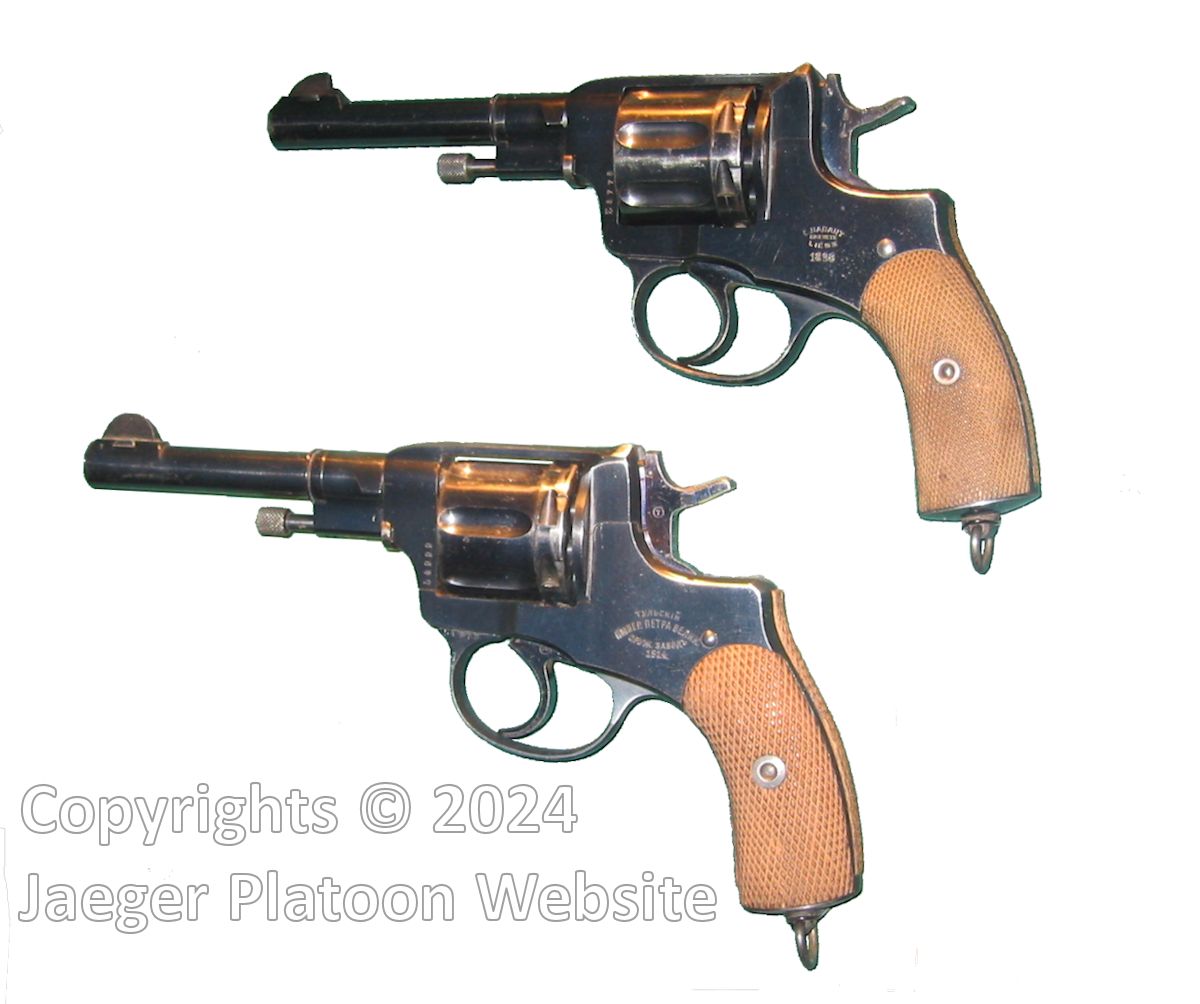
PICTURE: Two Nagant m/1895 revolvers. Top revolver has manufacturer's markings fors Fabrique
d'armes Léon Nagant in year 1898 and the one below it for Tula Arms Factory in year 1914. Notice front sight
designs. (Photo taken in Sotamuseo). CLICK THUMBNAIL TO SEE LARGER PIC (119 KB).

PICTURE: Nagant revolver M/1895 with opened holster and some ammunition. This individual revolver
was manufactured by Izhevsk arsenal in year 1944. Revolver's loading port is open with partially inserted cartridge.
Holster has opened small ammunition pouch designed to carry 14 rounds - enough for reloading the revolver twice.
Copyrights for the photo Jaeger Platoon Website. CLICK THUMBNAIL TO SEE LARGER PIC (82 KB).
Also some rare special versions of Nagant M/1895 exist. From these special versions the one that is probably most common is shorter version, which is sometimes referred "NKVD version" or "commander's version" - although neither term appears to be very accurate and it was manufactured in much smaller numbers than the full-size Nagant M/1895. It has shorter (typically 85-mm long) barrel and smaller grip. It mainly manufactured for non-military authorities (police, customs etc). Shorter version was already manufactured in small numbers around 1911 - 1914, but large-scale production (estimated about 25,000 total) took place in Tula around 1925 - 1930. While calling this revolver as "NKVD version" is not totally accurate, it is not totally false either, since it seems to have seen use with NVKD and OGPU, but was not inclusive to them and was used by variety of Soviet law enforcement and security organisations. Another rare early special version of Nagant m/1895 was equipped with attachment lug in rear of pistol grip - this allowed using small axe of Soviet Engineer Corps to be used as a shoulder stock. Another very rare group of special versions were Nagant M/1895 revolvers equipped with silencer (usual revolvers cannot really be silenced in this manner due to gap in between revolver's frame and front of cylinder, but thanks to Nagant's gas-seal system it is an exception). In addition there were also Nagant M/1895 assembled from substandard parts only intended for training use and not intended to be fired with live ammunition, which can only be identified as such from marking above grip in right side of frame. However maybe the rarest of all special versions of Nagant M/1895 was nickel-plated presentation version, which the Soviets used for awarding their officers with Order of the Red Banner until year 1930. In addition of Russia slightly modified version of Nagant M/1895 revolvers were also shortly manufactured in Poland in 1930's. These Polish revolvers were manufactured by Fabryka Broni for Polish police and postal guards and referred as rewolwer Nagant wz. 30 and rewolwer Nagant wz. 32.

PICTURE: Shorter version of Nagant m/1895 revolver. This particular gun is rather unusual being
being manufactured by Tula in year 1918. It appears that front sight have been modified by filing off part of it.
(Photo taken in Museum Militaria). CLICK
THUMBNAIL TO SEE LARGER PIC (191 KB).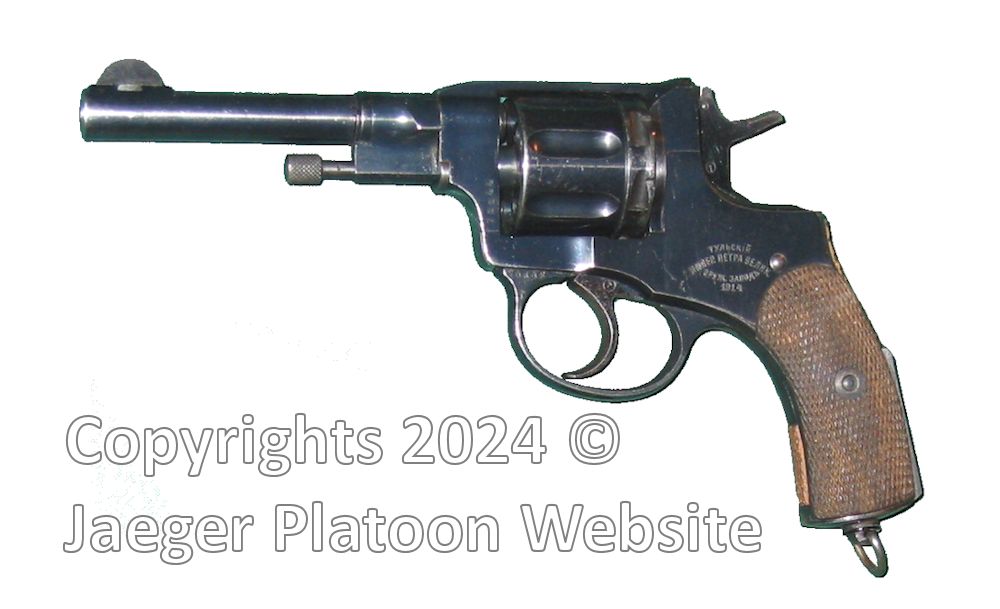
PICTURE: Nagant m/1895 revolver with manufacturer's marking of Tula in year 1914 and attachment
lug in rear section of pistol grip.(Photo taken in Sotamuseo). CLICK
THUMBNAIL TO SEE LARGER PIC (81 KB).

PICTURE: Soldier of Finnish White Army (Helsinki Civil Guard to be more specific - hence the
civilian clothing with non-standard insignia) with Nagant M/1895 revolver and Winchester
M/1895 rifle. Apparently this soldier had no holster for the revolver, because he carries it tucked
under ammunition bandolier. Photographed by Atelier Nyblin in
19th of April in year 1918. Photo source Finnish Heritage Agency (Museovirasto), acquired via
finna.fi and used with with CC
BY 4.0 Creative Commons license. CLICK THUMBNAIL TO SEE LARGER PIC (120 KB).
Finnish military did not gain any more interest towards Nagant after the World War 2 either. Year 1951 Finnish Defence Forces had some 1,400 Nagant revolvers, over 1,100 of these were officer's (double-action) model. Year 1960 Finnish military sold remaining Nagant revolvers to Interarmco, which exported them. This marked the ending for the use of Nagant M/1895 in Finnish Armed Forces. Large number brought back by Finnish soldiers were unlikely to see much use after the war either - there was no ammunition commercially available, so once their new owners run out of captured ammunition, they were unlikely to succeed finding more. This may have been one of the reasons, why so many of the soldiers who had brought one of these revolvers back from war later decided to hand them over instead of worrying about legal problems possibly caused by having unlicensed firearm.

PICTURE: Group of Finnish soldiers photograhed while checking out knocked out Soviet
T-26 model 1931 tank for useful supplies. Soldier watching to camera has found himself Nagant
M/1895 revolver in addition to which he has infantry rifle M/91, soldier on the right
is in process of liberating DT machine gun, while the one middle is apparently checking if
Soviet field bottle has something stronger than water inside it. Soldier standing behind them and leaning to tank turret has
Suomi M/31 submachine gun. All soldiers have Czechoslovakian m/34
steel helmets. Photographed by Military official A. Viitasalo in August of 1941.(SA-kuva.fi archive, photo
number 30543). CLICK THUMBNAIL TO SEE LARGER PIC (235 KB).
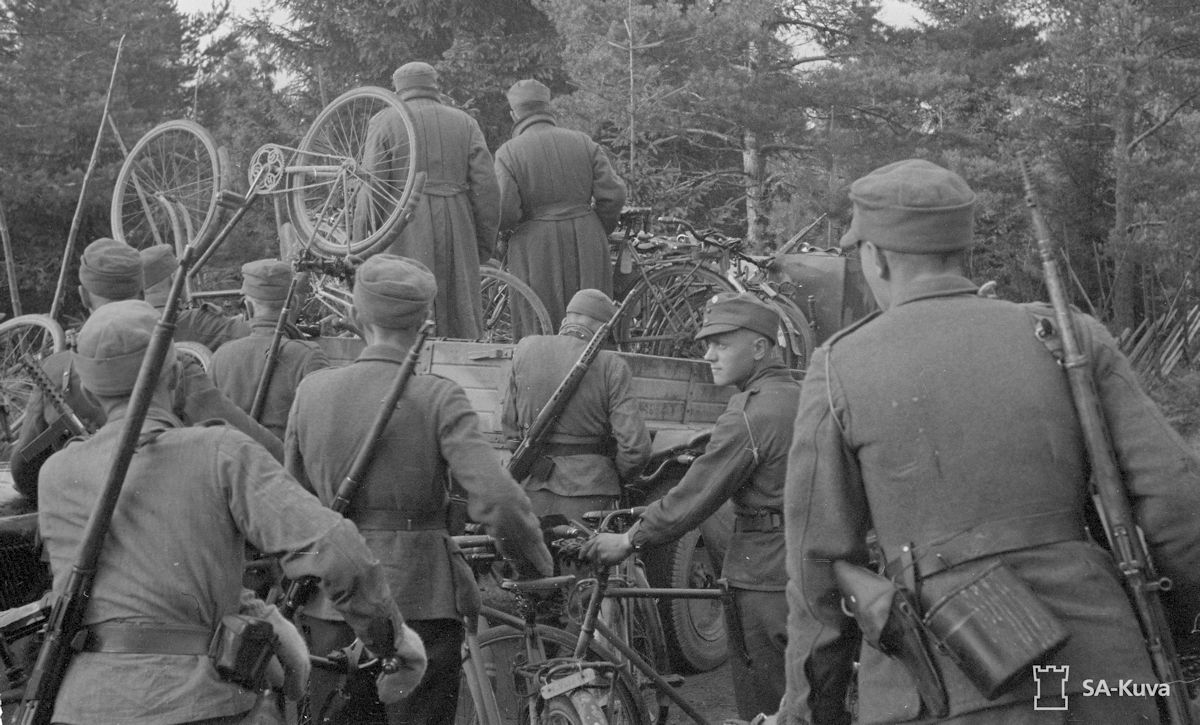
PICTURE: Finnish Army soldiers of bicycle troops (possibly Light Detachment 18 / Kevyt Osasto 18)
photographed in process of loading their bicycles on a truck. Rightmost soldier has holster of Nagant M/1895 on his hip,
he and another soldier in middle of photograph have Tokarev SVT-40 rifles and soldier
in the left has submachine gun, which is likely MP 28-II. Photographed by H.
Harrivirta in August of 1941.(SA-kuva.fi archive, photo number 45183). CLICK THUMBNAIL TO SEE LARGER PIC (181 KB).
For number of years refurbished Nagant M/1895 revolvers were available in the market for a decent price, while prices have gone up the availability is still quite good due to number of guns, but Nagant ammunition has not been cheap. Only two sources of 7.62 mm x 38R Nagant ammunition seem to be available lately - Fiocchi and Prvi Partizan. Both Fiocchi and Prvi Partizan manufactured ammunition are quite expensive. Many owners of Nagant M/1895 are shooting .32 calibre revolver ammunition loaded with lead bullets in these revolvers as a cheaper alternative. This somewhat works, but not without some setbacks and risks. Shooting .32 calibre rounds (like .32 S & W Long) is potentially risky and can get the gun barrel very dirty very fast. The pressure level produced by these rounds is higher than that produced by mild target loads of 7.62 x 38R Nagant round manufactured by Fiocchi or Prvi. It is doubtful if anybody had calculated and tested how powerful cartridge Nagant M/1895 can handle - so especially on the long run there might be enough safety margin for this - or not. In addition cartridge case of Nagant cartridge is fatter than what are used in .32 calibre revolver rounds - so if unmodified .32 cal revolver rounds are fired in normal Nagant M/1895 cylinder they may bulge and get stuck. I have not seen any reports of accidents with .32 Smith & Wesson Long ammunition in unmodified m/1895 cylinder, but if you try this, you can do that only with your own responsibility. Personally I have decided to stick with original 7.62 mm x 38R ammunition. Also replacement cylinders made for .32 ACP (7.65 mm x 17 Browning) have been manufactured for these revolvers. Installing such replacement cylinder may require fitting. Earlier some cylinders have also been modified for 7.62 mm x 25 Tokarev cartridge - but these are to be considered extremely dangerous. The pressure level created by 7.62 mm x 25 Tokarev cartridge is way beyond, what Nagant M/1895 was intended to handle and modifying cylinder to this ammunition would weaken it considerably - in short, a recipe for a disaster about to happen.
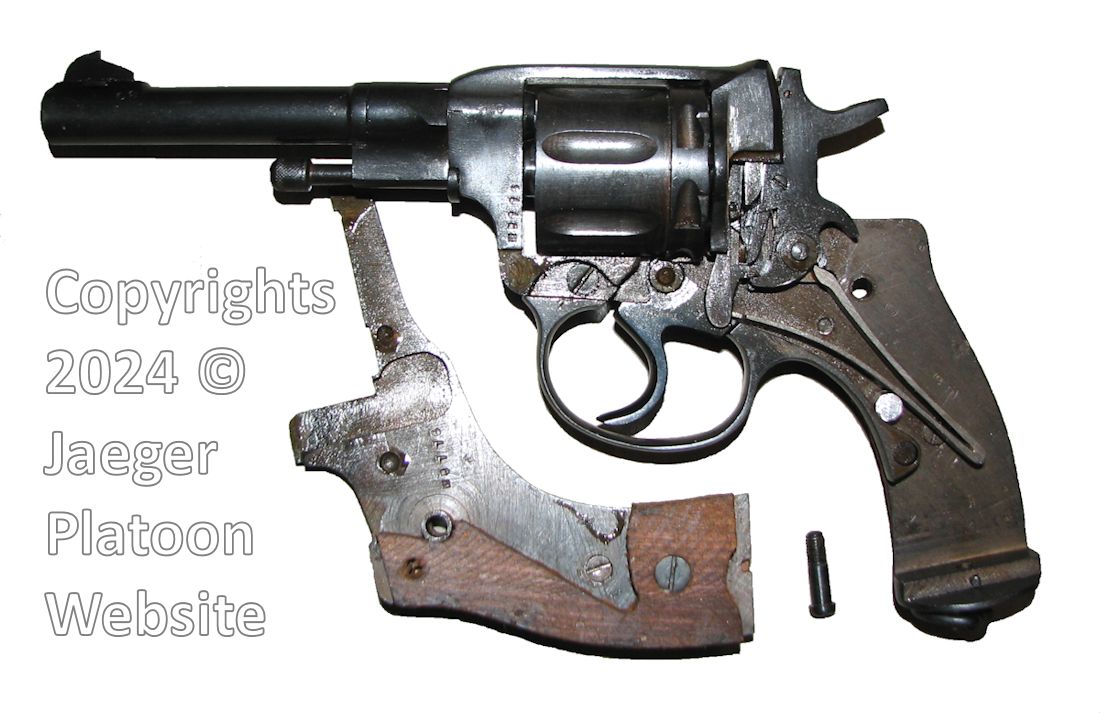
PICTURE: Nagant m/1895 revolver with sideplate removed. Notice (silver-colored) piece of bullet
placed in between main spring and frame to reduce trigger pressure. This was traditional Russian / Soviet trick used
for the purpose. Photographed by JTV. Copyrights of Photo Jaeger Platoon Website. CLICK THUMBNAIL TO SEE LARGER PIC
(123 KB).
7,62 mm Pistol Tokarev TT-33:
(Samozarjadnyi Pistolet Tula-Tokareva)
(Pistolet Tokareva, opytnyj obrazets 1930 g.)

PICTURE: Tokarev TT-33 pistol manufactured in year 1942. During World War 2 manufacturing quality of TT-33
pistols deteriorated - they are still fully functional, but tend to be more poorly finished with machine marks appearing in
outside surfaces. This individual pistol has been refurbished (with marking indicating that visible just below slide release).
Due to way in which the gun blueing was applied to their pistol slides, it is typical for front and rear part of slide to have
different shades. CLICK THUMBNAIL TO SEE LARGER PIC (109 KB).
|
Calibre: |
7,62 mm x 25 Tokarev |
||
|
Length: |
195 mm |
||
|
Barrel length: |
115 mm |
||
|
Weight: |
900 g |
||
|
Magazine: |
8, removable |
||
|
Official abbreviations: |
"7,63 pist/ven." and "763 PIST SOV" |
||
|
Country of origin: |
Soviet Union |
||
|
Prototype: |
1930 (early TT-30 version) |
||
|
Production: |
TT-30 1933 - 1935, TT-33 1935 - 1953, about 1 million. |
Finnish use: Officially only some issued to non-frontline units during Continuation War. Unofficially used in large numbers by Finnish soldiers who had captured pistols of this type.
The Soviets started planning military pistol using 7,62 mm x 25 (basically a bit more hot loaded copy of 7,63 mm x 25 Mauser) cartridge already in year 1928. TT-30 prototype of Fedor Vasilevich Tokarev using Browning-system proved best in the tests the Soviets arranged for selecting new service pistol for Soviet Red Army in July of 1930. Other pistols taking part in those tests included: Walther, Parabellum, Browning, Prilutsky and Korovin. However, even if the TT-30 prototype was the best in the tests, it needed improvements before being introduced to military use. The improved TT-30 prototype was successfully tested in January of 1931 and approved to Soviet military. After this acceptance 1,000 TT-30 pistols were ordered for testing in various Red Army units in February of 1931. The mass-production in Tula arsenal gained momentum in 1931 - 1933 and got into full swing in 1934. Some changes (mainly ones making manufacturing easier) were made to the pistol already during this process in year 1933. These changes led into introducing a new version of the pistol called TT-33, which replaced TT-30 in production by year 1935. However soon the Soviets found TT-30 pistol to have its share of problems: Their main spring had short service life and the user could quite easily accidentally eject its magazine. Before World War it was also criticised for being unsuitable to be fired through vision slits, which the the Soviets were still building to their tanks. Because of these reasons the Soviets started looking new service pistol in year 1938. Prototypes made by Korovin, Rakov, Tokarev and Voevodin took part to tests done in July of 1939. From these prototypes the Voevodin's design proved most successful. It had short-recoil action with 18-round magazine and without the war its improved version might replaced TT-30. But then came the the war and changed plans - the Soviets did not want to disrupt production by introducing new pistol so they decided to keep TT-30 pistol and Nagant revolver in manufacturing and forget the new pistol. During World War 2 TT-33 pistol was main pistol type used by Soviet military, during war years its yearly production was over 100,000 pistols/year, but during the war quality also deteriorated and bakelite grip plates were often replaced with ones made from wood. T-33 pistols manufactured after the war were again equipped with bakelite grips. The pistol remained in production in Soviet Union until 1953, when Makarov (PM) pistol entered production. After World War 2 more or less direct copies of Soviet TT-33 were manufactured in my many countries such as Poland (Pistolet TT and .22 LR calibre Sportowy-version), Hungary (48M and 9-mm Tokagypt 58) and Yugoslavia (M57, M70 and M70A), China (Type 54, Type 54-1 and Type 213) and North Korea. In this day T-33 and its copies are still used by authorities in some countries - largest remaining user being China. During World War 2 captured TT-33 saw also some use with German military, which called the pistol "Pistole 615(r)".

PICTURE: After Soviet Union found itself in receiving end of invasion in summer of 1941,
the manufacturing quality of TT-33 pistols dropped signicantly. This pistol manufactured in 1943 is a good
example exactly how rough the finish could get. TT-33 pistols manufactured in 1942 - 1944 were originally equipped
with wooden grip panels like in this photo. (Photo taken in Sotamuseo). CLICK THUMBNAIL TO SEE LARGER PIC
(115 KB).
From technical point of view TT-30 and TT-33 were obviously based to John Browning's military pistol designs and their basic mechanism was "tilting barrel" which he had first introduced. But the pistol also has some rather interesting characteristics. It does not have safety (unless one counts the "half-way cocked" notch in its hammer as such) and pistol's trigger group has been designed as separate component, so they can be removed from the pistol as one package when the pistol is dismantled. The magazines are also rather unusual - they do not have feed lips (from which the round is fed to cartridge chamber), but instead the part acting as lips are integral part of the pistols grip section. This rather interesting arrangement pretty much removes the possibility of jams caused by bent magazine lips and at the same time makes manufacturing magazines easier and cheaper. The easiest way (without dismantling the pistol) of separating TT-30 from TT-33 is checking back of the grip - TT-30 has a separate part which covers almost whole back of the grip in there and allows removing return spring, while TT-33 does not. TT-30 and TT-33 also have rather obvious differences in their barrels when dismantled and compared side by side - locking grooves outside barrel vital for "tilting barrel"-concept are only on top of the barrel in TT-30, while in TT-33 they go all the way around the barrel.
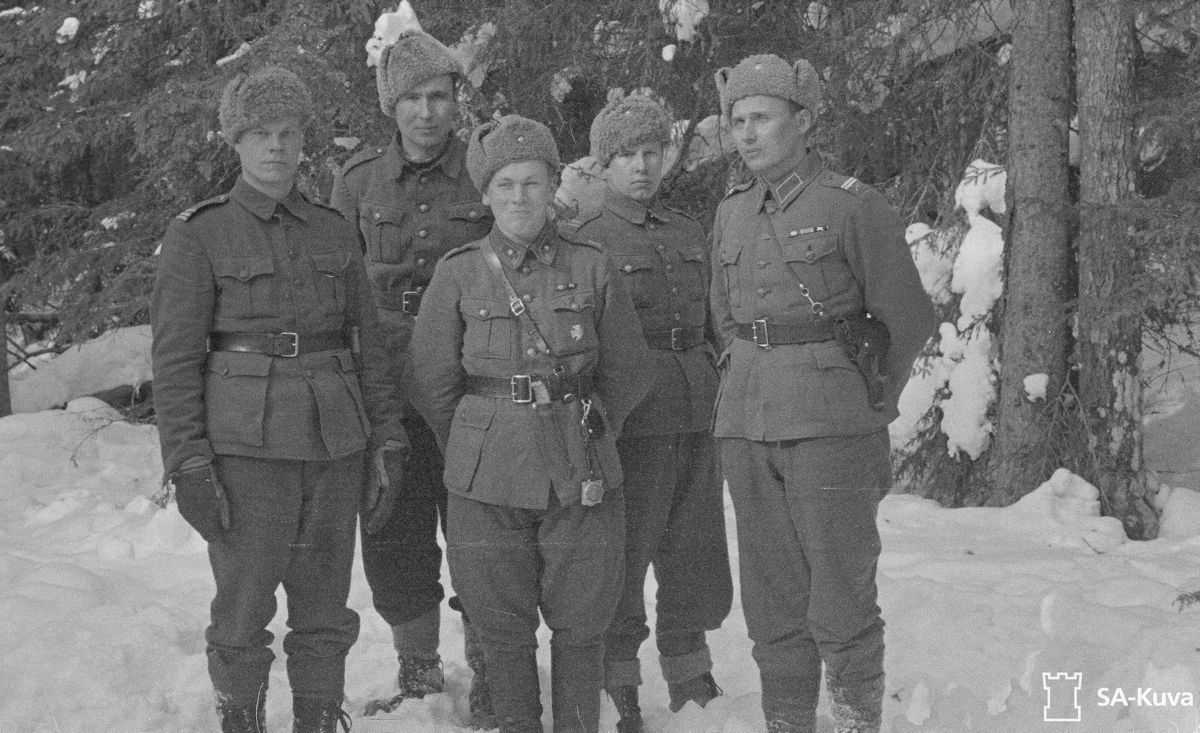
PICTURE: Soldiers from Jaeger Platoon of 2nd Battalion of Infantry Regiment 30. Corporal
on the right has pistol holster for TT-33 on his hip and appears to have used its leather lanyard to stabilise his belt.
2nd Lieutenant in the middle has puukko-knife and
marching compass m/34 in his belt. Photographed by Military official M. Persson
in February of 1942.(SA-kuva.fi archive, photo number 76215). CLICK THUMBNAIL TO SEE LARGER PIC (196 KB).
After Finnish soldiers captured their first TT-33 pistols they immediately nicknamed TT-33 as "tähti-pistooli" (="star-pistol") because of star emblem clearly marked to grip panels. Just like with Nagant revolvers they were captured in thousands, but Finnish soldiers who had captured them turned over only few hundred to proper channels. The reason for this was quite simple: The soldiers preferred keeping captured pistols as part of their personal weaponry during war and took them home as war-souvenirs after the war. In a way the attitude of soldiers made sense - for soldier armed with bolt-action rifle a automatic pistol of any kind was a useful backup. Even if they were not officially issued to frontline troops some Tokarev pistols were issued to Finnish troops serving in home front during Continuation War. Finnish ammunition supply did not separate 7.62 mm x 25 Tokarev ammunition from 7.63 mm x 25 Mauser, so it is more than likely that Mauser-ammunition was issued for TT-33 pistols used by Finnish units stationed in home front. Frontline soldiers with their thousands of captured unofficial pistols presumably relied more to captured ammunition.

PICTURE: Three Finnish officers - the captain on the right has holster of Tokarev TT-33
hanging on his belt. During World War 2 Finnish Armed Forces did not have enough pistols to issue them to everyone, who
was supposed to be equipped with one, hence captured TT-33 pistols proved highly useful . Lieutenant-Colonel in the
centre have pistol holster that is probably for Parabellum pistol. All three
officers wear fur hat M/22. Photographed by 2nd Lieutenant H.
Harrivirta in February of 1942.(SA-kuva.fi archive, photograph number 74425). CLICK THUMBNAIL TO SEE LARGER PIC
(134 KB).
Finnish military had very little interest towards these pistols (that used non-issue ammunition) after the war either. Remaining 669 TT-33 pistols were sold Interarmco, that shipped them abroad around 1959 - 1960. From collectors point of view for example TT-30 and .22 LR calibre Polish "Sportowy"-version are very rare and therefore quite expensive nowadays. TT-33 was simple and practical military pistol with some quite innovative ideas, but the design also had its fair share of flaws - the pistol has considerable safety issues if carried with round chambered. Another issue sometimes mentioned was accidentally dropping the magazine - a common complaint in Soviet sources, but not really a bigger hazard than in most modern pistols.

PICTURE: Tokarev TT-33 pistol disassembled for basic maintenance - no tools required, although
having some makes putting the pistol back together easier. CLICK THUMBNAIL TO SEE LARGER PIC (113 KB).
Writer's personal shooting experiences with TT-33 pistol: While TT-33 is not exactly a target pistol, it seems to be the very epitome of reliable military sidearm. The grip is short and grip angle is somewhat unusual, but otherwise the pistol is a natural pointer in which due to design and prioritisation allow to function reliably even if the fit and finish may not be necessarily too impressive. The ergonomics are rather poor with often a heavy trigger, which combined with strong recoil with such a small grip makes accurate shooting quite challenging. As to be expected from Soviet military pistols trigger pressure and accuracy vary considerably from one individual pistol to another. Typically fit and finish of pre World War 2 manufactured pistols seem to have been better than wartime production. Due to grip size and design hammer-bite is common problem while shooting with TT-33. Both disassembly and reassembly for basic maintenance are reasonably easy, but not among the easiest. If the person is familiar with Colt 1911 type pistols, the disassembly and reassembly of this pistol is quite similar. The pistol breaks into 7 (8 if magazine is included) parts in basic maintenance disassembly. Sight picture is otherwise pretty good, but tight in the sense that front sight post fills rear sight notch almost completely. While the Soviets apparently considered possibility of accidentally dropping the magazine a problem, I have not found this to be a problem. The magazine does drop freely off the pistol if the magazine release is pressed, but that is typical to most pistols nowadays. Reloading the pistol is both easy and fast. Magazines are easy to load into their full capacity. Since the pistol does not have real safety of any kind carrying it with cartridge in chamber is neither safe or recommendable - this may have been the most serious handicap of the design as a military sidearm.
SOURCES:
Markku Palokangas: Sotilaskäsiaseet Suomessa 1918 - 1988 osat 1 - 3 (= Military Small Arms in Finland 1918 - 1988 parts 1 - 3)
Timo Hyytinen: Arma Fennica 2, sotilasaseet (Arma Fennica 2, military weapons)
D.N. Bolotin: Soviet Small-Arms and Ammunition.
Jan Kronlund: Suomen Puolustuslaitos 1918 - 1939 (= Finnish Defence Department 1918 - 1939).
Small Arms of WWI Primer 09A*: Mauser C96 Italian Modello 1899 on C&Rsenal channel in Youtube.
Small Arms of WWI Primer 09B*: Mauser C96 at War on C&Rsenal channel in Youtube.
Small Arms of WWI Primer 098*: Russian Nagant 1895 Documentary on C&Rsenal channel in Youtube.
NKVD Officer's Model Nagant Revolver on Forgotten Weapons channel in Youtube.
Ian Hogg and John Wells: Pistols of the World.
Article: Ukko-Mauser-pistooli by Heikki Pohjolainen in Ase magazine vol. 4/1984.
Article: Sarja-automaatti Ukko Mauser by Heikki Pohjolainen in Ase magazine vol. 5/86.
Article: Mauser C 96 Bolo by Matti Ingman in Ase-lehti magazine vol. 3/93.
Article: Mauser C 96 pistoolin espanjalaiset kopiot by Matti Ingman in Ase-lehti magazine vol. 5/94.
Article: Harvinainen Mauser C 96 by Matti Ingman in Ase-lehti magazine vol. 1/95.
Article: Ukkoikäinen legenda Mauser C 96 by Mika Vuolle in Kaliberi magazine vol. 6/1995.
Article: Välimallin Mauser C96 by Mika Vuolle in Kaliberi magazine vol. 3/1998.
Article: Tähti-pistooli, I osa by Heikki Pohjolainen in Ase magazine vol 5/1985.
Article: Tokarevin toverit by Pekka Pohjolainen in Ase-lehti magazine vol. 1/86.
Article: Tokarev T-33 by Vesa Toivonen in Ase-lehti magazine vol. 2/93.
Article: N-liiton automaattipistoolit ennen Tokarev:in aikaa by Matti Ingman in Ase-lehti magazine vol. 3/96.
Article: Tokarevin pistooli by Mika Vuolle in Kaliberi magazine vol. 1/1999.
Article: Nagant revolveri Venäjän armeijassa by Heikki Pohjonen in Ase magazine vol. 5/1984.
Article: Nagantin sukujuuret by Matti Ingman in Ase-lehti magazine vol. 5/91.
Article: Kolmen linjan revolveri, Nagant M 1895 by Mika Vuolle in Kaliberi magazine vol. 2/1997.
Article: Miten Nagant-revolveri tuli Venäjälle by Tatjana N. Iljina, translated by Matti Virtanen in Ase-lehti magazine vol. 6/98.
Article: Vuosisatamme seitsenpanoksinen symboli by Sergej Monetsikov, translated by Viktor Mitsenkov and Tero Hasu in Ase-lehti magazine vol. 1/99.
Article: Nagant-revolverin eräitä malleja by Matti Ingman in Ase-lehti magazine vol. 2/2004.
Special thanks to Sotamuseo (Finnish Military Museum), Helsinki