


ARMOURED VEHICLES PART 11
Landsverk Anti II
(Landsverk L-62 Anti II)
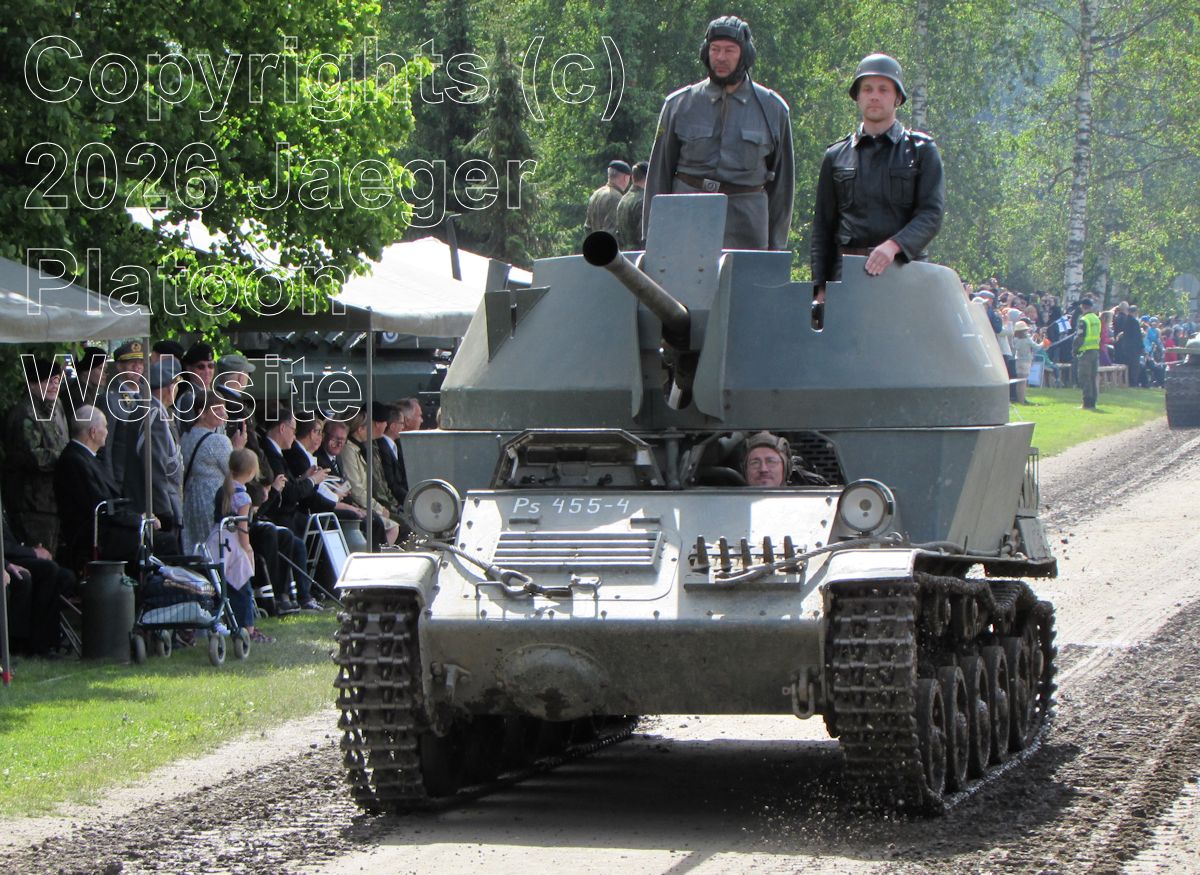
PICTURE: Landsverk Anti II Ps. 455-4 in Armour Division 75 Years parade in Parola at year 2017.
Crew is re-enactors in period uniforms. Driver's hatch is open. Photographed by JTV. (Copyrights (c) 2026 Jaeger
Platoon Website). CLICK THUMBNAIL TO SEE LARGER PIC (273 KB).
|
Weight: |
10.7 tons / 11.2 tons (*) |
|
|
Length: |
5.4 meters |
|
|
Width: |
2.3 meters |
|
|
Height: |
2.3 meters |
|
|
Max. Speed: |
40 km/h |
|
|
Engine: |
144 hp Scania Vabis 664 6-cylinder gasoline engine |
|
|
Armor: |
6 - 14 mm |
|
|
Ground Clearance: |
? cm |
|
|
Ground Pressure: |
? kg/square cm |
|
|
Gradient: |
? degrees |
|
|
Trench: |
? m |
|
|
Fording: |
? m |
|
|
Range: |
? km |
|
|
Weapons: |
40mm ItK/38 Bofors anti-aircraft gun (132 rounds) |
|
|
Crew: |
5 men |
|
|
Country of Origin: |
Sweden |
|
|
Production: |
Total production 6 vehicles, all of which were manufactured 1941 - 1942 for Finnish Army. |
(*) 10.7 tons empty and 11.2 tons fully loaded.
Finnish use: Six vehicles acquired by Finnish Army and issued to Armoured Anti-Aircraft Artillery Battery of Tank Division in year 1942. Used by Finnish Army until replaced with ZU-57-2 self-propelled anti-aircraft guns in 1960’s.
Landsverk Anti II is a self-propelled anti-aircraft artillery vehicle with medium-size anti-aircraft gun placed on rotating turret on a gun chassis – and as such it was highly advanced weapon system for the time when it was introduced. Swedish company AB Landsverk had developed the design in 1930´s with building of original L-62 Landsverk Anti self-propelled anti-aircraft gun prototype being completed at year 1937. Chassis design of Landsverk Anti was based chassis of its previous Landsverk L-60 light tank, but had been lengthened and equipped with one additional (5th) pair of road wheels. On top of the chassis is rotating circular open turret equipped with anti-aircraft gun.
While the original Landsverk Anti design failed to gain Swedish military as a customer, its improved versions succeeded attracting two customers – Finland and Hungary. Hungary had already earlier obtained manufacturing license for Landsverk L-60 light tank, from which it developed 38M Toldi light tank, which Manfréd Weiss Steel and Metal Works and MAVAG (Hungarian Royal State Iron, Steel and Machine Works) manufactured for Hungarian Army. When it came to Landsverk Anti self-propelled anti-aircraft gun the story with Hungary was very much the same. Hungary bought Landsverk Anti L-62 prototype from Sweden and after testing that was followed by improved version named M40 Nimród being developed in Hungary and placed into licensed production at MAVAG for Hungarian Army. Main improvement of M40 Nimród over original Landsverk Anti was new larger and notably more heavily armoured turret. In addition, during its production in M40 Nimróds were equipped with two different 155 hp gasoline engines – first production batch with German Büssing-NAG L8V/36TR and second production batch with Hungarian GANZ VIII EST 107 engine. Larger turret used in M40 Nimród allowed 2nd loader to be added to the crew operating the vehicle and its gun. It is worth noting that Hungarian Army had intended to use M40 Nimród not only as self-propelled anti-aircraft gun, but also as tank destroyer and utilised it in that role during early part of World War 2.
In contrast Finnish Army would use self-propelled anti-aircraft guns that it acquired from AB Landsverk saw very little use other than against aircraft. The version that Finnish Army acquired was Landsverk L-62 Anti II, which was more slightly more heavily armoured further development of original L-62 design. Landsverk L-62 Anti II were the first brand new armoured vehicles ordered by Finnish Army during World War 2 (with Vickers 6 ton tanks having been ordered already at year 1936). Finnish Army ordered batch of six L-62 Anti II from Landsverk in 25th of April 1941 and their delivery was scheduled to January of 1942. Price per vehicle was 165,000 Swedish Crowns or 1.9 million Finnish Marks with the vehicles being delivered unarmed, as Valtion Tykkitehdas (State Artillery Factory), which had manufacturing license for Bofors guns in Finland, was to produce 40 ItK/38 B anti-aircraft guns needed for equipping these self-propelled guns. To make sure that the Finnish-made guns would fit properly State Artillery Factory sent one of its 40 ItK/38 B guns to Sweden. Hence when Finnish military inspected and received all six Landsverk Anti II at 10th of March 1942, only one out of the six vehicles was equipped with the gun and other five vehicles received their guns after being delivered to Finland.
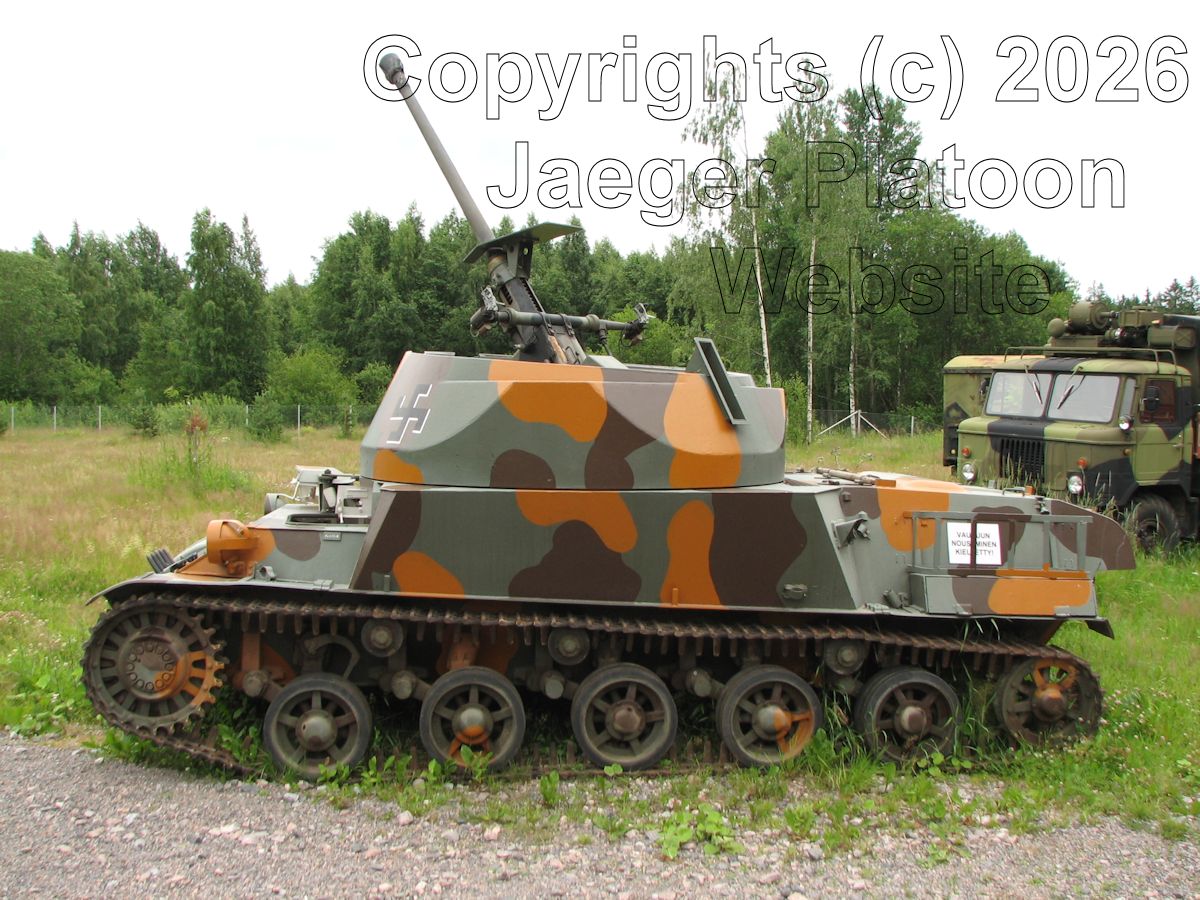
PICTURE: Landsverk Anti II R-906 painted with Swedish camo pattern, which was on these
vehicles when they were delivered to Finland. The gun extracts cartridge cases from through the hole visible
in rear of the turret. Black swastika with white highlights was standard country insignia for armoured vehicles of Finnish Army
during Continuation War. Photographed by JTV in Ilmatorjuntamuseo (Anti-Aircraft Museum) in year 2009.
(Copyrights (c) 2026 Jaeger Platoon Website). CLICK THUMBNAIL TO SEE LARGER PIC (241 KB).
Finnish military named Landsverk L-62 Anti II self-propelled anti-aircraft guns that it had received as 10 It.psv Anti (10-ton anti-aircraft tank model Anti), which was later on changed as 10 itpsv 41 (10-ton anti-aircraft tank model 1941). Once these vehicles had been transported to Finland and State Artillery Factory in city of Jyväskylä had equipped five of them with 40 ItK/38 B guns and all vehicles had been fully kitted, they were handed to the military unitcreated to operate them – Panssari-ilmatorjuntapatteri (Armoured Anti-aircraft Artillery Battery) at 14th of May 1942.Panssari-ilmatorjuntapatteri was part of Armour Division Panssaridivisioona) and was created for the purpose of providing air-defence to its units. Finnish Army had already before Finnish offensive of 1941 quite correctly reached the conclusion that due to their nature tank units had need for anti-aircraft guns, that could follow their advance and keep up when they were on the move. Conclusion, which experiences gained by Battle Group Lagus (Osasto Lagus - precursor of Armour Division) with subordinated normal anti-aircraft artillery during Finnish offensive of year 1941 proved correct. Normal anti-aircraft artillery units of Finnish Army were motorized and generally towed their guns with trucks, but each time had to set up their guns in fire positions at the place for which they provided air-defence and hence for them to change positions took too much time for them to be properly able to provide air-defence for advancing tank units. It might have been possible to place anti-aircraft machine gun or 20mm anti-aircraft gun on a truck in such manner that it could be used while on the truck, but this was not a standard practice in Finnish Army at the time and even then the resulting improvised self-propelled anti-aircraft vehicle lacked off-road mobility and were highly vulnerable due to being easy to spot target for enemy aircraft, while lacking any armour protection.
Landsverk Anti II was lightly armoured tracked vehicle with rotating turret capable turning 360 degrees equipped with 40mm Bofors anti-aircraft gun. This vehicle weight in total some 10.7 (metric) tons or when fully equipped 11.2 (metric) tons. Vehicle and its gun were operated by five-man crew consisting commander, driver, gunner, gun trainer and loader. Gunner adjustedgun’s elevation and fired it with pedal, while gun trainer was rotating the turret to take care of horizontal aiming process. Both gunner and gun trainer had reflector sights and commander was operating mechanical fire controlcomputer intended to provide correct lead for their aim plus adjusted its settings depending changes made to aim by gunner and gun trainer.
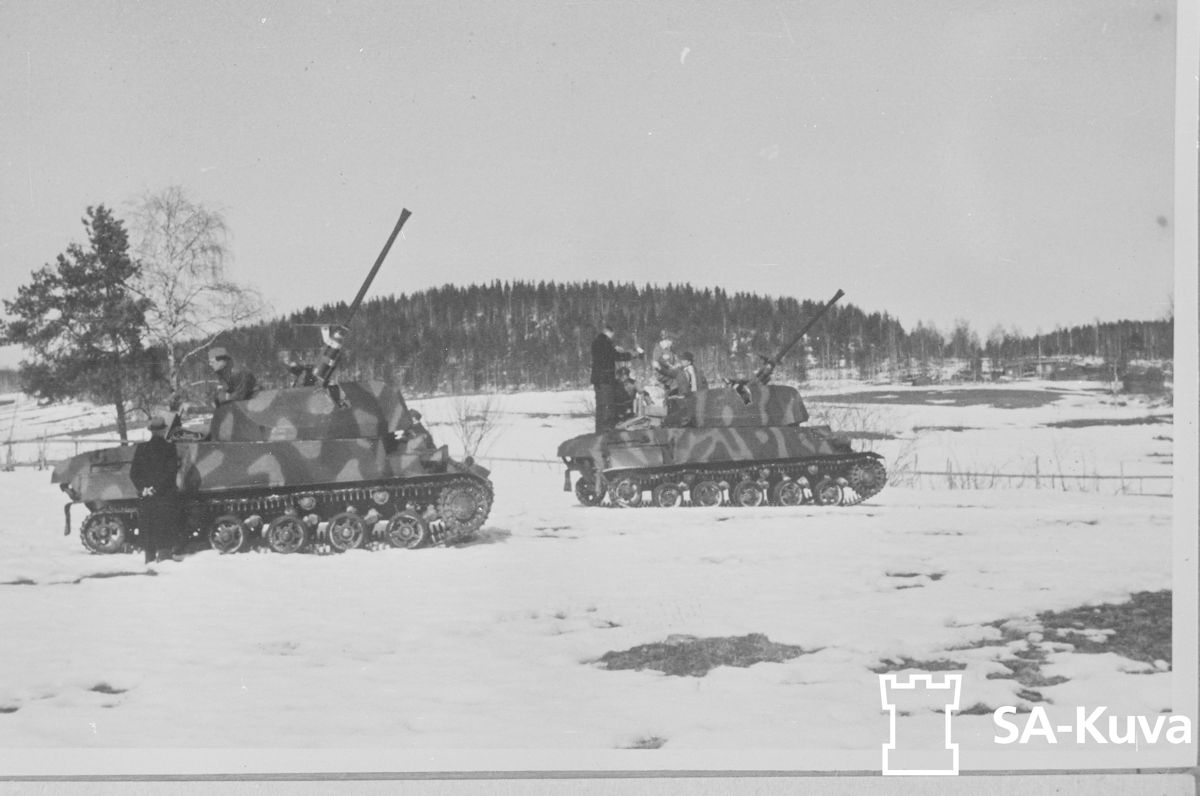
PICTURE: Two Landsverk Anti II self-propelled anti-aircraft guns of Finnish Army.
Considering they seem to be painted with Swedish camouflage, there is snow in the ground and winter-camo
was apparently the first time painted on these vehicles in November of 1942, this photograph could be
from October or November of 1942. Photo crop. Unknown photographer. (SA-kuva.fi photo archive,
photograph number 139210). CLICK THUMBNAIL TO SEE LARGER PIC (111 KB).
Six Landsverk L-62 Anti II self-propelled anti-aircraft guns acquired by Finnish Army were named with individual inventory numbers from R-901 to R-906. Summer of 1943 Finnish Army introduced new Ps-number system for identification of individual armoured vehicles. Landsverk Anti II self-propelled anti-aircraft guns were named with numbers reaching from Ps. 455-1 to Ps. 455-6, although old R-numbers apparently also continued to be used in documentation even after this.
Four men out of the five-man crew were placed inside the vehicle’s turret, with driver’s position being in left front corner of chassis. Anti II had originally neither radio or interphone and they were never equipped with radios, although it is possible that interphone system may have been added sometime during post-war era. 40mm Bofors anti-aircraft gun was only armament of this vehicle – unlike many other armoured vehicles of Finnish Army it did not even have storage point for submachine gun that could have use by the crew when needed. 40mm Bofors anti-aircraft gun is widely considered as the best medium anti-aircraft gun of World War 2 and also proved highly effective in use of Finnish Army. To be used in this vehicle 40mm Bofors gun used in it had been modified to extract cartridge cases from rear of the turret, while standard 40mm Bofors extracts them in front of the gun. 40mm Bofors gun has slow firing (cyclic rate was about 120 – 140 rounds per minute) automatic cannon fed with four round ammunition clips from top of the gun. Each Anti II was capable carrying in total 132 rounds of ammunition placed in 33 ammunition clips. From this ammunition load first five clips (containing 20 rounds of ammunition) were easily available to loader, another 10 clips (containing 40 rounds) were also stored in ammo brackets inside the turret and relatively easily available, but the rest was stored under turret floor and hence notably more complicated to access during combat.
While Landsverk Anti II is only lightly armoured, during the war its armour protection proved surprisingly sufficient, although admittedly there was also luck involved in the matter with number of potentially highly-destructive near misses existing in historical record. Grand majority of the vehicle is welded, which was pretty advanced for armoured vehicle originally designed in 1930's. Power source of the vehicle was Swedish-made 1.6-liter Scania Vabis 664 six-cylinder gasoline engine, which depending source provided some 144 – 160 horsepower. The gasoline it used was 98-octane and it typically consumed some 80 – 90 litres per 100 kilometres. Engine was usually started with ignition key, but also had a backup starting option with a winch. One of the graces noted by vehicle crews was that the engine was relatively quiet, which allowed crew to hear sounds of nearby aircraft also when the vehicle’s engine was running. Those who have test-driven Anti II have noted that handling-wise it resembles normal passenger car, although steering was with hand levers and gear shift is positioned in far less conventional location way on the right. As to be expected open top turret did not shelter the crew from weather in any manner, although a turret tarp could be used to cover the opening when suited.
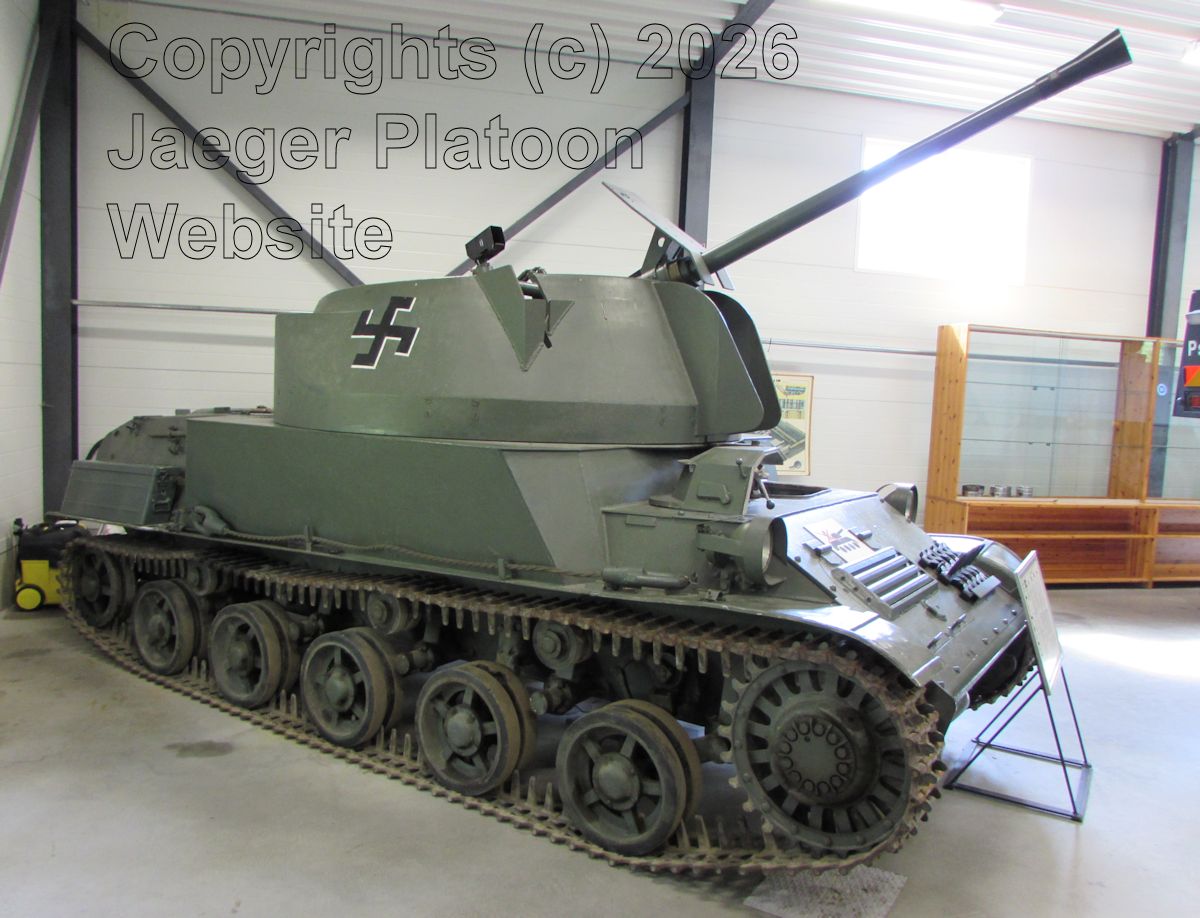
PICTURE: Another view to Landsverk Anti II Ps. 455-4. Photographed by JTV in Panssarimuseo
(The Parola Armour Museum). After Swedish camo these vehicles were repainted matt olive green, which on
its turn was replaced with Finnish three colour camo pattern in spring of 1943. For each winter
whitewash was added on top of existing paint job to provide winter camo. (Copyrights (c) 2026 Jaeger
Platoon Website). CLICK THUMBNAIL TO SEE LARGER PIC (153 KB).
But open top turret was not the only problem point of Landsverk Anti II. The vehicle had more favourable power-to-weight ratio than for example T-26 series tanks, which were the most common tanks in Finnish use during World War 2, but still apparently suffered from weaker mobility in deep snow at least partially possibly due to relatively low ground clearance (*). Vehicle crews also noted that getting engine started in cold winter temperatures was often difficult, due to which metal box filled with hot embers was often used at wintertime to warm the engine a bit before attempting to start it. In addition, rollers of the turret ring were exposed, which caused problems if any debris (such as sand blown into air by nearby explosions) got in them.
(*) No source seems to provide reliable info about ground clearance of Landsverk Anti II, but standard Landsverk L-60 light tank has ground clearance of 35 cm, which is only slightly less than 38 cm of T-26 tank.
As noted, the Finnish Army unit that would operate all six Landsverk Anti II self-propelled guns was Armoured Anti-Aircraft Artillery Battery (Panssari-ilmatorjuntapatteri), which had been established 14th of February of 1942 – almost a month before arrival of the vehicles to Finland and about three months before the unit received its fully kitted Landsverk Anti II vehicles at 14th of May 1942. After ten days of training the unit was assigned orders to provide air-defence for the Tank Brigade (of Armour Division) and participate in air-defence of Äänislinna / Petrozavodsk city. Personnel for this new unit was acquired by transferring them from variety of already existing Finnish Army units. Most of their gun crews (who would operate the guns) were transferred from anti-aircraft artillery units of 5th, 6th and 7th Army Corps, while drivers, mechanics and some of the non-commissioned officers got transferred from various units of Armour Division. To be specific according original orders 5th Army Corps was to provide one, 6th Army Corps two and 7th Army Corps three gun crews. The unit was organized as three Artillery Sections (Jaos), each of which contained two Anti II self-propelled guns and Staff Section (Toimitusjaos) containing other necessary personnel and vehicles. The total manpower strength of the unit became to be about 60 men.
BATTLES OF 1942 - 1943
The unit had its baptism of fire while serving in air-defence of Äänislinna when it fired its first shots in combat at 24th of June 1942 against two formations of PE-2 bombers. In general World War 2 era anti-aircraft artillery was lucky to shoot down the aircraft it was firing towards and the day was no different from the norm – no hits to PE-2 bombers were observed.
Along other units of Armour Division Armoured Anti-Aircraft Artillery Battery was sent to front with transfer to River Syväri / Svir in November of 1942, with the unit seeing combat in there with its heaviest day of battle in there being 8th of June in Mäkriä, where it defended railway station and area surrounding it against attack of eight IL-2 and four MiG-1. In mid-June of 1942 the unit was moved to nearby Kuuttilahti, where it took part in two operations unique in its war record. First of those operations was direct-fire mission performed 21st of June 1943 by Landsverk Anti II R-901 along BT-42 assault gun against enemy machine gun nests and/or bunkers across the river. Anti II R-901 was hit by return fire, but its armour protection saved it from any real damage. The second operation was two days later 23rd of June. Soviet IL-2 had emergency landed on open field close to frontline near village of Gorka. The emergency landed aircraft had been left quite intact, so the Soviets tried to destroy it with four MiG-1 aircraft and artillery to avoid it falling to Finnish hands. 2nd Section of Armoured Anti-Aircraft Artillery Battery with its Anti II R-903 and R-904 was sent to salvage the aircraft, succeeded keeping attacking MiG-1 at bay and towed IL-2 away.
After its service near frontline at River Syväri / Svir Armoured Anti-Aircraft Artillery Battery was transferred back to city of Äänislinna in October of 1943. The unit served again in air-defence of Äänislinna and had additional training, but in December of 1943 suffered a crisis of leadership leading to charges of disobedience, which caused soldiers involved being transferred from the unit and even some jail sentences – and it would take time until replacement personnel to reach proper skill level. Hence strict training program was launched. At February of 1944 Armour Division with Armoured Anti-Artillery Battery were transferred to Viipuri – Tali – Lappeenranta for wargames and as reserves for use of Armed Forces GHQ (Päämaja).
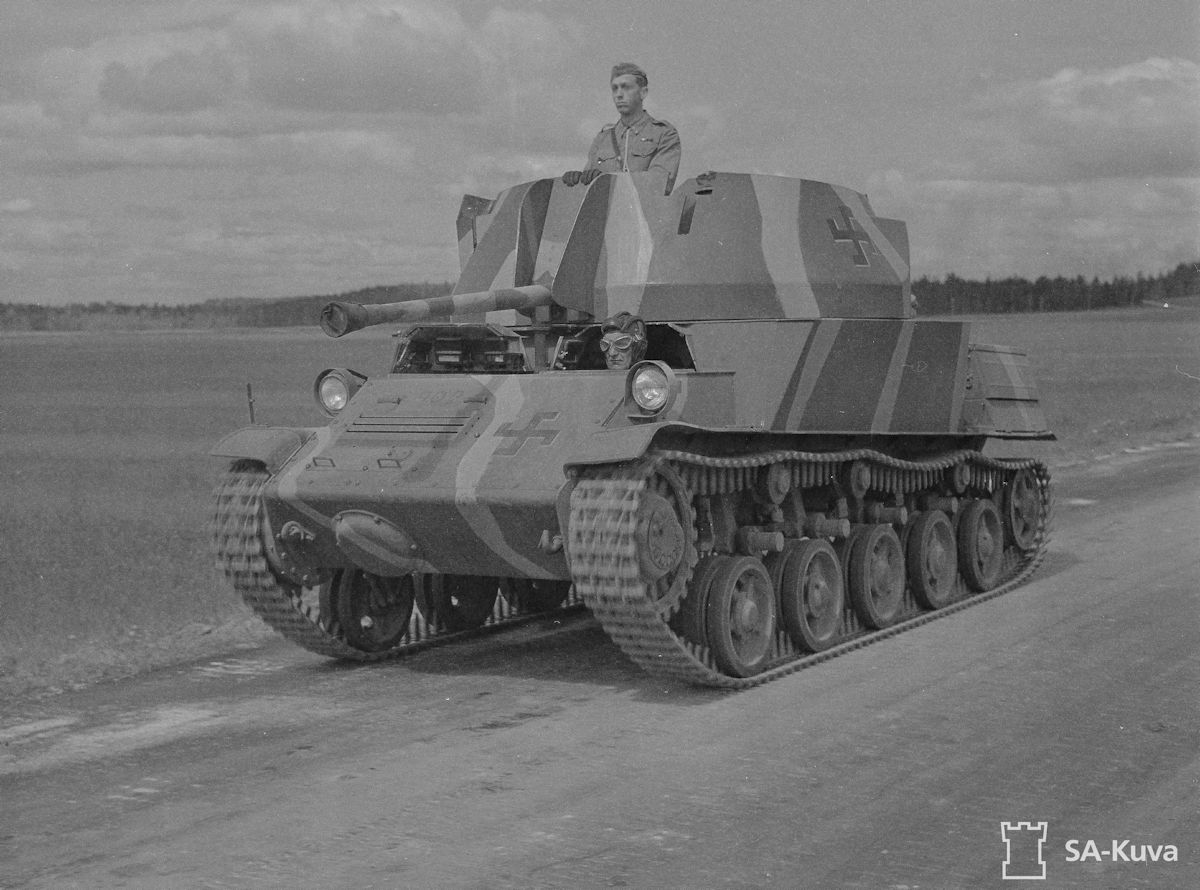
PICTURE: Landsverk Anti II R-902 self-propelled anti-aircraft guns in military parade
of Enso 4th of June 1944. The vehicle is painted with Finnish three colour camouflage pattern and
has barely visible R-number identicator in its front hull. Photo crop. Photographed by Military official
Hedenström. (SA-kuva.fi photo archive, photograph number 151589). CLICK THUMBNAIL TO SEE LARGER PIC
(158 KB).
4th of June is Armed Forces Flag Day of Finnish Armed Forces - one of the two annual days in Finland with national military parades. Year 1944 on that day Armour Division held in Enso military parade, which was inspected by President Risto Ryti and Marshal Mannerheim. The event took place without incident, but his proved to be calm before the storm.
BATTLES OF 1944
For those who are not familiar with battles of Finnish Armour Division, it is worth noting that much
of these battles the one and only Armour Division of Finnish Army was divided into two battle groups –
Battle Group Åkerman and Battle Group Puroma, both of which were named after their commanding officers,
who were brigade commanders of Armour Division.
Following Soviet offensive, which started in Carelian Ishtmus 9th of June 1944 Armour Division was again sent to combat. What followed were the hardest battles of Armoured Anti-Aircraft Battery. When Armour Division was transferred to Carelian Isthmus, Armoured Anti-Aircraft Battery had its vehicles loaded section at the time into three separate trains to provide air-defence for this major military transport. 3rd Section, which had spearheaded the transport in first train shot down one IL-2 ground-attack aircraft and damaged other in Perkjärvi 12th of June 1944. The first major operation of Armour Division in these battles was counter-attack launched to Kuuterselkä with intention of recapturing positions of VT-defence line in there. Finnish troops sent to counter-attack included Battle Group Puroma (three Jaeger Battalions, company of Stu 40 G assault guns and two anti-tank gun companies), three infanry battalions from 3rd Division with artillery support of five artillery battalions. The battle that followed is known as Battle of Kuuterselkä and was fought in 14th - 15th of June 1944. Armoured AA- Battery provided air-defence for troops taking part in Battle of Kuuterselkä with Soviet aviation being highly active in the area and Soviet artillery targeted the unit as well. 15th of June Armoured Anti-Aircraft Artillery Battery shot down two IL-2, to which the Soviets responded by sending by three squadrons of DB-3 medium bombers (27 bombers in total), which bombed the unit from altitude that was beyond range of its guns. The unit suffered casualties in this bombing, losing one man, had another two men wounded and Landsverk Anti II R-903 had its turret damaged by bomb fragments plus in addition two trucks belonging to the unit were also damaged. But the unit remained operational. Following the bombing the Soviets sent two LA-5 fighters presumably to check its results – only for Landsverk Anti II R-905 to promptly shoot down one of the two LA-5. By that time unit was already running low on ammunition. Hence R-903 was sent for repairs to visit repair and sent R-901 to fetch more ammunition. During its ammunition run Landsverk Anti II R-901 was attacked by six IL-2 and succeeded shooting down one of them. In total 5th of June 1944 Armoured Anti-Aircraft Artillery Battery had spent 1,250 rounds of ammunition for it 40mm Bofors guns and shot down four enemy aircraft during that single day.
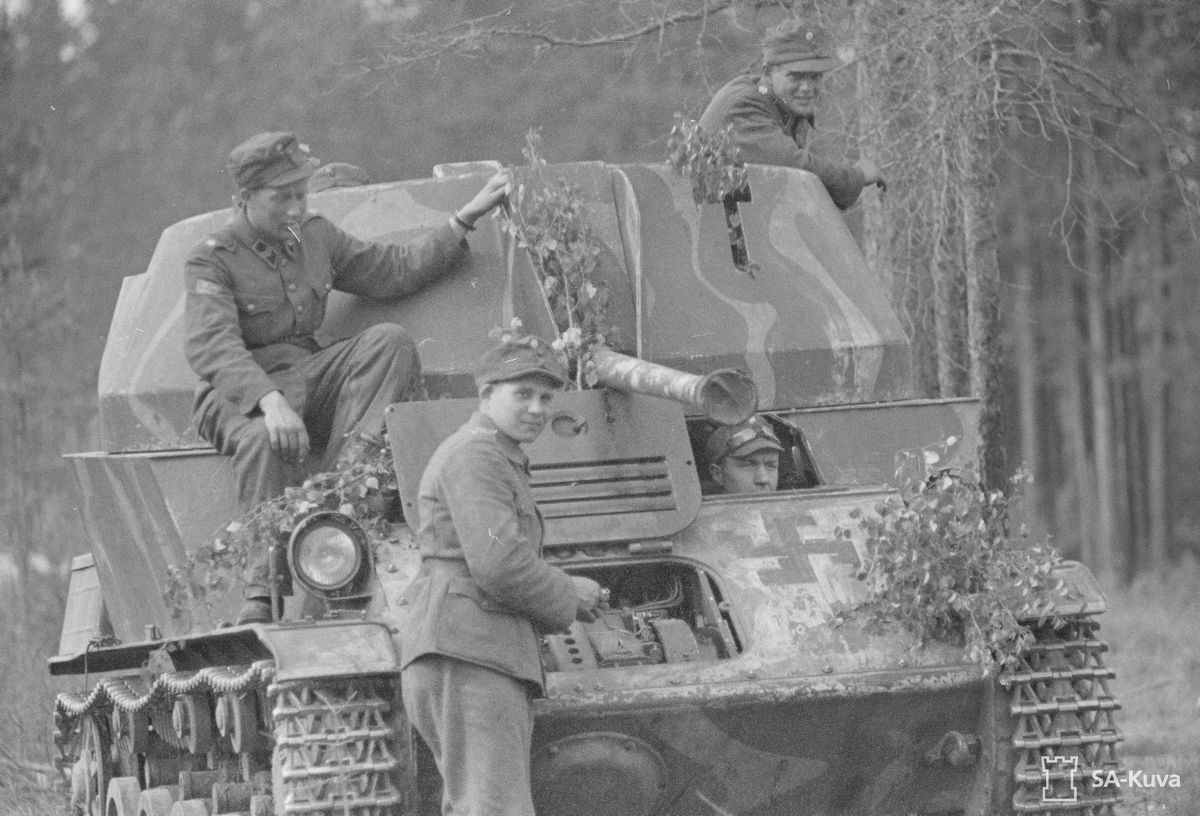
PICTURE: Landsverk Anti II photographed 15th of June 1944 - presumably right
after Battle of Kuuterselkä. Original photo caption mentions the vehicle having just returned from
counter-attack. Crew appears to be doing maintenance for the vehicle with hatch for transmission being open.
Photographed by Military official T. Nousiainen. (SA-kuva.fi photo archive, photograph number 155061). CLICK
THUMBNAIL TO SEE LARGER PIC (185 KB).
After Battle of Kuuterselkä Jaeger Battalions that had fought in it were pulled to rest, but Armoured AA Battery had little chance for longer rest due to air-defence being in contant demand with more battles against Soviet IL-2 and PE-2 formations following already the next day and being sent where needed most. The unit was first subordinated to Battle Group Puroma with mission to provide air-defence for it and also did a brief visit to city of Viipuri. 21st of June it was subordinated to Armour Division in large and provided air-defence in Juustila, which became its next major ordeal with Battle of Tali-Ihantala starting to form and became next major battle for Armour Division. 22nd of June 1944 the unit was in Juustila, where the day started with attack of more than hundred Soviet bombers and 70 IL-2 ground-attack aircraft. This continued from noon with 75 PE-2 bombers and 20 IL-2 targeting Armoured AA Battery and nearby field artillery, which it was defending. Several large bombs landed near Landsverk Anti II self-propelled guns. While many of the vehicles suffering minor damage in this attack, but some of its men were not as lucky with seven of them being wounded in action. In addition in battles of that day Landsverk Anti II R-905 was damaged in such manner, that demanded it to be sent for repairs all the way to Armour Centre Repair Shop, which was at Home Front in Varkaus. Rest of the unit continued fighting with their five remaining operational Landsverk Anti II.
21st of June the unit briefly provided air-defence for Air Base of Suur-Merijoki, before being returned to Armour Division and sent back to Juustila. The unit was again attacked by IL-2 ground-attack aircrafts in 26th of June. 28th of June it saw another battle with 2nd Section of Armoured AA Battery shooting down one IL-2. 3rd of July 1944 3rd Section of the unit, which was on i ts way back from Kilpeenoja to Pikkala fought against no less than 45 IL-2, but succeeded surviving the battle without losses. 11th of July 1944 one section sent to Pitsillanmäki fought there against Soviet aircraft and shot down one more IL-2.10th of July the unit was subordinated to Battle Group Åkerman (which contained Assault Gun Battalion and Jaeger Battalion) and was moved to rest along it in late July of 1944. Following these battles Landsverk Anti II self-propelled guns were in bad need for repairs and sent to Armour Centre repair facility. Mid-August R-901 and R-904 were returned from the repair faclity, while R-905 and R-906 were returned from there in mid-August of 1944.
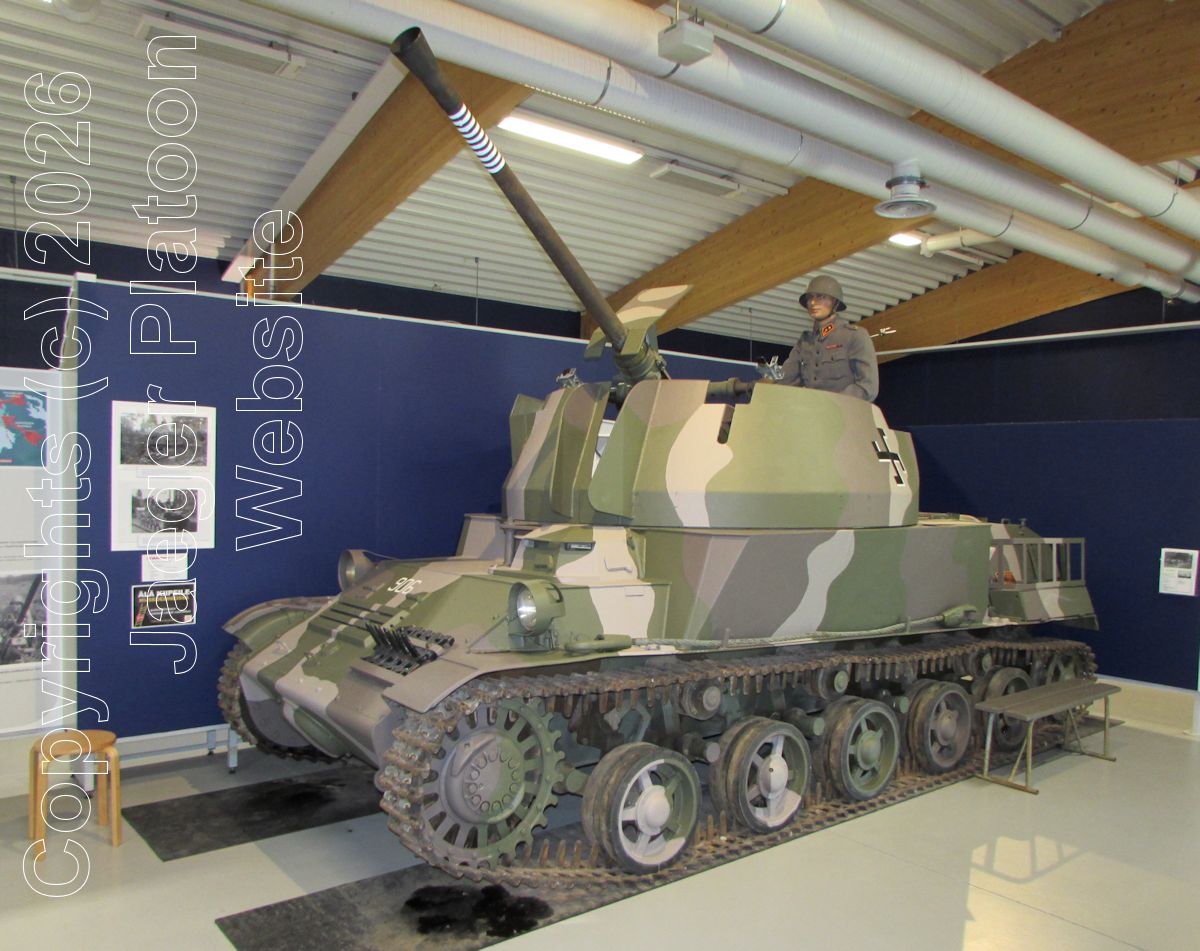
PICTURE: Landsverk Anti II R-906 painted with Finnish three colour camo pattern. This was
the camo pattern that Landsverk Anti II were equipped with during battles of summer 1944. Photographed by JTV
in Ilmatorjuntamuseo (Anti-Aircraft Museum). (Copyrights (c) 2026 Jaeger Platoon Website). CLICK THUMBNAIL TO SEE
LARGER PIC (153 KB).
Late September of 1944 Armoured Anti-Aircraft Artillery Battery was sent to Oulu and started its service in
Finnish - German Lapland War. The unit also received more guns when its Koulutusjaos (Training Section)
received three 20 ItK/38 BSW anti-aircraft guns. The unit protected Finnish
advance via Rovaniemi and Sodankylä all the way to Vuotso – at which time orders for demobilising Armour
Division reached it. Lapland War saw the unit shooting towards single German JU-88 bomber few times, but none
were shot down. At the same time the unit suffered losses of men due to landmines and accidents. The unit was
demobilised in Hämeenlinna in late November of 1944.
All six of its Landsverk Anti II self-propelled anti-aircraft guns survived the war, although they had seen more than their share of tear and wear. In total Armoured Anti-Aircraft Artillery Battery had shot down 11 Soviet aircraft and was in addition estimated as having damaged seven aircraft. One of the aircraft was shot down in year 1943 and another ten in year 1944. Combat losses of the unit from Continuation War were in total four men killed in action and 11 wounded in action. General observation from the battles of summer 1944 was that enemy seemingly learned to try avoiding self-propelled guns of Armoured AA Battery, but also repeated tried destroying them with concentrated attacks, high-altitude bombing of its medium bombers and field artillery.
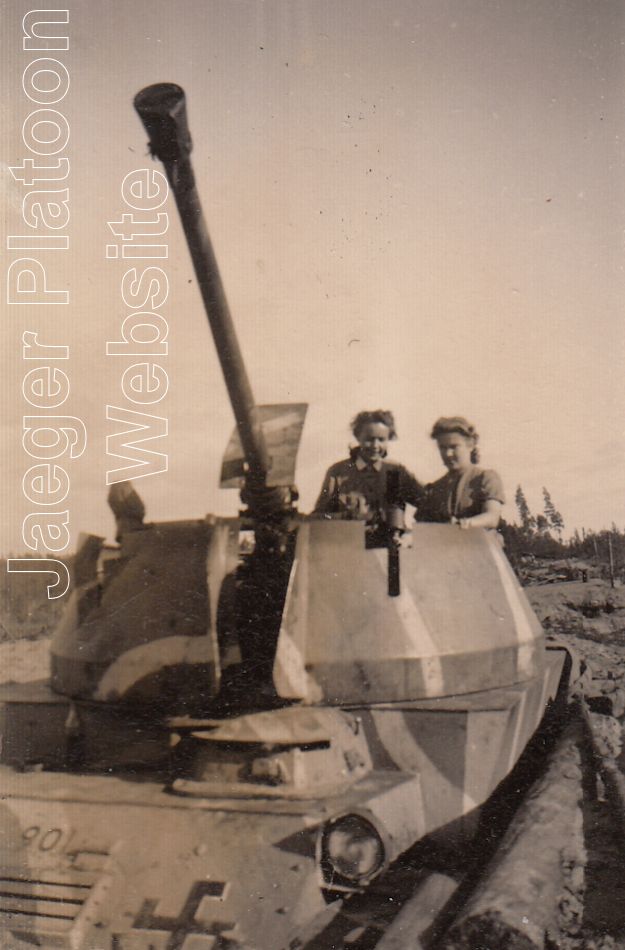
PICTURE: Two women pose in turret of Landsverk Anti II R-901. Considering Finnish three
colour camouflate pattern on vehicle that the women in the left seems to be wearing Lotta-Svärd uniform
this photograph might be from circa 1943 - 1944. Notice that the vehicle seems to be in hull down prepared
fire-position. Photographer unknown. (Original photograph part of Jaeger Platoon Website photo collection.
Unlicensed use of photograph prohibited.) CLICK THUMBNAIL TO SEE LARGER PIC (92 KB).
POST-WAR ERA
While Landsverk Anti II self-propelled anti-aircraft guns had been highly modern weapon system when introduced, it was fast becoming obsolescent already during World War 2. For example Soviet PE-2 bomber going full speed was flying too fast for maximum speed setting of mechanical fire-control computer of 40mm Bofors gun used in Landsverk Anti II – not to mention new breed of jet-powered aircraft, first of which were introduced in military use during World War 2 and became the new standard in post-war era. Landsverk Anti II just was uncapable to effectively targeting new fast moving jet aircraft.
Yet until about year 1960 Landsverk Anti II was the most modern anti-aircraft weapon system in inventory of Finnish Army. Hence they remained to be used in training until year 1958, at which point they were assigned as air-defence for air bases of Finnish Air Force, until officially removed from Finnish Army inventory year 1966. Early on in post-war era Landsverk Anti II were issued to 3rd Artillery Battalion of Anti-Aircraft Artillery Regiment 1, which was stationed in Kangasala. Year 1952 they were moved back home, becoming subordinated to Tank Brigade and issued to 4th Separate Anti-Aircraft Artillery Battalion, which was later renamed as Tampere Anti-Aircraft Artillery Battalion. With Landsverk Anti II self-propelled anti-aircraft guns becoming obsolete Finnish Defence Forces started search for more modern replacement. That replacement was twelve ZSU-57-2 self-propelled anti-aircraft guns, which Finland bought from Soviet Union in 1960 - 1961. Year 1966 the unit that operated self-propelled anti-aircraft guns was separated from Tampere Anti-Aircraft Battalion and got named a s Armoured Anti-Aircraft Company Panssari-ilmatorjuntakomppania),which was later renamed as Armoured Anti-Aircraft Artillery Battery (Panssari-ilmatorjuntapatteri) – the same unit name as during World War 2.
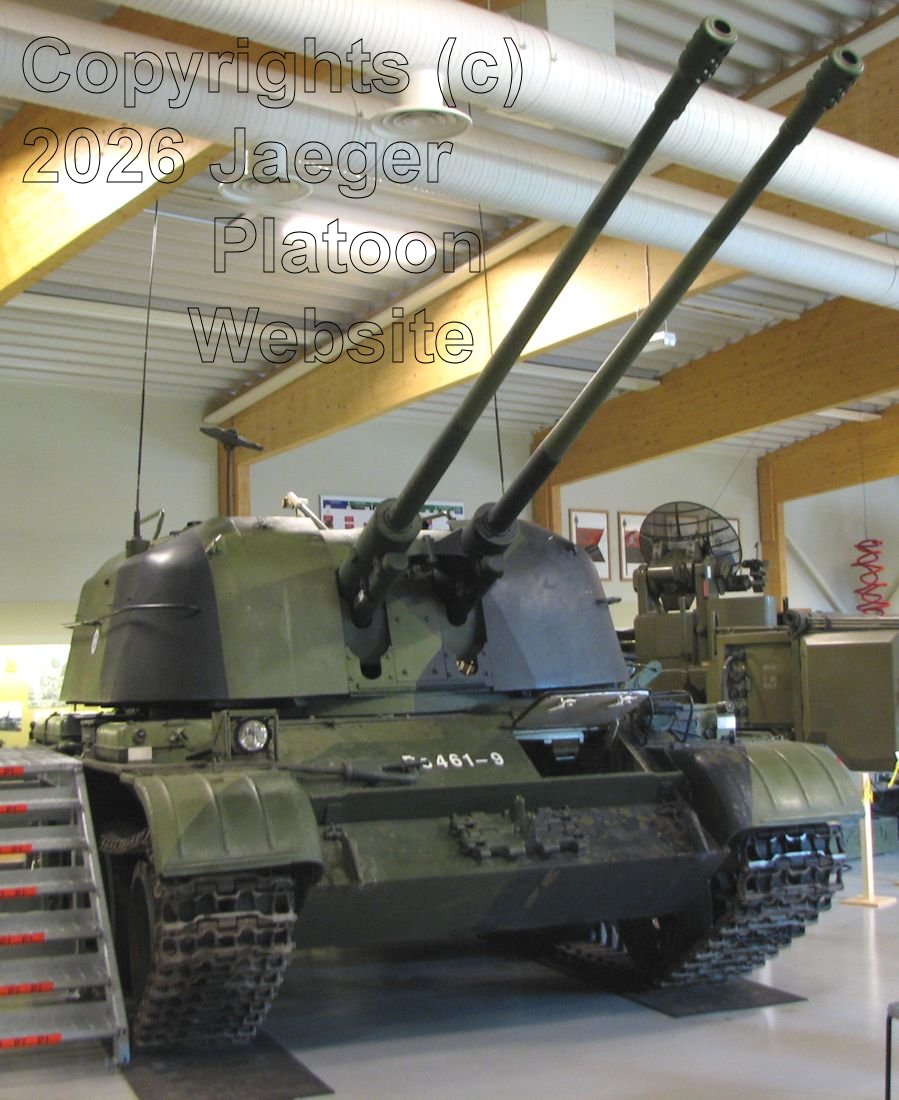
PICTURE: ZSU-57-2 self-propelled anti-aircraft gun Ps 461-9 of Finnish Defence forces. ZSU-57-2
was Soviet-designed self-propelled anti-aircraft gun introduced at year 1957. So they were still quite modern when
Finland bought dozen vehicles in 1960 - 1961. Eventually they were replaced with ITPSV 90 Marksman self-propelled
anti-aircraft guns and were retired at year 2006. This vehicle has been painted with Finnish military
"splinter" ("sirpale") camouflage pattern. Photographed by JTV in Ilmatorjuntamuseo
(Anti-Aircraft Museum). (Copyrights (c) 2026 Jaeger Platoon Website). CLICK THUMBNAIL TO SEE LARGER PIC (172 KB).
Once being declared obsolete some of the Landsverk Anti II suffered unfortunate fate of being used as target vehicles for live-fire training by Finnish military and destroyed, but several of these vehicles have survived and at least two are remaining in driving condition.
SOURCES:
Suomalaiset panssarivaunut 1918 – 1997 / The Finnish Armoured Vehicles 1918 – 1997 by Esa Muikku and Jukka Purhonen.
Juha Tuominen: Panssari-ilmatorjuntaa Suomessa 1942 – 2006. (Armoured Anti-aircraft Artillery in Finland 1942 - 2006
Erkki Hovilainen: Tankkirykmentistä Panssaripataljoonaan 1919 – 1949 (From Tank Regiment to Tank Battalion 1919 - 1949).
Pekka Kantakoski: Suomalaiset Panssarivaunujoukot 1919 – 1969 (Finnish Tank Corps 1919 - 1969).
Pekka Kantakoski: Panssarimuseo (Armour Museum)
Article: Landsverk Anti II by Marko Erikson and Jaakko Puuperä in Suomen Sotilas magazine vol 1/2003.
Article: Panssari-ilmatorjuntapatteri 50 vuotta (Armoured Anti-Aircraft Artillery Battery 50 Years) by Kapteeni Henrik Vähämartti in Panssari magazine vol. 1/2024.
Article: Suomen sotilas koeajaa. Osa 1, Landsverk Anti II (Suomen sotilas test-drives), Part 1, Landsverk Anti II) by Marko Erikson in Suomen sotilas magazine vol 1/2003.
War journals of Panssari-ilmatorjuntapatteri (which unforunately are incomplete due to unit's war journals not being kept in between 17th) of July 1942 - 30th of July 1943.
Landsverk Anti II video in Youtube.
Inside the Chieftain’s Hatch: ItPsv 41 Anti II in Youtube.